mirror of
https://github.com/infiniflow/ragflow.git
synced 2026-01-04 03:25:30 +08:00
Compare commits
60 Commits
2e00d8d3d4
...
v0.20.5
| Author | SHA1 | Date | |
|---|---|---|---|
| e650f0d368 | |||
| 067b4fc012 | |||
| 38ff2ffc01 | |||
| a9cc992d13 | |||
| 5cf2c97908 | |||
| 81fede0041 | |||
| 07a83f93d5 | |||
| 1a904edd94 | |||
| 906969fe4e | |||
| 776ea078a6 | |||
| fcdde26a7f | |||
| 79076ffb5f | |||
| e8dcdfb9f0 | |||
| c4f43a395d | |||
| a255c78b59 | |||
| 936f27e9e5 | |||
| 2616f651c9 | |||
| e8018fde83 | |||
| f514482c0a | |||
| e9ee9269f5 | |||
| cf18231713 | |||
| f48aed6d4a | |||
| b524cf0ec8 | |||
| 994517495f | |||
| 63781bde3f | |||
| 91d6fb8061 | |||
| 45f52e85d7 | |||
| 9aa8cfb73a | |||
| 79ca25ec7e | |||
| 6ff7cfe005 | |||
| 4e16936fa4 | |||
| 677c99b090 | |||
| 8e30a75e5c | |||
| b14052e5a2 | |||
| ddaed541ff | |||
| 1ee9c0b8d9 | |||
| 9b724b3b5e | |||
| 3b1ee769eb | |||
| 41cb94324a | |||
| 982ec24fa7 | |||
| 1f7a035340 | |||
| d04ae3f943 | |||
| abd19b0f48 | |||
| aa1251af9a | |||
| 483f3aa71d | |||
| 72bb79e8dd | |||
| 927a195008 | |||
| d13dc0c24d | |||
| 37ac7576f1 | |||
| c832e0b858 | |||
| 5d015e48c1 | |||
| b58e882eaa | |||
| 1bc33009c7 | |||
| cb731dce34 | |||
| 1595cdc48f | |||
| 4179ecd469 | |||
| cb14dafaca | |||
| c2567844ea | |||
| 757c5376be | |||
| 79968c37a8 |

1
.github/workflows/tests.yml
vendored
1
.github/workflows/tests.yml
vendored
@ -67,6 +67,7 @@ jobs:
|
||||
|
||||
- name: Start ragflow:nightly-slim
|
||||
run: |
|
||||
sudo docker compose -f docker/docker-compose.yml down --volumes --remove-orphans
|
||||
echo -e "\nRAGFLOW_IMAGE=infiniflow/ragflow:nightly-slim" >> docker/.env
|
||||
sudo docker compose -f docker/docker-compose.yml up -d
|
||||
|
||||
|
||||
17
README.md
17
README.md
@ -22,7 +22,7 @@
|
||||
<img alt="Static Badge" src="https://img.shields.io/badge/Online-Demo-4e6b99">
|
||||
</a>
|
||||
<a href="https://hub.docker.com/r/infiniflow/ragflow" target="_blank">
|
||||
<img src="https://img.shields.io/docker/pulls/infiniflow/ragflow?label=Docker%20Pulls&color=0db7ed&logo=docker&logoColor=white&style=flat-square" alt="docker pull infiniflow/ragflow:v0.20.4">
|
||||
<img src="https://img.shields.io/docker/pulls/infiniflow/ragflow?label=Docker%20Pulls&color=0db7ed&logo=docker&logoColor=white&style=flat-square" alt="docker pull infiniflow/ragflow:v0.20.5">
|
||||
</a>
|
||||
<a href="https://github.com/infiniflow/ragflow/releases/latest">
|
||||
<img src="https://img.shields.io/github/v/release/infiniflow/ragflow?color=blue&label=Latest%20Release" alt="Latest Release">
|
||||
@ -71,10 +71,7 @@
|
||||
|
||||
## 💡 What is RAGFlow?
|
||||
|
||||
[RAGFlow](https://ragflow.io/) is an open-source RAG (Retrieval-Augmented Generation) engine based on deep document
|
||||
understanding. It offers a streamlined RAG workflow for businesses of any scale, combining LLM (Large Language Models)
|
||||
to provide truthful question-answering capabilities, backed by well-founded citations from various complex formatted
|
||||
data.
|
||||
[RAGFlow](https://ragflow.io/) is a leading open-source Retrieval-Augmented Generation (RAG) engine that fuses cutting-edge RAG with Agent capabilities to create a superior context layer for LLMs. It offers a streamlined RAG workflow adaptable to enterprises of any scale. Powered by a converged context engine and pre-built agent templates, RAGFlow enables developers to transform complex data into high-fidelity, production-ready AI systems with exceptional efficiency and precision.
|
||||
|
||||
## 🎮 Demo
|
||||
|
||||
@ -190,7 +187,7 @@ releases! 🌟
|
||||
> All Docker images are built for x86 platforms. We don't currently offer Docker images for ARM64.
|
||||
> If you are on an ARM64 platform, follow [this guide](https://ragflow.io/docs/dev/build_docker_image) to build a Docker image compatible with your system.
|
||||
|
||||
> The command below downloads the `v0.20.4-slim` edition of the RAGFlow Docker image. See the following table for descriptions of different RAGFlow editions. To download a RAGFlow edition different from `v0.20.4-slim`, update the `RAGFLOW_IMAGE` variable accordingly in **docker/.env** before using `docker compose` to start the server. For example: set `RAGFLOW_IMAGE=infiniflow/ragflow:v0.20.4` for the full edition `v0.20.4`.
|
||||
> The command below downloads the `v0.20.5-slim` edition of the RAGFlow Docker image. See the following table for descriptions of different RAGFlow editions. To download a RAGFlow edition different from `v0.20.5-slim`, update the `RAGFLOW_IMAGE` variable accordingly in **docker/.env** before using `docker compose` to start the server. For example: set `RAGFLOW_IMAGE=infiniflow/ragflow:v0.20.5` for the full edition `v0.20.5`.
|
||||
|
||||
```bash
|
||||
$ cd ragflow/docker
|
||||
@ -203,8 +200,8 @@ releases! 🌟
|
||||
|
||||
| RAGFlow image tag | Image size (GB) | Has embedding models? | Stable? |
|
||||
|-------------------|-----------------|-----------------------|--------------------------|
|
||||
| v0.20.4 | ≈9 | :heavy_check_mark: | Stable release |
|
||||
| v0.20.4-slim | ≈2 | ❌ | Stable release |
|
||||
| v0.20.5 | ≈9 | :heavy_check_mark: | Stable release |
|
||||
| v0.20.5-slim | ≈2 | ❌ | Stable release |
|
||||
| nightly | ≈9 | :heavy_check_mark: | _Unstable_ nightly build |
|
||||
| nightly-slim | ≈2 | ❌ | _Unstable_ nightly build |
|
||||
|
||||
@ -348,8 +345,10 @@ docker build --platform linux/amd64 -f Dockerfile -t infiniflow/ragflow:nightly
|
||||
sudo apt-get install libjemalloc-dev
|
||||
# centos
|
||||
sudo yum install jemalloc
|
||||
# mac
|
||||
sudo brew install jemalloc
|
||||
```
|
||||
|
||||
|
||||
6. Launch backend service:
|
||||
|
||||
```bash
|
||||
|
||||
12
README_id.md
12
README_id.md
@ -22,7 +22,7 @@
|
||||
<img alt="Lencana Daring" src="https://img.shields.io/badge/Online-Demo-4e6b99">
|
||||
</a>
|
||||
<a href="https://hub.docker.com/r/infiniflow/ragflow" target="_blank">
|
||||
<img src="https://img.shields.io/docker/pulls/infiniflow/ragflow?label=Docker%20Pulls&color=0db7ed&logo=docker&logoColor=white&style=flat-square" alt="docker pull infiniflow/ragflow:v0.20.4">
|
||||
<img src="https://img.shields.io/docker/pulls/infiniflow/ragflow?label=Docker%20Pulls&color=0db7ed&logo=docker&logoColor=white&style=flat-square" alt="docker pull infiniflow/ragflow:v0.20.5">
|
||||
</a>
|
||||
<a href="https://github.com/infiniflow/ragflow/releases/latest">
|
||||
<img src="https://img.shields.io/github/v/release/infiniflow/ragflow?color=blue&label=Rilis%20Terbaru" alt="Rilis Terbaru">
|
||||
@ -67,7 +67,7 @@
|
||||
|
||||
## 💡 Apa Itu RAGFlow?
|
||||
|
||||
[RAGFlow](https://ragflow.io/) adalah mesin RAG (Retrieval-Augmented Generation) open-source berbasis pemahaman dokumen yang mendalam. Platform ini menyediakan alur kerja RAG yang efisien untuk bisnis dengan berbagai skala, menggabungkan LLM (Large Language Models) untuk menyediakan kemampuan tanya-jawab yang benar dan didukung oleh referensi dari data terstruktur kompleks.
|
||||
[RAGFlow](https://ragflow.io/) adalah mesin RAG (Retrieval-Augmented Generation) open-source terkemuka yang mengintegrasikan teknologi RAG mutakhir dengan kemampuan Agent untuk menciptakan lapisan kontekstual superior bagi LLM. Menyediakan alur kerja RAG yang efisien dan dapat diadaptasi untuk perusahaan segala skala. Didukung oleh mesin konteks terkonvergensi dan template Agent yang telah dipra-bangun, RAGFlow memungkinkan pengembang mengubah data kompleks menjadi sistem AI kesetiaan-tinggi dan siap-produksi dengan efisiensi dan presisi yang luar biasa.
|
||||
|
||||
## 🎮 Demo
|
||||
|
||||
@ -181,7 +181,7 @@ Coba demo kami di [https://demo.ragflow.io](https://demo.ragflow.io).
|
||||
> Semua gambar Docker dibangun untuk platform x86. Saat ini, kami tidak menawarkan gambar Docker untuk ARM64.
|
||||
> Jika Anda menggunakan platform ARM64, [silakan gunakan panduan ini untuk membangun gambar Docker yang kompatibel dengan sistem Anda](https://ragflow.io/docs/dev/build_docker_image).
|
||||
|
||||
> Perintah di bawah ini mengunduh edisi v0.20.4-slim dari gambar Docker RAGFlow. Silakan merujuk ke tabel berikut untuk deskripsi berbagai edisi RAGFlow. Untuk mengunduh edisi RAGFlow yang berbeda dari v0.20.4-slim, perbarui variabel RAGFLOW_IMAGE di docker/.env sebelum menggunakan docker compose untuk memulai server. Misalnya, atur RAGFLOW_IMAGE=infiniflow/ragflow:v0.20.4 untuk edisi lengkap v0.20.4.
|
||||
> Perintah di bawah ini mengunduh edisi v0.20.5-slim dari gambar Docker RAGFlow. Silakan merujuk ke tabel berikut untuk deskripsi berbagai edisi RAGFlow. Untuk mengunduh edisi RAGFlow yang berbeda dari v0.20.5-slim, perbarui variabel RAGFLOW_IMAGE di docker/.env sebelum menggunakan docker compose untuk memulai server. Misalnya, atur RAGFLOW_IMAGE=infiniflow/ragflow:v0.20.5 untuk edisi lengkap v0.20.5.
|
||||
|
||||
```bash
|
||||
$ cd ragflow/docker
|
||||
@ -194,8 +194,8 @@ $ docker compose -f docker-compose.yml up -d
|
||||
|
||||
| RAGFlow image tag | Image size (GB) | Has embedding models? | Stable? |
|
||||
| ----------------- | --------------- | --------------------- | ------------------------ |
|
||||
| v0.20.4 | ≈9 | :heavy_check_mark: | Stable release |
|
||||
| v0.20.4-slim | ≈2 | ❌ | Stable release |
|
||||
| v0.20.5 | ≈9 | :heavy_check_mark: | Stable release |
|
||||
| v0.20.5-slim | ≈2 | ❌ | Stable release |
|
||||
| nightly | ≈9 | :heavy_check_mark: | _Unstable_ nightly build |
|
||||
| nightly-slim | ≈2 | ❌ | _Unstable_ nightly build |
|
||||
|
||||
@ -312,6 +312,8 @@ docker build --platform linux/amd64 -f Dockerfile -t infiniflow/ragflow:nightly
|
||||
sudo apt-get install libjemalloc-dev
|
||||
# centos
|
||||
sudo yum install jemalloc
|
||||
# mac
|
||||
sudo brew install jemalloc
|
||||
```
|
||||
|
||||
6. Jalankan aplikasi backend:
|
||||
|
||||
14
README_ja.md
14
README_ja.md
@ -22,7 +22,7 @@
|
||||
<img alt="Static Badge" src="https://img.shields.io/badge/Online-Demo-4e6b99">
|
||||
</a>
|
||||
<a href="https://hub.docker.com/r/infiniflow/ragflow" target="_blank">
|
||||
<img src="https://img.shields.io/docker/pulls/infiniflow/ragflow?label=Docker%20Pulls&color=0db7ed&logo=docker&logoColor=white&style=flat-square" alt="docker pull infiniflow/ragflow:v0.20.4">
|
||||
<img src="https://img.shields.io/docker/pulls/infiniflow/ragflow?label=Docker%20Pulls&color=0db7ed&logo=docker&logoColor=white&style=flat-square" alt="docker pull infiniflow/ragflow:v0.20.5">
|
||||
</a>
|
||||
<a href="https://github.com/infiniflow/ragflow/releases/latest">
|
||||
<img src="https://img.shields.io/github/v/release/infiniflow/ragflow?color=blue&label=Latest%20Release" alt="Latest Release">
|
||||
@ -47,7 +47,7 @@
|
||||
|
||||
## 💡 RAGFlow とは?
|
||||
|
||||
[RAGFlow](https://ragflow.io/) は、深い文書理解に基づいたオープンソースの RAG (Retrieval-Augmented Generation) エンジンである。LLM(大規模言語モデル)を組み合わせることで、様々な複雑なフォーマットのデータから根拠のある引用に裏打ちされた、信頼できる質問応答機能を実現し、あらゆる規模のビジネスに適した RAG ワークフローを提供します。
|
||||
[RAGFlow](https://ragflow.io/) は、先進的なRAG(Retrieval-Augmented Generation)技術と Agent 機能を融合し、大規模言語モデル(LLM)に優れたコンテキスト層を構築する最先端のオープンソース RAG エンジンです。あらゆる規模の企業に対応可能な合理化された RAG ワークフローを提供し、統合型コンテキストエンジンと事前構築されたAgentテンプレートにより、開発者が複雑なデータを驚異的な効率性と精度で高精細なプロダクションレディAIシステムへ変換することを可能にします。
|
||||
|
||||
## 🎮 Demo
|
||||
|
||||
@ -160,7 +160,7 @@
|
||||
> 現在、公式に提供されているすべての Docker イメージは x86 アーキテクチャ向けにビルドされており、ARM64 用の Docker イメージは提供されていません。
|
||||
> ARM64 アーキテクチャのオペレーティングシステムを使用している場合は、[このドキュメント](https://ragflow.io/docs/dev/build_docker_image)を参照して Docker イメージを自分でビルドしてください。
|
||||
|
||||
> 以下のコマンドは、RAGFlow Docker イメージの v0.20.4-slim エディションをダウンロードします。異なる RAGFlow エディションの説明については、以下の表を参照してください。v0.20.4-slim とは異なるエディションをダウンロードするには、docker/.env ファイルの RAGFLOW_IMAGE 変数を適宜更新し、docker compose を使用してサーバーを起動してください。例えば、完全版 v0.20.4 をダウンロードするには、RAGFLOW_IMAGE=infiniflow/ragflow:v0.20.4 と設定します。
|
||||
> 以下のコマンドは、RAGFlow Docker イメージの v0.20.5-slim エディションをダウンロードします。異なる RAGFlow エディションの説明については、以下の表を参照してください。v0.20.5-slim とは異なるエディションをダウンロードするには、docker/.env ファイルの RAGFLOW_IMAGE 変数を適宜更新し、docker compose を使用してサーバーを起動してください。例えば、完全版 v0.20.5 をダウンロードするには、RAGFLOW_IMAGE=infiniflow/ragflow:v0.20.5 と設定します。
|
||||
|
||||
```bash
|
||||
$ cd ragflow/docker
|
||||
@ -173,8 +173,8 @@
|
||||
|
||||
| RAGFlow image tag | Image size (GB) | Has embedding models? | Stable? |
|
||||
| ----------------- | --------------- | --------------------- | ------------------------ |
|
||||
| v0.20.4 | ≈9 | :heavy_check_mark: | Stable release |
|
||||
| v0.20.4-slim | ≈2 | ❌ | Stable release |
|
||||
| v0.20.5 | ≈9 | :heavy_check_mark: | Stable release |
|
||||
| v0.20.5-slim | ≈2 | ❌ | Stable release |
|
||||
| nightly | ≈9 | :heavy_check_mark: | _Unstable_ nightly build |
|
||||
| nightly-slim | ≈2 | ❌ | _Unstable_ nightly build |
|
||||
|
||||
@ -301,12 +301,14 @@ docker build --platform linux/amd64 -f Dockerfile -t infiniflow/ragflow:nightly
|
||||
```
|
||||
|
||||
5. オペレーティングシステムにjemallocがない場合は、次のようにインストールします:
|
||||
|
||||
|
||||
```bash
|
||||
# ubuntu
|
||||
sudo apt-get install libjemalloc-dev
|
||||
# centos
|
||||
sudo yum install jemalloc
|
||||
# mac
|
||||
sudo brew install jemalloc
|
||||
```
|
||||
|
||||
6. バックエンドサービスを起動する:
|
||||
|
||||
14
README_ko.md
14
README_ko.md
@ -22,7 +22,7 @@
|
||||
<img alt="Static Badge" src="https://img.shields.io/badge/Online-Demo-4e6b99">
|
||||
</a>
|
||||
<a href="https://hub.docker.com/r/infiniflow/ragflow" target="_blank">
|
||||
<img src="https://img.shields.io/docker/pulls/infiniflow/ragflow?label=Docker%20Pulls&color=0db7ed&logo=docker&logoColor=white&style=flat-square" alt="docker pull infiniflow/ragflow:v0.20.4">
|
||||
<img src="https://img.shields.io/docker/pulls/infiniflow/ragflow?label=Docker%20Pulls&color=0db7ed&logo=docker&logoColor=white&style=flat-square" alt="docker pull infiniflow/ragflow:v0.20.5">
|
||||
</a>
|
||||
<a href="https://github.com/infiniflow/ragflow/releases/latest">
|
||||
<img src="https://img.shields.io/github/v/release/infiniflow/ragflow?color=blue&label=Latest%20Release" alt="Latest Release">
|
||||
@ -47,7 +47,7 @@
|
||||
|
||||
## 💡 RAGFlow란?
|
||||
|
||||
[RAGFlow](https://ragflow.io/)는 심층 문서 이해에 기반한 오픈소스 RAG (Retrieval-Augmented Generation) 엔진입니다. 이 엔진은 대규모 언어 모델(LLM)과 결합하여 정확한 질문 응답 기능을 제공하며, 다양한 복잡한 형식의 데이터에서 신뢰할 수 있는 출처를 바탕으로 한 인용을 통해 이를 뒷받침합니다. RAGFlow는 규모에 상관없이 모든 기업에 최적화된 RAG 워크플로우를 제공합니다.
|
||||
[RAGFlow](https://ragflow.io/) 는 최첨단 RAG(Retrieval-Augmented Generation)와 Agent 기능을 융합하여 대규모 언어 모델(LLM)을 위한 우수한 컨텍스트 계층을 생성하는 선도적인 오픈소스 RAG 엔진입니다. 모든 규모의 기업에 적용 가능한 효율적인 RAG 워크플로를 제공하며, 통합 컨텍스트 엔진과 사전 구축된 Agent 템플릿을 통해 개발자들이 복잡한 데이터를 예외적인 효율성과 정밀도로 고급 구현도의 프로덕션 준비 완료 AI 시스템으로 변환할 수 있도록 지원합니다.
|
||||
|
||||
## 🎮 데모
|
||||
|
||||
@ -160,7 +160,7 @@
|
||||
> 모든 Docker 이미지는 x86 플랫폼을 위해 빌드되었습니다. 우리는 현재 ARM64 플랫폼을 위한 Docker 이미지를 제공하지 않습니다.
|
||||
> ARM64 플랫폼을 사용 중이라면, [시스템과 호환되는 Docker 이미지를 빌드하려면 이 가이드를 사용해 주세요](https://ragflow.io/docs/dev/build_docker_image).
|
||||
|
||||
> 아래 명령어는 RAGFlow Docker 이미지의 v0.20.4-slim 버전을 다운로드합니다. 다양한 RAGFlow 버전에 대한 설명은 다음 표를 참조하십시오. v0.20.4-slim과 다른 RAGFlow 버전을 다운로드하려면, docker/.env 파일에서 RAGFLOW_IMAGE 변수를 적절히 업데이트한 후 docker compose를 사용하여 서버를 시작하십시오. 예를 들어, 전체 버전인 v0.20.4을 다운로드하려면 RAGFLOW_IMAGE=infiniflow/ragflow:v0.20.4로 설정합니다.
|
||||
> 아래 명령어는 RAGFlow Docker 이미지의 v0.20.5-slim 버전을 다운로드합니다. 다양한 RAGFlow 버전에 대한 설명은 다음 표를 참조하십시오. v0.20.5-slim과 다른 RAGFlow 버전을 다운로드하려면, docker/.env 파일에서 RAGFLOW_IMAGE 변수를 적절히 업데이트한 후 docker compose를 사용하여 서버를 시작하십시오. 예를 들어, 전체 버전인 v0.20.5을 다운로드하려면 RAGFLOW_IMAGE=infiniflow/ragflow:v0.20.5로 설정합니다.
|
||||
|
||||
```bash
|
||||
$ cd ragflow/docker
|
||||
@ -173,8 +173,8 @@
|
||||
|
||||
| RAGFlow image tag | Image size (GB) | Has embedding models? | Stable? |
|
||||
| ----------------- | --------------- | --------------------- | ------------------------ |
|
||||
| v0.20.4 | ≈9 | :heavy_check_mark: | Stable release |
|
||||
| v0.20.4-slim | ≈2 | ❌ | Stable release |
|
||||
| v0.20.5 | ≈9 | :heavy_check_mark: | Stable release |
|
||||
| v0.20.5-slim | ≈2 | ❌ | Stable release |
|
||||
| nightly | ≈9 | :heavy_check_mark: | _Unstable_ nightly build |
|
||||
| nightly-slim | ≈2 | ❌ | _Unstable_ nightly build |
|
||||
|
||||
@ -306,6 +306,8 @@ docker build --platform linux/amd64 -f Dockerfile -t infiniflow/ragflow:nightly
|
||||
sudo apt-get install libjemalloc-dev
|
||||
# centos
|
||||
sudo yum install jemalloc
|
||||
# mac
|
||||
sudo brew install jemalloc
|
||||
```
|
||||
|
||||
6. 백엔드 서비스를 시작합니다:
|
||||
@ -339,7 +341,7 @@ docker build --platform linux/amd64 -f Dockerfile -t infiniflow/ragflow:nightly
|
||||
```bash
|
||||
pkill -f "ragflow_server.py|task_executor.py"
|
||||
```
|
||||
|
||||
|
||||
|
||||
## 📚 문서
|
||||
|
||||
|
||||
@ -22,7 +22,7 @@
|
||||
<img alt="Badge Estático" src="https://img.shields.io/badge/Online-Demo-4e6b99">
|
||||
</a>
|
||||
<a href="https://hub.docker.com/r/infiniflow/ragflow" target="_blank">
|
||||
<img src="https://img.shields.io/docker/pulls/infiniflow/ragflow?label=Docker%20Pulls&color=0db7ed&logo=docker&logoColor=white&style=flat-square" alt="docker pull infiniflow/ragflow:v0.20.4">
|
||||
<img src="https://img.shields.io/docker/pulls/infiniflow/ragflow?label=Docker%20Pulls&color=0db7ed&logo=docker&logoColor=white&style=flat-square" alt="docker pull infiniflow/ragflow:v0.20.5">
|
||||
</a>
|
||||
<a href="https://github.com/infiniflow/ragflow/releases/latest">
|
||||
<img src="https://img.shields.io/github/v/release/infiniflow/ragflow?color=blue&label=Última%20Relese" alt="Última Versão">
|
||||
@ -67,7 +67,7 @@
|
||||
|
||||
## 💡 O que é o RAGFlow?
|
||||
|
||||
[RAGFlow](https://ragflow.io/) é um mecanismo RAG (Geração Aumentada por Recuperação) de código aberto baseado em entendimento profundo de documentos. Ele oferece um fluxo de trabalho RAG simplificado para empresas de qualquer porte, combinando LLMs (Modelos de Linguagem de Grande Escala) para fornecer capacidades de perguntas e respostas verídicas, respaldadas por citações bem fundamentadas de diversos dados complexos formatados.
|
||||
[RAGFlow](https://ragflow.io/) é um mecanismo de RAG (Retrieval-Augmented Generation) open-source líder que fusiona tecnologias RAG de ponta com funcionalidades Agent para criar uma camada contextual superior para LLMs. Oferece um fluxo de trabalho RAG otimizado adaptável a empresas de qualquer escala. Alimentado por um motor de contexto convergente e modelos Agent pré-construídos, o RAGFlow permite que desenvolvedores transformem dados complexos em sistemas de IA de alta fidelidade e pronto para produção com excepcional eficiência e precisão.
|
||||
|
||||
## 🎮 Demo
|
||||
|
||||
@ -180,7 +180,7 @@ Experimente nossa demo em [https://demo.ragflow.io](https://demo.ragflow.io).
|
||||
> Todas as imagens Docker são construídas para plataformas x86. Atualmente, não oferecemos imagens Docker para ARM64.
|
||||
> Se você estiver usando uma plataforma ARM64, por favor, utilize [este guia](https://ragflow.io/docs/dev/build_docker_image) para construir uma imagem Docker compatível com o seu sistema.
|
||||
|
||||
> O comando abaixo baixa a edição `v0.20.4-slim` da imagem Docker do RAGFlow. Consulte a tabela a seguir para descrições de diferentes edições do RAGFlow. Para baixar uma edição do RAGFlow diferente da `v0.20.4-slim`, atualize a variável `RAGFLOW_IMAGE` conforme necessário no **docker/.env** antes de usar `docker compose` para iniciar o servidor. Por exemplo: defina `RAGFLOW_IMAGE=infiniflow/ragflow:v0.20.4` para a edição completa `v0.20.4`.
|
||||
> O comando abaixo baixa a edição `v0.20.5-slim` da imagem Docker do RAGFlow. Consulte a tabela a seguir para descrições de diferentes edições do RAGFlow. Para baixar uma edição do RAGFlow diferente da `v0.20.5-slim`, atualize a variável `RAGFLOW_IMAGE` conforme necessário no **docker/.env** antes de usar `docker compose` para iniciar o servidor. Por exemplo: defina `RAGFLOW_IMAGE=infiniflow/ragflow:v0.20.5` para a edição completa `v0.20.5`.
|
||||
|
||||
```bash
|
||||
$ cd ragflow/docker
|
||||
@ -193,8 +193,8 @@ Experimente nossa demo em [https://demo.ragflow.io](https://demo.ragflow.io).
|
||||
|
||||
| Tag da imagem RAGFlow | Tamanho da imagem (GB) | Possui modelos de incorporação? | Estável? |
|
||||
| --------------------- | ---------------------- | ------------------------------- | ------------------------ |
|
||||
| v0.20.4 | ~9 | :heavy_check_mark: | Lançamento estável |
|
||||
| v0.20.4-slim | ~2 | ❌ | Lançamento estável |
|
||||
| v0.20.5 | ~9 | :heavy_check_mark: | Lançamento estável |
|
||||
| v0.20.5-slim | ~2 | ❌ | Lançamento estável |
|
||||
| nightly | ~9 | :heavy_check_mark: | _Instável_ build noturno |
|
||||
| nightly-slim | ~2 | ❌ | _Instável_ build noturno |
|
||||
|
||||
@ -330,6 +330,8 @@ docker build --platform linux/amd64 -f Dockerfile -t infiniflow/ragflow:nightly
|
||||
sudo apt-get install libjemalloc-dev
|
||||
# centos
|
||||
sudo yum instalar jemalloc
|
||||
# mac
|
||||
sudo brew install jemalloc
|
||||
```
|
||||
|
||||
6. Lance o serviço de back-end:
|
||||
|
||||
@ -22,7 +22,7 @@
|
||||
<img alt="Static Badge" src="https://img.shields.io/badge/Online-Demo-4e6b99">
|
||||
</a>
|
||||
<a href="https://hub.docker.com/r/infiniflow/ragflow" target="_blank">
|
||||
<img src="https://img.shields.io/docker/pulls/infiniflow/ragflow?label=Docker%20Pulls&color=0db7ed&logo=docker&logoColor=white&style=flat-square" alt="docker pull infiniflow/ragflow:v0.20.4">
|
||||
<img src="https://img.shields.io/docker/pulls/infiniflow/ragflow?label=Docker%20Pulls&color=0db7ed&logo=docker&logoColor=white&style=flat-square" alt="docker pull infiniflow/ragflow:v0.20.5">
|
||||
</a>
|
||||
<a href="https://github.com/infiniflow/ragflow/releases/latest">
|
||||
<img src="https://img.shields.io/github/v/release/infiniflow/ragflow?color=blue&label=Latest%20Release" alt="Latest Release">
|
||||
@ -70,7 +70,7 @@
|
||||
|
||||
## 💡 RAGFlow 是什麼?
|
||||
|
||||
[RAGFlow](https://ragflow.io/) 是一款基於深度文件理解所建構的開源 RAG(Retrieval-Augmented Generation)引擎。 RAGFlow 可以為各種規模的企業及個人提供一套精簡的 RAG 工作流程,結合大語言模型(LLM)針對用戶各類不同的複雜格式數據提供可靠的問答以及有理有據的引用。
|
||||
[RAGFlow](https://ragflow.io/) 是一款領先的開源 RAG(Retrieval-Augmented Generation)引擎,通過融合前沿的 RAG 技術與 Agent 能力,為大型語言模型提供卓越的上下文層。它提供可適配任意規模企業的端到端 RAG 工作流,憑藉融合式上下文引擎與預置的 Agent 模板,助力開發者以極致效率與精度將複雜數據轉化為高可信、生產級的人工智能系統。
|
||||
|
||||
## 🎮 Demo 試用
|
||||
|
||||
@ -183,7 +183,7 @@
|
||||
> 所有 Docker 映像檔都是為 x86 平台建置的。目前,我們不提供 ARM64 平台的 Docker 映像檔。
|
||||
> 如果您使用的是 ARM64 平台,請使用 [這份指南](https://ragflow.io/docs/dev/build_docker_image) 來建置適合您系統的 Docker 映像檔。
|
||||
|
||||
> 執行以下指令會自動下載 RAGFlow slim Docker 映像 `v0.20.4-slim`。請參考下表查看不同 Docker 發行版的說明。如需下載不同於 `v0.20.4-slim` 的 Docker 映像,請在執行 `docker compose` 啟動服務之前先更新 **docker/.env** 檔案內的 `RAGFLOW_IMAGE` 變數。例如,你可以透過設定 `RAGFLOW_IMAGE=infiniflow/ragflow:v0.20.4` 來下載 RAGFlow 鏡像的 `v0.20.4` 完整發行版。
|
||||
> 執行以下指令會自動下載 RAGFlow slim Docker 映像 `v0.20.5-slim`。請參考下表查看不同 Docker 發行版的說明。如需下載不同於 `v0.20.5-slim` 的 Docker 映像,請在執行 `docker compose` 啟動服務之前先更新 **docker/.env** 檔案內的 `RAGFLOW_IMAGE` 變數。例如,你可以透過設定 `RAGFLOW_IMAGE=infiniflow/ragflow:v0.20.5` 來下載 RAGFlow 鏡像的 `v0.20.5` 完整發行版。
|
||||
|
||||
```bash
|
||||
$ cd ragflow/docker
|
||||
@ -196,8 +196,8 @@
|
||||
|
||||
| RAGFlow image tag | Image size (GB) | Has embedding models? | Stable? |
|
||||
| ----------------- | --------------- | --------------------- | ------------------------ |
|
||||
| v0.20.4 | ≈9 | :heavy_check_mark: | Stable release |
|
||||
| v0.20.4-slim | ≈2 | ❌ | Stable release |
|
||||
| v0.20.5 | ≈9 | :heavy_check_mark: | Stable release |
|
||||
| v0.20.5-slim | ≈2 | ❌ | Stable release |
|
||||
| nightly | ≈9 | :heavy_check_mark: | _Unstable_ nightly build |
|
||||
| nightly-slim | ≈2 | ❌ | _Unstable_ nightly build |
|
||||
|
||||
@ -343,6 +343,8 @@ docker build --platform linux/amd64 --build-arg NEED_MIRROR=1 -f Dockerfile -t i
|
||||
sudo apt-get install libjemalloc-dev
|
||||
# centos
|
||||
sudo yum install jemalloc
|
||||
# mac
|
||||
sudo brew install jemalloc
|
||||
```
|
||||
|
||||
6. 啟動後端服務:
|
||||
|
||||
12
README_zh.md
12
README_zh.md
@ -22,7 +22,7 @@
|
||||
<img alt="Static Badge" src="https://img.shields.io/badge/Online-Demo-4e6b99">
|
||||
</a>
|
||||
<a href="https://hub.docker.com/r/infiniflow/ragflow" target="_blank">
|
||||
<img src="https://img.shields.io/docker/pulls/infiniflow/ragflow?label=Docker%20Pulls&color=0db7ed&logo=docker&logoColor=white&style=flat-square" alt="docker pull infiniflow/ragflow:v0.20.4">
|
||||
<img src="https://img.shields.io/docker/pulls/infiniflow/ragflow?label=Docker%20Pulls&color=0db7ed&logo=docker&logoColor=white&style=flat-square" alt="docker pull infiniflow/ragflow:v0.20.5">
|
||||
</a>
|
||||
<a href="https://github.com/infiniflow/ragflow/releases/latest">
|
||||
<img src="https://img.shields.io/github/v/release/infiniflow/ragflow?color=blue&label=Latest%20Release" alt="Latest Release">
|
||||
@ -70,7 +70,7 @@
|
||||
|
||||
## 💡 RAGFlow 是什么?
|
||||
|
||||
[RAGFlow](https://ragflow.io/) 是一款基于深度文档理解构建的开源 RAG(Retrieval-Augmented Generation)引擎。RAGFlow 可以为各种规模的企业及个人提供一套精简的 RAG 工作流程,结合大语言模型(LLM)针对用户各类不同的复杂格式数据提供可靠的问答以及有理有据的引用。
|
||||
[RAGFlow](https://ragflow.io/) 是一款领先的开源检索增强生成(RAG)引擎,通过融合前沿的 RAG 技术与 Agent 能力,为大型语言模型提供卓越的上下文层。它提供可适配任意规模企业的端到端 RAG 工作流,凭借融合式上下文引擎与预置的 Agent 模板,助力开发者以极致效率与精度将复杂数据转化为高可信、生产级的人工智能系统。
|
||||
|
||||
## 🎮 Demo 试用
|
||||
|
||||
@ -183,7 +183,7 @@
|
||||
> 请注意,目前官方提供的所有 Docker 镜像均基于 x86 架构构建,并不提供基于 ARM64 的 Docker 镜像。
|
||||
> 如果你的操作系统是 ARM64 架构,请参考[这篇文档](https://ragflow.io/docs/dev/build_docker_image)自行构建 Docker 镜像。
|
||||
|
||||
> 运行以下命令会自动下载 RAGFlow slim Docker 镜像 `v0.20.4-slim`。请参考下表查看不同 Docker 发行版的描述。如需下载不同于 `v0.20.4-slim` 的 Docker 镜像,请在运行 `docker compose` 启动服务之前先更新 **docker/.env** 文件内的 `RAGFLOW_IMAGE` 变量。比如,你可以通过设置 `RAGFLOW_IMAGE=infiniflow/ragflow:v0.20.4` 来下载 RAGFlow 镜像的 `v0.20.4` 完整发行版。
|
||||
> 运行以下命令会自动下载 RAGFlow slim Docker 镜像 `v0.20.5-slim`。请参考下表查看不同 Docker 发行版的描述。如需下载不同于 `v0.20.5-slim` 的 Docker 镜像,请在运行 `docker compose` 启动服务之前先更新 **docker/.env** 文件内的 `RAGFLOW_IMAGE` 变量。比如,你可以通过设置 `RAGFLOW_IMAGE=infiniflow/ragflow:v0.20.5` 来下载 RAGFlow 镜像的 `v0.20.5` 完整发行版。
|
||||
|
||||
```bash
|
||||
$ cd ragflow/docker
|
||||
@ -196,8 +196,8 @@
|
||||
|
||||
| RAGFlow image tag | Image size (GB) | Has embedding models? | Stable? |
|
||||
| ----------------- | --------------- | --------------------- | ------------------------ |
|
||||
| v0.20.4 | ≈9 | :heavy_check_mark: | Stable release |
|
||||
| v0.20.4-slim | ≈2 | ❌ | Stable release |
|
||||
| v0.20.5 | ≈9 | :heavy_check_mark: | Stable release |
|
||||
| v0.20.5-slim | ≈2 | ❌ | Stable release |
|
||||
| nightly | ≈9 | :heavy_check_mark: | _Unstable_ nightly build |
|
||||
| nightly-slim | ≈2 | ❌ | _Unstable_ nightly build |
|
||||
|
||||
@ -342,6 +342,8 @@ docker build --platform linux/amd64 --build-arg NEED_MIRROR=1 -f Dockerfile -t i
|
||||
sudo apt-get install libjemalloc-dev
|
||||
# centos
|
||||
sudo yum install jemalloc
|
||||
# mac
|
||||
sudo brew install jemalloc
|
||||
```
|
||||
|
||||
6. 启动后端服务:
|
||||
|
||||
@ -16,6 +16,7 @@
|
||||
import base64
|
||||
import json
|
||||
import logging
|
||||
import re
|
||||
import time
|
||||
from concurrent.futures import ThreadPoolExecutor
|
||||
from copy import deepcopy
|
||||
@ -300,9 +301,11 @@ class Canvas(Graph):
|
||||
yield decorate("message", {"content": m})
|
||||
_m += m
|
||||
cpn_obj.set_output("content", _m)
|
||||
cite = re.search(r"\[ID:[ 0-9]+\]", _m)
|
||||
else:
|
||||
yield decorate("message", {"content": cpn_obj.output("content")})
|
||||
yield decorate("message_end", {"reference": self.get_reference()})
|
||||
cite = re.search(r"\[ID:[ 0-9]+\]", cpn_obj.output("content"))
|
||||
yield decorate("message_end", {"reference": self.get_reference() if cite else None})
|
||||
|
||||
while partials:
|
||||
_cpn_obj = self.get_component_obj(partials[0])
|
||||
@ -481,7 +484,7 @@ class Canvas(Graph):
|
||||
except Exception as e:
|
||||
logging.exception(e)
|
||||
|
||||
def add_refernce(self, chunks: list[object], doc_infos: list[object]):
|
||||
def add_reference(self, chunks: list[object], doc_infos: list[object]):
|
||||
if not self.retrieval:
|
||||
self.retrieval = [{"chunks": {}, "doc_aggs": {}}]
|
||||
|
||||
|
||||
@ -155,18 +155,18 @@ class Agent(LLM, ToolBase):
|
||||
if not self.tools:
|
||||
return LLM._invoke(self, **kwargs)
|
||||
|
||||
prompt, msg = self._prepare_prompt_variables()
|
||||
prompt, msg, user_defined_prompt = self._prepare_prompt_variables()
|
||||
|
||||
downstreams = self._canvas.get_component(self._id)["downstream"] if self._canvas.get_component(self._id) else []
|
||||
ex = self.exception_handler()
|
||||
if any([self._canvas.get_component_obj(cid).component_name.lower()=="message" for cid in downstreams]) and not self._param.output_structure and not (ex and ex["goto"]):
|
||||
self.set_output("content", partial(self.stream_output_with_tools, prompt, msg))
|
||||
self.set_output("content", partial(self.stream_output_with_tools, prompt, msg, user_defined_prompt))
|
||||
return
|
||||
|
||||
_, msg = message_fit_in([{"role": "system", "content": prompt}, *msg], int(self.chat_mdl.max_length * 0.97))
|
||||
use_tools = []
|
||||
ans = ""
|
||||
for delta_ans, tk in self._react_with_tools_streamly(prompt, msg, use_tools):
|
||||
for delta_ans, tk in self._react_with_tools_streamly(prompt, msg, use_tools, user_defined_prompt):
|
||||
ans += delta_ans
|
||||
|
||||
if ans.find("**ERROR**") >= 0:
|
||||
@ -182,11 +182,11 @@ class Agent(LLM, ToolBase):
|
||||
self.set_output("use_tools", use_tools)
|
||||
return ans
|
||||
|
||||
def stream_output_with_tools(self, prompt, msg):
|
||||
def stream_output_with_tools(self, prompt, msg, user_defined_prompt={}):
|
||||
_, msg = message_fit_in([{"role": "system", "content": prompt}, *msg], int(self.chat_mdl.max_length * 0.97))
|
||||
answer_without_toolcall = ""
|
||||
use_tools = []
|
||||
for delta_ans,_ in self._react_with_tools_streamly(prompt, msg, use_tools):
|
||||
for delta_ans,_ in self._react_with_tools_streamly(prompt, msg, use_tools, user_defined_prompt):
|
||||
if delta_ans.find("**ERROR**") >= 0:
|
||||
if self.get_exception_default_value():
|
||||
self.set_output("content", self.get_exception_default_value())
|
||||
@ -209,7 +209,7 @@ class Agent(LLM, ToolBase):
|
||||
]):
|
||||
yield delta_ans
|
||||
|
||||
def _react_with_tools_streamly(self, prompt, history: list[dict], use_tools):
|
||||
def _react_with_tools_streamly(self, prompt, history: list[dict], use_tools, user_defined_prompt={}):
|
||||
token_count = 0
|
||||
tool_metas = self.tool_meta
|
||||
hist = deepcopy(history)
|
||||
@ -230,7 +230,7 @@ class Agent(LLM, ToolBase):
|
||||
# last_calling,
|
||||
# last_calling != name
|
||||
#]):
|
||||
# self.toolcall_session.get_tool_obj(name).add2system_prompt(f"The chat history with other agents are as following: \n" + self.get_useful_memory(user_request, str(args["user_prompt"])))
|
||||
# self.toolcall_session.get_tool_obj(name).add2system_prompt(f"The chat history with other agents are as following: \n" + self.get_useful_memory(user_request, str(args["user_prompt"]),user_defined_prompt))
|
||||
last_calling = name
|
||||
tool_response = self.toolcall_session.tool_call(name, args)
|
||||
use_tools.append({
|
||||
@ -239,7 +239,7 @@ class Agent(LLM, ToolBase):
|
||||
"results": tool_response
|
||||
})
|
||||
# self.callback("add_memory", {}, "...")
|
||||
#self.add_memory(hist[-2]["content"], hist[-1]["content"], name, args, str(tool_response))
|
||||
#self.add_memory(hist[-2]["content"], hist[-1]["content"], name, args, str(tool_response), user_defined_prompt)
|
||||
|
||||
return name, tool_response
|
||||
|
||||
@ -279,10 +279,10 @@ class Agent(LLM, ToolBase):
|
||||
hist.append({"role": "user", "content": content})
|
||||
|
||||
st = timer()
|
||||
task_desc = analyze_task(self.chat_mdl, prompt, user_request, tool_metas)
|
||||
task_desc = analyze_task(self.chat_mdl, prompt, user_request, tool_metas, user_defined_prompt)
|
||||
self.callback("analyze_task", {}, task_desc, elapsed_time=timer()-st)
|
||||
for _ in range(self._param.max_rounds + 1):
|
||||
response, tk = next_step(self.chat_mdl, hist, tool_metas, task_desc)
|
||||
response, tk = next_step(self.chat_mdl, hist, tool_metas, task_desc, user_defined_prompt)
|
||||
# self.callback("next_step", {}, str(response)[:256]+"...")
|
||||
token_count += tk
|
||||
hist.append({"role": "assistant", "content": response})
|
||||
@ -307,7 +307,7 @@ class Agent(LLM, ToolBase):
|
||||
thr.append(executor.submit(use_tool, name, args))
|
||||
|
||||
st = timer()
|
||||
reflection = reflect(self.chat_mdl, hist, [th.result() for th in thr])
|
||||
reflection = reflect(self.chat_mdl, hist, [th.result() for th in thr], user_defined_prompt)
|
||||
append_user_content(hist, reflection)
|
||||
self.callback("reflection", {}, str(reflection), elapsed_time=timer()-st)
|
||||
|
||||
@ -334,10 +334,10 @@ Respond immediately with your final comprehensive answer.
|
||||
for txt, tkcnt in complete():
|
||||
yield txt, tkcnt
|
||||
|
||||
def get_useful_memory(self, goal: str, sub_goal:str, topn=3) -> str:
|
||||
def get_useful_memory(self, goal: str, sub_goal:str, topn=3, user_defined_prompt:dict={}) -> str:
|
||||
# self.callback("get_useful_memory", {"topn": 3}, "...")
|
||||
mems = self._canvas.get_memory()
|
||||
rank = rank_memories(self.chat_mdl, goal, sub_goal, [summ for (user, assist, summ) in mems])
|
||||
rank = rank_memories(self.chat_mdl, goal, sub_goal, [summ for (user, assist, summ) in mems], user_defined_prompt)
|
||||
try:
|
||||
rank = json_repair.loads(re.sub(r"```.*", "", rank))[:topn]
|
||||
mems = [mems[r] for r in rank]
|
||||
|
||||
@ -17,6 +17,7 @@ import json
|
||||
import logging
|
||||
import os
|
||||
import re
|
||||
from copy import deepcopy
|
||||
from typing import Any, Generator
|
||||
import json_repair
|
||||
from functools import partial
|
||||
@ -141,15 +142,26 @@ class LLM(ComponentBase):
|
||||
for p in self._param.prompts:
|
||||
if msg and msg[-1]["role"] == p["role"]:
|
||||
continue
|
||||
msg.append(p)
|
||||
msg.append(deepcopy(p))
|
||||
|
||||
sys_prompt = self.string_format(sys_prompt, args)
|
||||
user_defined_prompt, sys_prompt = self._extract_prompts(sys_prompt)
|
||||
for m in msg:
|
||||
m["content"] = self.string_format(m["content"], args)
|
||||
if self._param.cite and self._canvas.get_reference()["chunks"]:
|
||||
sys_prompt += citation_prompt()
|
||||
sys_prompt += citation_prompt(user_defined_prompt)
|
||||
|
||||
return sys_prompt, msg
|
||||
return sys_prompt, msg, user_defined_prompt
|
||||
|
||||
def _extract_prompts(self, sys_prompt):
|
||||
pts = {}
|
||||
for tag in ["TASK_ANALYSIS", "PLAN_GENERATION", "REFLECTION", "CONTEXT_SUMMARY", "CONTEXT_RANKING", "CITATION_GUIDELINES"]:
|
||||
r = re.search(rf"<{tag}>(.*?)</{tag}>", sys_prompt, flags=re.DOTALL|re.IGNORECASE)
|
||||
if not r:
|
||||
continue
|
||||
pts[tag.lower()] = r.group(1)
|
||||
sys_prompt = re.sub(rf"<{tag}>(.*?)</{tag}>", "", sys_prompt, flags=re.DOTALL|re.IGNORECASE)
|
||||
return pts, sys_prompt
|
||||
|
||||
def _generate(self, msg:list[dict], **kwargs) -> str:
|
||||
if not self.imgs:
|
||||
@ -197,7 +209,7 @@ class LLM(ComponentBase):
|
||||
ans = re.sub(r"^.*```json", "", ans, flags=re.DOTALL)
|
||||
return re.sub(r"```\n*$", "", ans, flags=re.DOTALL)
|
||||
|
||||
prompt, msg = self._prepare_prompt_variables()
|
||||
prompt, msg, _ = self._prepare_prompt_variables()
|
||||
error = ""
|
||||
|
||||
if self._param.output_structure:
|
||||
@ -261,11 +273,11 @@ class LLM(ComponentBase):
|
||||
answer += ans
|
||||
self.set_output("content", answer)
|
||||
|
||||
def add_memory(self, user:str, assist:str, func_name: str, params: dict, results: str):
|
||||
summ = tool_call_summary(self.chat_mdl, func_name, params, results)
|
||||
def add_memory(self, user:str, assist:str, func_name: str, params: dict, results: str, user_defined_prompt:dict={}):
|
||||
summ = tool_call_summary(self.chat_mdl, func_name, params, results, user_defined_prompt)
|
||||
logging.info(f"[MEMORY]: {summ}")
|
||||
self._canvas.add_memory(user, assist, summ)
|
||||
|
||||
def thoughts(self) -> str:
|
||||
_, msg = self._prepare_prompt_variables()
|
||||
_, msg,_ = self._prepare_prompt_variables()
|
||||
return "⌛Give me a moment—starting from: \n\n" + re.sub(r"(User's query:|[\\]+)", '', msg[-1]['content'], flags=re.DOTALL) + "\n\nI’ll figure out our best next move."
|
||||
@ -166,7 +166,7 @@ class ToolBase(ComponentBase):
|
||||
"count": 1,
|
||||
"url": url
|
||||
})
|
||||
self._canvas.add_refernce(chunks, aggs)
|
||||
self._canvas.add_reference(chunks, aggs)
|
||||
self.set_output("formalized_content", "\n".join(kb_prompt({"chunks": chunks, "doc_aggs": aggs}, 200000, True)))
|
||||
|
||||
def thoughts(self) -> str:
|
||||
|
||||
@ -64,5 +64,5 @@ class Crawler(ToolBase, ABC):
|
||||
elif self._param.extract_type == 'markdown':
|
||||
return result.markdown
|
||||
elif self._param.extract_type == 'content':
|
||||
result.extracted_content
|
||||
return result.extracted_content
|
||||
return result.markdown
|
||||
|
||||
@ -43,7 +43,7 @@ class DeepLParam(ComponentParamBase):
|
||||
|
||||
|
||||
class DeepL(ComponentBase, ABC):
|
||||
component_name = "GitHub"
|
||||
component_name = "DeepL"
|
||||
|
||||
def _run(self, history, **kwargs):
|
||||
ans = self.get_input()
|
||||
|
||||
@ -13,6 +13,7 @@
|
||||
# See the License for the specific language governing permissions and
|
||||
# limitations under the License.
|
||||
#
|
||||
import json
|
||||
import os
|
||||
import re
|
||||
from abc import ABC
|
||||
@ -93,8 +94,20 @@ class ExeSQL(ToolBase, ABC):
|
||||
sql = kwargs.get("sql")
|
||||
if not sql:
|
||||
raise Exception("SQL for `ExeSQL` MUST not be empty.")
|
||||
sqls = sql.split(";")
|
||||
|
||||
vars = self.get_input_elements_from_text(sql)
|
||||
args = {}
|
||||
for k, o in vars.items():
|
||||
args[k] = o["value"]
|
||||
if not isinstance(args[k], str):
|
||||
try:
|
||||
args[k] = json.dumps(args[k], ensure_ascii=False)
|
||||
except Exception:
|
||||
args[k] = str(args[k])
|
||||
self.set_input_value(k, args[k])
|
||||
sql = self.string_format(sql, args)
|
||||
|
||||
sqls = sql.split(";")
|
||||
if self._param.db_type in ["mysql", "mariadb"]:
|
||||
db = pymysql.connect(db=self._param.database, user=self._param.username, host=self._param.host,
|
||||
port=self._param.port, password=self._param.password)
|
||||
|
||||
@ -163,7 +163,7 @@ class Retrieval(ToolBase, ABC):
|
||||
self.set_output("formalized_content", self._param.empty_response)
|
||||
return
|
||||
|
||||
self._canvas.add_refernce(kbinfos["chunks"], kbinfos["doc_aggs"])
|
||||
self._canvas.add_reference(kbinfos["chunks"], kbinfos["doc_aggs"])
|
||||
form_cnt = "\n".join(kb_prompt(kbinfos, 200000, True))
|
||||
self.set_output("formalized_content", form_cnt)
|
||||
return form_cnt
|
||||
|
||||
@ -24,7 +24,7 @@ from flask import request, Response
|
||||
from flask_login import login_required, current_user
|
||||
|
||||
from agent.component import LLM
|
||||
from api.db import FileType
|
||||
from api.db import CanvasCategory, FileType
|
||||
from api.db.services.canvas_service import CanvasTemplateService, UserCanvasService, API4ConversationService
|
||||
from api.db.services.document_service import DocumentService
|
||||
from api.db.services.file_service import FileService
|
||||
@ -45,14 +45,14 @@ from rag.utils.redis_conn import REDIS_CONN
|
||||
@manager.route('/templates', methods=['GET']) # noqa: F821
|
||||
@login_required
|
||||
def templates():
|
||||
return get_json_result(data=[c.to_dict() for c in CanvasTemplateService.get_all()])
|
||||
return get_json_result(data=[c.to_dict() for c in CanvasTemplateService.query(canvas_category=CanvasCategory.Agent)])
|
||||
|
||||
|
||||
@manager.route('/list', methods=['GET']) # noqa: F821
|
||||
@login_required
|
||||
def canvas_list():
|
||||
return get_json_result(data=sorted([c.to_dict() for c in \
|
||||
UserCanvasService.query(user_id=current_user.id)], key=lambda x: x["update_time"]*-1)
|
||||
UserCanvasService.query(user_id=current_user.id, canvas_category=CanvasCategory.Agent)], key=lambda x: x["update_time"]*-1)
|
||||
)
|
||||
|
||||
|
||||
@ -79,7 +79,7 @@ def save():
|
||||
req["dsl"] = json.loads(req["dsl"])
|
||||
if "id" not in req:
|
||||
req["user_id"] = current_user.id
|
||||
if UserCanvasService.query(user_id=current_user.id, title=req["title"].strip()):
|
||||
if UserCanvasService.query(user_id=current_user.id, title=req["title"].strip(), canvas_category=CanvasCategory.Agent):
|
||||
return get_data_error_result(message=f"{req['title'].strip()} already exists.")
|
||||
req["id"] = get_uuid()
|
||||
if not UserCanvasService.save(**req):
|
||||
@ -91,7 +91,7 @@ def save():
|
||||
code=RetCode.OPERATING_ERROR)
|
||||
UserCanvasService.update_by_id(req["id"], req)
|
||||
# save version
|
||||
UserCanvasVersionService.insert( user_canvas_id=req["id"], dsl=req["dsl"], title="{0}_{1}".format(req["title"], time.strftime("%Y_%m_%d_%H_%M_%S")))
|
||||
UserCanvasVersionService.insert(user_canvas_id=req["id"], dsl=req["dsl"], title="{0}_{1}".format(req["title"], time.strftime("%Y_%m_%d_%H_%M_%S")))
|
||||
UserCanvasVersionService.delete_all_versions(req["id"])
|
||||
return get_json_result(data=req)
|
||||
|
||||
@ -395,7 +395,7 @@ def list_canvas():
|
||||
tenants = TenantService.get_joined_tenants_by_user_id(current_user.id)
|
||||
canvas, total = UserCanvasService.get_by_tenant_ids(
|
||||
[m["tenant_id"] for m in tenants], current_user.id, page_number,
|
||||
items_per_page, orderby, desc, keywords)
|
||||
items_per_page, orderby, desc, keywords, canvas_category=CanvasCategory.Agent)
|
||||
return get_json_result(data={"canvas": canvas, "total": total})
|
||||
except Exception as e:
|
||||
return server_error_response(e)
|
||||
@ -418,12 +418,10 @@ def setting():
|
||||
return get_data_error_result(message="canvas not found.")
|
||||
flow = flow.to_dict()
|
||||
flow["title"] = req["title"]
|
||||
if req["description"]:
|
||||
flow["description"] = req["description"]
|
||||
if req["permission"]:
|
||||
flow["permission"] = req["permission"]
|
||||
if req["avatar"]:
|
||||
flow["avatar"] = req["avatar"]
|
||||
|
||||
for key in ["description", "permission", "avatar"]:
|
||||
if value := req.get(key):
|
||||
flow[key] = value
|
||||
|
||||
num= UserCanvasService.update_by_id(req["id"], flow)
|
||||
return get_json_result(data=num)
|
||||
@ -472,3 +470,16 @@ def sessions(canvas_id):
|
||||
except Exception as e:
|
||||
return server_error_response(e)
|
||||
|
||||
|
||||
@manager.route('/prompts', methods=['GET']) # noqa: F821
|
||||
@login_required
|
||||
def prompts():
|
||||
from rag.prompts.prompts import ANALYZE_TASK_SYSTEM, ANALYZE_TASK_USER, NEXT_STEP, REFLECT, CITATION_PROMPT_TEMPLATE
|
||||
return get_json_result(data={
|
||||
"task_analysis": ANALYZE_TASK_SYSTEM +"\n\n"+ ANALYZE_TASK_USER,
|
||||
"plan_generation": NEXT_STEP,
|
||||
"reflection": REFLECT,
|
||||
#"context_summary": SUMMARY4MEMORY,
|
||||
#"context_ranking": RANK_MEMORY,
|
||||
"citation_guidelines": CITATION_PROMPT_TEMPLATE
|
||||
})
|
||||
|
||||
@ -291,6 +291,10 @@ def retrieval_test():
|
||||
kb_ids = req["kb_id"]
|
||||
if isinstance(kb_ids, str):
|
||||
kb_ids = [kb_ids]
|
||||
if not kb_ids:
|
||||
return get_json_result(data=False, message='Please specify dataset firstly.',
|
||||
code=settings.RetCode.DATA_ERROR)
|
||||
|
||||
doc_ids = req.get("doc_ids", [])
|
||||
use_kg = req.get("use_kg", False)
|
||||
top = int(req.get("top_k", 1024))
|
||||
|
||||
@ -400,6 +400,8 @@ def related_questions():
|
||||
chat_mdl = LLMBundle(current_user.id, LLMType.CHAT, chat_id)
|
||||
|
||||
gen_conf = search_config.get("llm_setting", {"temperature": 0.9})
|
||||
if "parameter" in gen_conf:
|
||||
del gen_conf["parameter"]
|
||||
prompt = load_prompt("related_question")
|
||||
ans = chat_mdl.chat(
|
||||
prompt,
|
||||
|
||||
353
api/apps/dataflow_app.py
Normal file
353
api/apps/dataflow_app.py
Normal file
@ -0,0 +1,353 @@
|
||||
#
|
||||
# Copyright 2024 The InfiniFlow Authors. All Rights Reserved.
|
||||
#
|
||||
# Licensed under the Apache License, Version 2.0 (the "License");
|
||||
# you may not use this file except in compliance with the License.
|
||||
# You may obtain a copy of the License at
|
||||
#
|
||||
# http://www.apache.org/licenses/LICENSE-2.0
|
||||
#
|
||||
# Unless required by applicable law or agreed to in writing, software
|
||||
# distributed under the License is distributed on an "AS IS" BASIS,
|
||||
# WITHOUT WARRANTIES OR CONDITIONS OF ANY KIND, either express or implied.
|
||||
# See the License for the specific language governing permissions and
|
||||
# limitations under the License.
|
||||
#
|
||||
import json
|
||||
import re
|
||||
import sys
|
||||
import time
|
||||
from functools import partial
|
||||
|
||||
import trio
|
||||
from flask import request
|
||||
from flask_login import current_user, login_required
|
||||
|
||||
from agent.canvas import Canvas
|
||||
from agent.component import LLM
|
||||
from api.db import CanvasCategory, FileType
|
||||
from api.db.services.canvas_service import CanvasTemplateService, UserCanvasService
|
||||
from api.db.services.document_service import DocumentService
|
||||
from api.db.services.file_service import FileService
|
||||
from api.db.services.task_service import queue_dataflow
|
||||
from api.db.services.user_canvas_version import UserCanvasVersionService
|
||||
from api.db.services.user_service import TenantService
|
||||
from api.settings import RetCode
|
||||
from api.utils import get_uuid
|
||||
from api.utils.api_utils import get_data_error_result, get_json_result, server_error_response, validate_request
|
||||
from api.utils.file_utils import filename_type, read_potential_broken_pdf
|
||||
from rag.flow.pipeline import Pipeline
|
||||
|
||||
|
||||
@manager.route("/templates", methods=["GET"]) # noqa: F821
|
||||
@login_required
|
||||
def templates():
|
||||
return get_json_result(data=[c.to_dict() for c in CanvasTemplateService.query(canvas_category=CanvasCategory.DataFlow)])
|
||||
|
||||
|
||||
@manager.route("/list", methods=["GET"]) # noqa: F821
|
||||
@login_required
|
||||
def canvas_list():
|
||||
return get_json_result(data=sorted([c.to_dict() for c in UserCanvasService.query(user_id=current_user.id, canvas_category=CanvasCategory.DataFlow)], key=lambda x: x["update_time"] * -1))
|
||||
|
||||
|
||||
@manager.route("/rm", methods=["POST"]) # noqa: F821
|
||||
@validate_request("canvas_ids")
|
||||
@login_required
|
||||
def rm():
|
||||
for i in request.json["canvas_ids"]:
|
||||
if not UserCanvasService.accessible(i, current_user.id):
|
||||
return get_json_result(data=False, message="Only owner of canvas authorized for this operation.", code=RetCode.OPERATING_ERROR)
|
||||
UserCanvasService.delete_by_id(i)
|
||||
return get_json_result(data=True)
|
||||
|
||||
|
||||
@manager.route("/set", methods=["POST"]) # noqa: F821
|
||||
@validate_request("dsl", "title")
|
||||
@login_required
|
||||
def save():
|
||||
req = request.json
|
||||
if not isinstance(req["dsl"], str):
|
||||
req["dsl"] = json.dumps(req["dsl"], ensure_ascii=False)
|
||||
req["dsl"] = json.loads(req["dsl"])
|
||||
req["canvas_category"] = CanvasCategory.DataFlow
|
||||
if "id" not in req:
|
||||
req["user_id"] = current_user.id
|
||||
if UserCanvasService.query(user_id=current_user.id, title=req["title"].strip(), canvas_category=CanvasCategory.DataFlow):
|
||||
return get_data_error_result(message=f"{req['title'].strip()} already exists.")
|
||||
req["id"] = get_uuid()
|
||||
|
||||
if not UserCanvasService.save(**req):
|
||||
return get_data_error_result(message="Fail to save canvas.")
|
||||
else:
|
||||
if not UserCanvasService.accessible(req["id"], current_user.id):
|
||||
return get_json_result(data=False, message="Only owner of canvas authorized for this operation.", code=RetCode.OPERATING_ERROR)
|
||||
UserCanvasService.update_by_id(req["id"], req)
|
||||
# save version
|
||||
UserCanvasVersionService.insert(user_canvas_id=req["id"], dsl=req["dsl"], title="{0}_{1}".format(req["title"], time.strftime("%Y_%m_%d_%H_%M_%S")))
|
||||
UserCanvasVersionService.delete_all_versions(req["id"])
|
||||
return get_json_result(data=req)
|
||||
|
||||
|
||||
@manager.route("/get/<canvas_id>", methods=["GET"]) # noqa: F821
|
||||
@login_required
|
||||
def get(canvas_id):
|
||||
if not UserCanvasService.accessible(canvas_id, current_user.id):
|
||||
return get_data_error_result(message="canvas not found.")
|
||||
e, c = UserCanvasService.get_by_tenant_id(canvas_id)
|
||||
return get_json_result(data=c)
|
||||
|
||||
|
||||
@manager.route("/run", methods=["POST"]) # noqa: F821
|
||||
@validate_request("id")
|
||||
@login_required
|
||||
def run():
|
||||
req = request.json
|
||||
flow_id = req.get("id", "")
|
||||
doc_id = req.get("doc_id", "")
|
||||
if not all([flow_id, doc_id]):
|
||||
return get_data_error_result(message="id and doc_id are required.")
|
||||
|
||||
if not DocumentService.get_by_id(doc_id):
|
||||
return get_data_error_result(message=f"Document for {doc_id} not found.")
|
||||
|
||||
user_id = req.get("user_id", current_user.id)
|
||||
if not UserCanvasService.accessible(flow_id, current_user.id):
|
||||
return get_json_result(data=False, message="Only owner of canvas authorized for this operation.", code=RetCode.OPERATING_ERROR)
|
||||
|
||||
e, cvs = UserCanvasService.get_by_id(flow_id)
|
||||
if not e:
|
||||
return get_data_error_result(message="canvas not found.")
|
||||
|
||||
if not isinstance(cvs.dsl, str):
|
||||
cvs.dsl = json.dumps(cvs.dsl, ensure_ascii=False)
|
||||
|
||||
task_id = get_uuid()
|
||||
|
||||
ok, error_message = queue_dataflow(dsl=cvs.dsl, tenant_id=user_id, doc_id=doc_id, task_id=task_id, flow_id=flow_id, priority=0)
|
||||
if not ok:
|
||||
return server_error_response(error_message)
|
||||
|
||||
return get_json_result(data={"task_id": task_id, "flow_id": flow_id})
|
||||
|
||||
|
||||
@manager.route("/reset", methods=["POST"]) # noqa: F821
|
||||
@validate_request("id")
|
||||
@login_required
|
||||
def reset():
|
||||
req = request.json
|
||||
flow_id = req.get("id", "")
|
||||
if not flow_id:
|
||||
return get_data_error_result(message="id is required.")
|
||||
|
||||
if not UserCanvasService.accessible(flow_id, current_user.id):
|
||||
return get_json_result(data=False, message="Only owner of canvas authorized for this operation.", code=RetCode.OPERATING_ERROR)
|
||||
|
||||
task_id = req.get("task_id", "")
|
||||
|
||||
try:
|
||||
e, user_canvas = UserCanvasService.get_by_id(req["id"])
|
||||
if not e:
|
||||
return get_data_error_result(message="canvas not found.")
|
||||
|
||||
dataflow = Pipeline(dsl=json.dumps(user_canvas.dsl), tenant_id=current_user.id, flow_id=flow_id, task_id=task_id)
|
||||
dataflow.reset()
|
||||
req["dsl"] = json.loads(str(dataflow))
|
||||
UserCanvasService.update_by_id(req["id"], {"dsl": req["dsl"]})
|
||||
return get_json_result(data=req["dsl"])
|
||||
except Exception as e:
|
||||
return server_error_response(e)
|
||||
|
||||
|
||||
@manager.route("/upload/<canvas_id>", methods=["POST"]) # noqa: F821
|
||||
def upload(canvas_id):
|
||||
e, cvs = UserCanvasService.get_by_tenant_id(canvas_id)
|
||||
if not e:
|
||||
return get_data_error_result(message="canvas not found.")
|
||||
|
||||
user_id = cvs["user_id"]
|
||||
|
||||
def structured(filename, filetype, blob, content_type):
|
||||
nonlocal user_id
|
||||
if filetype == FileType.PDF.value:
|
||||
blob = read_potential_broken_pdf(blob)
|
||||
|
||||
location = get_uuid()
|
||||
FileService.put_blob(user_id, location, blob)
|
||||
|
||||
return {
|
||||
"id": location,
|
||||
"name": filename,
|
||||
"size": sys.getsizeof(blob),
|
||||
"extension": filename.split(".")[-1].lower(),
|
||||
"mime_type": content_type,
|
||||
"created_by": user_id,
|
||||
"created_at": time.time(),
|
||||
"preview_url": None,
|
||||
}
|
||||
|
||||
if request.args.get("url"):
|
||||
from crawl4ai import AsyncWebCrawler, BrowserConfig, CrawlerRunConfig, CrawlResult, DefaultMarkdownGenerator, PruningContentFilter
|
||||
|
||||
try:
|
||||
url = request.args.get("url")
|
||||
filename = re.sub(r"\?.*", "", url.split("/")[-1])
|
||||
|
||||
async def adownload():
|
||||
browser_config = BrowserConfig(
|
||||
headless=True,
|
||||
verbose=False,
|
||||
)
|
||||
async with AsyncWebCrawler(config=browser_config) as crawler:
|
||||
crawler_config = CrawlerRunConfig(markdown_generator=DefaultMarkdownGenerator(content_filter=PruningContentFilter()), pdf=True, screenshot=False)
|
||||
result: CrawlResult = await crawler.arun(url=url, config=crawler_config)
|
||||
return result
|
||||
|
||||
page = trio.run(adownload())
|
||||
if page.pdf:
|
||||
if filename.split(".")[-1].lower() != "pdf":
|
||||
filename += ".pdf"
|
||||
return get_json_result(data=structured(filename, "pdf", page.pdf, page.response_headers["content-type"]))
|
||||
|
||||
return get_json_result(data=structured(filename, "html", str(page.markdown).encode("utf-8"), page.response_headers["content-type"], user_id))
|
||||
|
||||
except Exception as e:
|
||||
return server_error_response(e)
|
||||
|
||||
file = request.files["file"]
|
||||
try:
|
||||
DocumentService.check_doc_health(user_id, file.filename)
|
||||
return get_json_result(data=structured(file.filename, filename_type(file.filename), file.read(), file.content_type))
|
||||
except Exception as e:
|
||||
return server_error_response(e)
|
||||
|
||||
|
||||
@manager.route("/input_form", methods=["GET"]) # noqa: F821
|
||||
@login_required
|
||||
def input_form():
|
||||
flow_id = request.args.get("id")
|
||||
cpn_id = request.args.get("component_id")
|
||||
try:
|
||||
e, user_canvas = UserCanvasService.get_by_id(flow_id)
|
||||
if not e:
|
||||
return get_data_error_result(message="canvas not found.")
|
||||
if not UserCanvasService.query(user_id=current_user.id, id=flow_id):
|
||||
return get_json_result(data=False, message="Only owner of canvas authorized for this operation.", code=RetCode.OPERATING_ERROR)
|
||||
|
||||
dataflow = Pipeline(dsl=json.dumps(user_canvas.dsl), tenant_id=current_user.id, flow_id=flow_id, task_id="")
|
||||
|
||||
return get_json_result(data=dataflow.get_component_input_form(cpn_id))
|
||||
except Exception as e:
|
||||
return server_error_response(e)
|
||||
|
||||
|
||||
@manager.route("/debug", methods=["POST"]) # noqa: F821
|
||||
@validate_request("id", "component_id", "params")
|
||||
@login_required
|
||||
def debug():
|
||||
req = request.json
|
||||
if not UserCanvasService.accessible(req["id"], current_user.id):
|
||||
return get_json_result(data=False, message="Only owner of canvas authorized for this operation.", code=RetCode.OPERATING_ERROR)
|
||||
try:
|
||||
e, user_canvas = UserCanvasService.get_by_id(req["id"])
|
||||
canvas = Canvas(json.dumps(user_canvas.dsl), current_user.id)
|
||||
canvas.reset()
|
||||
canvas.message_id = get_uuid()
|
||||
component = canvas.get_component(req["component_id"])["obj"]
|
||||
component.reset()
|
||||
|
||||
if isinstance(component, LLM):
|
||||
component.set_debug_inputs(req["params"])
|
||||
component.invoke(**{k: o["value"] for k, o in req["params"].items()})
|
||||
outputs = component.output()
|
||||
for k in outputs.keys():
|
||||
if isinstance(outputs[k], partial):
|
||||
txt = ""
|
||||
for c in outputs[k]():
|
||||
txt += c
|
||||
outputs[k] = txt
|
||||
return get_json_result(data=outputs)
|
||||
except Exception as e:
|
||||
return server_error_response(e)
|
||||
|
||||
|
||||
# api get list version dsl of canvas
|
||||
@manager.route("/getlistversion/<canvas_id>", methods=["GET"]) # noqa: F821
|
||||
@login_required
|
||||
def getlistversion(canvas_id):
|
||||
try:
|
||||
list = sorted([c.to_dict() for c in UserCanvasVersionService.list_by_canvas_id(canvas_id)], key=lambda x: x["update_time"] * -1)
|
||||
return get_json_result(data=list)
|
||||
except Exception as e:
|
||||
return get_data_error_result(message=f"Error getting history files: {e}")
|
||||
|
||||
|
||||
# api get version dsl of canvas
|
||||
@manager.route("/getversion/<version_id>", methods=["GET"]) # noqa: F821
|
||||
@login_required
|
||||
def getversion(version_id):
|
||||
try:
|
||||
e, version = UserCanvasVersionService.get_by_id(version_id)
|
||||
if version:
|
||||
return get_json_result(data=version.to_dict())
|
||||
except Exception as e:
|
||||
return get_json_result(data=f"Error getting history file: {e}")
|
||||
|
||||
|
||||
@manager.route("/listteam", methods=["GET"]) # noqa: F821
|
||||
@login_required
|
||||
def list_canvas():
|
||||
keywords = request.args.get("keywords", "")
|
||||
page_number = int(request.args.get("page", 1))
|
||||
items_per_page = int(request.args.get("page_size", 150))
|
||||
orderby = request.args.get("orderby", "create_time")
|
||||
desc = request.args.get("desc", True)
|
||||
try:
|
||||
tenants = TenantService.get_joined_tenants_by_user_id(current_user.id)
|
||||
canvas, total = UserCanvasService.get_by_tenant_ids(
|
||||
[m["tenant_id"] for m in tenants], current_user.id, page_number, items_per_page, orderby, desc, keywords, canvas_category=CanvasCategory.DataFlow
|
||||
)
|
||||
return get_json_result(data={"canvas": canvas, "total": total})
|
||||
except Exception as e:
|
||||
return server_error_response(e)
|
||||
|
||||
|
||||
@manager.route("/setting", methods=["POST"]) # noqa: F821
|
||||
@validate_request("id", "title", "permission")
|
||||
@login_required
|
||||
def setting():
|
||||
req = request.json
|
||||
req["user_id"] = current_user.id
|
||||
|
||||
if not UserCanvasService.accessible(req["id"], current_user.id):
|
||||
return get_json_result(data=False, message="Only owner of canvas authorized for this operation.", code=RetCode.OPERATING_ERROR)
|
||||
|
||||
e, flow = UserCanvasService.get_by_id(req["id"])
|
||||
if not e:
|
||||
return get_data_error_result(message="canvas not found.")
|
||||
flow = flow.to_dict()
|
||||
flow["title"] = req["title"]
|
||||
for key in ("description", "permission", "avatar"):
|
||||
if value := req.get(key):
|
||||
flow[key] = value
|
||||
|
||||
num = UserCanvasService.update_by_id(req["id"], flow)
|
||||
return get_json_result(data=num)
|
||||
|
||||
|
||||
@manager.route("/trace", methods=["GET"]) # noqa: F821
|
||||
def trace():
|
||||
dataflow_id = request.args.get("dataflow_id")
|
||||
task_id = request.args.get("task_id")
|
||||
if not all([dataflow_id, task_id]):
|
||||
return get_data_error_result(message="dataflow_id and task_id are required.")
|
||||
|
||||
e, dataflow_canvas = UserCanvasService.get_by_id(dataflow_id)
|
||||
if not e:
|
||||
return get_data_error_result(message="dataflow not found.")
|
||||
|
||||
dsl_str = json.dumps(dataflow_canvas.dsl, ensure_ascii=False)
|
||||
dataflow = Pipeline(dsl=dsl_str, tenant_id=dataflow_canvas.user_id, flow_id=dataflow_id, task_id=task_id)
|
||||
log = dataflow.fetch_logs()
|
||||
|
||||
return get_json_result(data=log)
|
||||
@ -456,8 +456,7 @@ def run():
|
||||
cancel_all_task_of(id)
|
||||
else:
|
||||
return get_data_error_result(message="Cannot cancel a task that is not in RUNNING status")
|
||||
|
||||
if str(req["run"]) == TaskStatus.RUNNING.value and str(doc.run) == TaskStatus.DONE.value:
|
||||
if all([("delete" not in req or req["delete"]), str(req["run"]) == TaskStatus.RUNNING.value, str(doc.run) == TaskStatus.DONE.value]):
|
||||
DocumentService.clear_chunk_num_when_rerun(doc.id)
|
||||
|
||||
DocumentService.update_by_id(id, info)
|
||||
@ -683,7 +682,7 @@ def set_meta():
|
||||
meta = json.loads(req["meta"])
|
||||
if not isinstance(meta, dict):
|
||||
return get_json_result(data=False, message="Only dictionary type supported.", code=settings.RetCode.ARGUMENT_ERROR)
|
||||
for k,v in meta.items():
|
||||
for k, v in meta.items():
|
||||
if not isinstance(v, str) and not isinstance(v, int) and not isinstance(v, float):
|
||||
return get_json_result(data=False, message=f"The type is not supported: {v}", code=settings.RetCode.ARGUMENT_ERROR)
|
||||
except Exception as e:
|
||||
|
||||
@ -24,7 +24,7 @@ from api.db.services.llm_service import LLMBundle
|
||||
from api import settings
|
||||
from api.utils.api_utils import validate_request, build_error_result, apikey_required
|
||||
from rag.app.tag import label_question
|
||||
from api.db.services.dialog_service import meta_filter
|
||||
from api.db.services.dialog_service import meta_filter, convert_conditions
|
||||
|
||||
|
||||
@manager.route('/dify/retrieval', methods=['POST']) # noqa: F821
|
||||
@ -101,19 +101,4 @@ def retrieval(tenant_id):
|
||||
logging.exception(e)
|
||||
return build_error_result(message=str(e), code=settings.RetCode.SERVER_ERROR)
|
||||
|
||||
def convert_conditions(metadata_condition):
|
||||
if metadata_condition is None:
|
||||
metadata_condition = {}
|
||||
op_mapping = {
|
||||
"is": "=",
|
||||
"not is": "≠"
|
||||
}
|
||||
return [
|
||||
{
|
||||
"op": op_mapping.get(cond["comparison_operator"], cond["comparison_operator"]),
|
||||
"key": cond["name"],
|
||||
"value": cond["value"]
|
||||
}
|
||||
for cond in metadata_condition.get("conditions", [])
|
||||
]
|
||||
|
||||
|
||||
@ -35,6 +35,7 @@ from api.db.services.knowledgebase_service import KnowledgebaseService
|
||||
from api.db.services.llm_service import LLMBundle
|
||||
from api.db.services.tenant_llm_service import TenantLLMService
|
||||
from api.db.services.task_service import TaskService, queue_tasks
|
||||
from api.db.services.dialog_service import meta_filter, convert_conditions
|
||||
from api.utils.api_utils import check_duplicate_ids, construct_json_result, get_error_data_result, get_parser_config, get_result, server_error_response, token_required
|
||||
from rag.app.qa import beAdoc, rmPrefix
|
||||
from rag.app.tag import label_question
|
||||
@ -1350,6 +1351,9 @@ def retrieval_test(tenant_id):
|
||||
highlight:
|
||||
type: boolean
|
||||
description: Whether to highlight matched content.
|
||||
metadata_condition:
|
||||
type: object
|
||||
description: metadata filter condition.
|
||||
- in: header
|
||||
name: Authorization
|
||||
type: string
|
||||
@ -1413,6 +1417,10 @@ def retrieval_test(tenant_id):
|
||||
for doc_id in doc_ids:
|
||||
if doc_id not in doc_ids_list:
|
||||
return get_error_data_result(f"The datasets don't own the document {doc_id}")
|
||||
if not doc_ids:
|
||||
metadata_condition = req.get("metadata_condition", {})
|
||||
metas = DocumentService.get_meta_by_kbs(kb_ids)
|
||||
doc_ids = meta_filter(metas, convert_conditions(metadata_condition))
|
||||
similarity_threshold = float(req.get("similarity_threshold", 0.2))
|
||||
vector_similarity_weight = float(req.get("vector_similarity_weight", 0.3))
|
||||
top = int(req.get("top_k", 1024))
|
||||
|
||||
@ -941,6 +941,9 @@ def retrieval_test_embedded():
|
||||
kb_ids = req["kb_id"]
|
||||
if isinstance(kb_ids, str):
|
||||
kb_ids = [kb_ids]
|
||||
if not kb_ids:
|
||||
return get_json_result(data=False, message='Please specify dataset firstly.',
|
||||
code=settings.RetCode.DATA_ERROR)
|
||||
doc_ids = req.get("doc_ids", [])
|
||||
similarity_threshold = float(req.get("similarity_threshold", 0.0))
|
||||
vector_similarity_weight = float(req.get("vector_similarity_weight", 0.3))
|
||||
|
||||
@ -74,8 +74,10 @@ class TaskStatus(StrEnum):
|
||||
DONE = "3"
|
||||
FAIL = "4"
|
||||
|
||||
|
||||
VALID_TASK_STATUS = {TaskStatus.UNSTART, TaskStatus.RUNNING, TaskStatus.CANCEL, TaskStatus.DONE, TaskStatus.FAIL}
|
||||
|
||||
|
||||
class ParserType(StrEnum):
|
||||
PRESENTATION = "presentation"
|
||||
LAWS = "laws"
|
||||
@ -105,10 +107,19 @@ class CanvasType(StrEnum):
|
||||
DocBot = "docbot"
|
||||
|
||||
|
||||
class CanvasCategory(StrEnum):
|
||||
Agent = "agent_canvas"
|
||||
DataFlow = "dataflow_canvas"
|
||||
|
||||
VALID_CAVAS_CATEGORIES = {CanvasCategory.Agent, CanvasCategory.DataFlow}
|
||||
|
||||
|
||||
class MCPServerType(StrEnum):
|
||||
SSE = "sse"
|
||||
STREAMABLE_HTTP = "streamable-http"
|
||||
|
||||
|
||||
VALID_MCP_SERVER_TYPES = {MCPServerType.SSE, MCPServerType.STREAMABLE_HTTP}
|
||||
|
||||
|
||||
KNOWLEDGEBASE_FOLDER_NAME=".knowledgebase"
|
||||
|
||||
@ -245,22 +245,21 @@ class JsonSerializedField(SerializedField):
|
||||
|
||||
class RetryingPooledMySQLDatabase(PooledMySQLDatabase):
|
||||
def __init__(self, *args, **kwargs):
|
||||
self.max_retries = kwargs.pop('max_retries', 5)
|
||||
self.retry_delay = kwargs.pop('retry_delay', 1)
|
||||
self.max_retries = kwargs.pop("max_retries", 5)
|
||||
self.retry_delay = kwargs.pop("retry_delay", 1)
|
||||
super().__init__(*args, **kwargs)
|
||||
|
||||
def execute_sql(self, sql, params=None, commit=True):
|
||||
from peewee import OperationalError
|
||||
|
||||
for attempt in range(self.max_retries + 1):
|
||||
try:
|
||||
return super().execute_sql(sql, params, commit)
|
||||
except OperationalError as e:
|
||||
if e.args[0] in (2013, 2006) and attempt < self.max_retries:
|
||||
logging.warning(
|
||||
f"Lost connection (attempt {attempt+1}/{self.max_retries}): {e}"
|
||||
)
|
||||
logging.warning(f"Lost connection (attempt {attempt + 1}/{self.max_retries}): {e}")
|
||||
self._handle_connection_loss()
|
||||
time.sleep(self.retry_delay * (2 ** attempt))
|
||||
time.sleep(self.retry_delay * (2**attempt))
|
||||
else:
|
||||
logging.error(f"DB execution failure: {e}")
|
||||
raise
|
||||
@ -272,16 +271,15 @@ class RetryingPooledMySQLDatabase(PooledMySQLDatabase):
|
||||
|
||||
def begin(self):
|
||||
from peewee import OperationalError
|
||||
|
||||
for attempt in range(self.max_retries + 1):
|
||||
try:
|
||||
return super().begin()
|
||||
except OperationalError as e:
|
||||
if e.args[0] in (2013, 2006) and attempt < self.max_retries:
|
||||
logging.warning(
|
||||
f"Lost connection during transaction (attempt {attempt+1}/{self.max_retries})"
|
||||
)
|
||||
logging.warning(f"Lost connection during transaction (attempt {attempt + 1}/{self.max_retries})")
|
||||
self._handle_connection_loss()
|
||||
time.sleep(self.retry_delay * (2 ** attempt))
|
||||
time.sleep(self.retry_delay * (2**attempt))
|
||||
else:
|
||||
raise
|
||||
|
||||
@ -815,6 +813,7 @@ class UserCanvas(DataBaseModel):
|
||||
permission = CharField(max_length=16, null=False, help_text="me|team", default="me", index=True)
|
||||
description = TextField(null=True, help_text="Canvas description")
|
||||
canvas_type = CharField(max_length=32, null=True, help_text="Canvas type", index=True)
|
||||
canvas_category = CharField(max_length=32, null=False, default="agent_canvas", help_text="Canvas category: agent_canvas|dataflow_canvas", index=True)
|
||||
dsl = JSONField(null=True, default={})
|
||||
|
||||
class Meta:
|
||||
@ -827,6 +826,7 @@ class CanvasTemplate(DataBaseModel):
|
||||
title = JSONField(null=True, default=dict, help_text="Canvas title")
|
||||
description = JSONField(null=True, default=dict, help_text="Canvas description")
|
||||
canvas_type = CharField(max_length=32, null=True, help_text="Canvas type", index=True)
|
||||
canvas_category = CharField(max_length=32, null=False, default="agent_canvas", help_text="Canvas category: agent_canvas|dataflow_canvas", index=True)
|
||||
dsl = JSONField(null=True, default={})
|
||||
|
||||
class Meta:
|
||||
@ -1029,4 +1029,12 @@ def migrate_db():
|
||||
migrate(migrator.alter_column_type("canvas_template", "description", JSONField(null=True, default=dict, help_text="Canvas description")))
|
||||
except Exception:
|
||||
pass
|
||||
try:
|
||||
migrate(migrator.add_column("user_canvas", "canvas_category", CharField(max_length=32, null=False, default="agent_canvas", help_text="agent_canvas|dataflow_canvas", index=True)))
|
||||
except Exception:
|
||||
pass
|
||||
try:
|
||||
migrate(migrator.add_column("canvas_template", "canvas_category", CharField(max_length=32, null=False, default="agent_canvas", help_text="agent_canvas|dataflow_canvas", index=True)))
|
||||
except Exception:
|
||||
pass
|
||||
logging.disable(logging.NOTSET)
|
||||
|
||||
@ -18,7 +18,7 @@ import logging
|
||||
import time
|
||||
from uuid import uuid4
|
||||
from agent.canvas import Canvas
|
||||
from api.db import TenantPermission
|
||||
from api.db import CanvasCategory, TenantPermission
|
||||
from api.db.db_models import DB, CanvasTemplate, User, UserCanvas, API4Conversation
|
||||
from api.db.services.api_service import API4ConversationService
|
||||
from api.db.services.common_service import CommonService
|
||||
@ -31,6 +31,12 @@ from peewee import fn
|
||||
class CanvasTemplateService(CommonService):
|
||||
model = CanvasTemplate
|
||||
|
||||
class DataFlowTemplateService(CommonService):
|
||||
"""
|
||||
Alias of CanvasTemplateService
|
||||
"""
|
||||
model = CanvasTemplate
|
||||
|
||||
|
||||
class UserCanvasService(CommonService):
|
||||
model = UserCanvas
|
||||
@ -38,13 +44,14 @@ class UserCanvasService(CommonService):
|
||||
@classmethod
|
||||
@DB.connection_context()
|
||||
def get_list(cls, tenant_id,
|
||||
page_number, items_per_page, orderby, desc, id, title):
|
||||
page_number, items_per_page, orderby, desc, id, title, canvas_category=CanvasCategory.Agent):
|
||||
agents = cls.model.select()
|
||||
if id:
|
||||
agents = agents.where(cls.model.id == id)
|
||||
if title:
|
||||
agents = agents.where(cls.model.title == title)
|
||||
agents = agents.where(cls.model.user_id == tenant_id)
|
||||
agents = agents.where(cls.model.canvas_category == canvas_category)
|
||||
if desc:
|
||||
agents = agents.order_by(cls.model.getter_by(orderby).desc())
|
||||
else:
|
||||
@ -71,6 +78,7 @@ class UserCanvasService(CommonService):
|
||||
cls.model.create_time,
|
||||
cls.model.create_date,
|
||||
cls.model.update_date,
|
||||
cls.model.canvas_category,
|
||||
User.nickname,
|
||||
User.avatar.alias('tenant_avatar'),
|
||||
]
|
||||
@ -87,7 +95,7 @@ class UserCanvasService(CommonService):
|
||||
@DB.connection_context()
|
||||
def get_by_tenant_ids(cls, joined_tenant_ids, user_id,
|
||||
page_number, items_per_page,
|
||||
orderby, desc, keywords,
|
||||
orderby, desc, keywords, canvas_category=CanvasCategory.Agent,
|
||||
):
|
||||
fields = [
|
||||
cls.model.id,
|
||||
@ -98,7 +106,8 @@ class UserCanvasService(CommonService):
|
||||
cls.model.permission,
|
||||
User.nickname,
|
||||
User.avatar.alias('tenant_avatar'),
|
||||
cls.model.update_time
|
||||
cls.model.update_time,
|
||||
cls.model.canvas_category,
|
||||
]
|
||||
if keywords:
|
||||
agents = cls.model.select(*fields).join(User, on=(cls.model.user_id == User.id)).where(
|
||||
@ -113,6 +122,7 @@ class UserCanvasService(CommonService):
|
||||
TenantPermission.TEAM.value)) | (
|
||||
cls.model.user_id == user_id))
|
||||
)
|
||||
agents = agents.where(cls.model.canvas_category == canvas_category)
|
||||
if desc:
|
||||
agents = agents.order_by(cls.model.getter_by(orderby).desc())
|
||||
else:
|
||||
|
||||
@ -21,11 +21,9 @@ from copy import deepcopy
|
||||
from datetime import datetime
|
||||
from functools import partial
|
||||
from timeit import default_timer as timer
|
||||
|
||||
import trio
|
||||
from langfuse import Langfuse
|
||||
from peewee import fn
|
||||
|
||||
from agentic_reasoning import DeepResearcher
|
||||
from api import settings
|
||||
from api.db import LLMType, ParserType, StatusEnum
|
||||
@ -255,6 +253,23 @@ def repair_bad_citation_formats(answer: str, kbinfos: dict, idx: set):
|
||||
return answer, idx
|
||||
|
||||
|
||||
def convert_conditions(metadata_condition):
|
||||
if metadata_condition is None:
|
||||
metadata_condition = {}
|
||||
op_mapping = {
|
||||
"is": "=",
|
||||
"not is": "≠"
|
||||
}
|
||||
return [
|
||||
{
|
||||
"op": op_mapping.get(cond["comparison_operator"], cond["comparison_operator"]),
|
||||
"key": cond["name"],
|
||||
"value": cond["value"]
|
||||
}
|
||||
for cond in metadata_condition.get("conditions", [])
|
||||
]
|
||||
|
||||
|
||||
def meta_filter(metas: dict, filters: list[dict]):
|
||||
doc_ids = set([])
|
||||
|
||||
@ -350,7 +365,7 @@ def chat(dialog, messages, stream=True, **kwargs):
|
||||
# try to use sql if field mapping is good to go
|
||||
if field_map:
|
||||
logging.debug("Use SQL to retrieval:{}".format(questions[-1]))
|
||||
ans = use_sql(questions[-1], field_map, dialog.tenant_id, chat_mdl, prompt_config.get("quote", True))
|
||||
ans = use_sql(questions[-1], field_map, dialog.tenant_id, chat_mdl, prompt_config.get("quote", True), dialog.kb_ids)
|
||||
if ans:
|
||||
yield ans
|
||||
return
|
||||
@ -578,7 +593,7 @@ def chat(dialog, messages, stream=True, **kwargs):
|
||||
yield res
|
||||
|
||||
|
||||
def use_sql(question, field_map, tenant_id, chat_mdl, quota=True):
|
||||
def use_sql(question, field_map, tenant_id, chat_mdl, quota=True, kb_ids=None):
|
||||
sys_prompt = "You are a Database Administrator. You need to check the fields of the following tables based on the user's list of questions and write the SQL corresponding to the last question."
|
||||
user_prompt = """
|
||||
Table name: {};
|
||||
@ -615,6 +630,13 @@ Please write the SQL, only SQL, without any other explanations or text.
|
||||
flds.append(k)
|
||||
sql = "select doc_id,docnm_kwd," + ",".join(flds) + sql[8:]
|
||||
|
||||
if kb_ids:
|
||||
kb_filter = "(" + " OR ".join([f"kb_id = '{kb_id}'" for kb_id in kb_ids]) + ")"
|
||||
if "where" not in sql.lower():
|
||||
sql += f" WHERE {kb_filter}"
|
||||
else:
|
||||
sql += f" AND {kb_filter}"
|
||||
|
||||
logging.debug(f"{question} get SQL(refined): {sql}")
|
||||
tried_times += 1
|
||||
return settings.retrievaler.sql_retrieval(sql, format="json"), sql
|
||||
@ -821,4 +843,4 @@ def gen_mindmap(question, kb_ids, tenant_id, search_config={}):
|
||||
)
|
||||
mindmap = MindMapExtractor(chat_mdl)
|
||||
mind_map = trio.run(mindmap, [c["content_with_weight"] for c in ranks["chunks"]])
|
||||
return mind_map.output
|
||||
return mind_map.output
|
||||
|
||||
@ -54,15 +54,15 @@ def trim_header_by_lines(text: str, max_length) -> str:
|
||||
|
||||
class TaskService(CommonService):
|
||||
"""Service class for managing document processing tasks.
|
||||
|
||||
|
||||
This class extends CommonService to provide specialized functionality for document
|
||||
processing task management, including task creation, progress tracking, and chunk
|
||||
management. It handles various document types (PDF, Excel, etc.) and manages their
|
||||
processing lifecycle.
|
||||
|
||||
|
||||
The class implements a robust task queue system with retry mechanisms and progress
|
||||
tracking, supporting both synchronous and asynchronous task execution.
|
||||
|
||||
|
||||
Attributes:
|
||||
model: The Task model class for database operations.
|
||||
"""
|
||||
@ -72,14 +72,14 @@ class TaskService(CommonService):
|
||||
@DB.connection_context()
|
||||
def get_task(cls, task_id):
|
||||
"""Retrieve detailed task information by task ID.
|
||||
|
||||
|
||||
This method fetches comprehensive task details including associated document,
|
||||
knowledge base, and tenant information. It also handles task retry logic and
|
||||
progress updates.
|
||||
|
||||
|
||||
Args:
|
||||
task_id (str): The unique identifier of the task to retrieve.
|
||||
|
||||
|
||||
Returns:
|
||||
dict: Task details dictionary containing all task information and related metadata.
|
||||
Returns None if task is not found or has exceeded retry limit.
|
||||
@ -139,13 +139,13 @@ class TaskService(CommonService):
|
||||
@DB.connection_context()
|
||||
def get_tasks(cls, doc_id: str):
|
||||
"""Retrieve all tasks associated with a document.
|
||||
|
||||
|
||||
This method fetches all processing tasks for a given document, ordered by page
|
||||
number and creation time. It includes task progress and chunk information.
|
||||
|
||||
|
||||
Args:
|
||||
doc_id (str): The unique identifier of the document.
|
||||
|
||||
|
||||
Returns:
|
||||
list[dict]: List of task dictionaries containing task details.
|
||||
Returns None if no tasks are found.
|
||||
@ -170,10 +170,10 @@ class TaskService(CommonService):
|
||||
@DB.connection_context()
|
||||
def update_chunk_ids(cls, id: str, chunk_ids: str):
|
||||
"""Update the chunk IDs associated with a task.
|
||||
|
||||
|
||||
This method updates the chunk_ids field of a task, which stores the IDs of
|
||||
processed document chunks in a space-separated string format.
|
||||
|
||||
|
||||
Args:
|
||||
id (str): The unique identifier of the task.
|
||||
chunk_ids (str): Space-separated string of chunk identifiers.
|
||||
@ -184,11 +184,11 @@ class TaskService(CommonService):
|
||||
@DB.connection_context()
|
||||
def get_ongoing_doc_name(cls):
|
||||
"""Get names of documents that are currently being processed.
|
||||
|
||||
|
||||
This method retrieves information about documents that are in the processing state,
|
||||
including their locations and associated IDs. It uses database locking to ensure
|
||||
thread safety when accessing the task information.
|
||||
|
||||
|
||||
Returns:
|
||||
list[tuple]: A list of tuples, each containing (parent_id/kb_id, location)
|
||||
for documents currently being processed. Returns empty list if
|
||||
@ -238,14 +238,14 @@ class TaskService(CommonService):
|
||||
@DB.connection_context()
|
||||
def do_cancel(cls, id):
|
||||
"""Check if a task should be cancelled based on its document status.
|
||||
|
||||
|
||||
This method determines whether a task should be cancelled by checking the
|
||||
associated document's run status and progress. A task should be cancelled
|
||||
if its document is marked for cancellation or has negative progress.
|
||||
|
||||
|
||||
Args:
|
||||
id (str): The unique identifier of the task to check.
|
||||
|
||||
|
||||
Returns:
|
||||
bool: True if the task should be cancelled, False otherwise.
|
||||
"""
|
||||
@ -311,18 +311,18 @@ class TaskService(CommonService):
|
||||
|
||||
def queue_tasks(doc: dict, bucket: str, name: str, priority: int):
|
||||
"""Create and queue document processing tasks.
|
||||
|
||||
|
||||
This function creates processing tasks for a document based on its type and configuration.
|
||||
It handles different document types (PDF, Excel, etc.) differently and manages task
|
||||
chunking and configuration. It also implements task reuse optimization by checking
|
||||
for previously completed tasks.
|
||||
|
||||
|
||||
Args:
|
||||
doc (dict): Document dictionary containing metadata and configuration.
|
||||
bucket (str): Storage bucket name where the document is stored.
|
||||
name (str): File name of the document.
|
||||
priority (int, optional): Priority level for task queueing (default is 0).
|
||||
|
||||
|
||||
Note:
|
||||
- For PDF documents, tasks are created per page range based on configuration
|
||||
- For Excel documents, tasks are created per row range
|
||||
@ -410,19 +410,19 @@ def queue_tasks(doc: dict, bucket: str, name: str, priority: int):
|
||||
|
||||
def reuse_prev_task_chunks(task: dict, prev_tasks: list[dict], chunking_config: dict):
|
||||
"""Attempt to reuse chunks from previous tasks for optimization.
|
||||
|
||||
|
||||
This function checks if chunks from previously completed tasks can be reused for
|
||||
the current task, which can significantly improve processing efficiency. It matches
|
||||
tasks based on page ranges and configuration digests.
|
||||
|
||||
|
||||
Args:
|
||||
task (dict): Current task dictionary to potentially reuse chunks for.
|
||||
prev_tasks (list[dict]): List of previous task dictionaries to check for reuse.
|
||||
chunking_config (dict): Configuration dictionary for chunk processing.
|
||||
|
||||
|
||||
Returns:
|
||||
int: Number of chunks successfully reused. Returns 0 if no chunks could be reused.
|
||||
|
||||
|
||||
Note:
|
||||
Chunks can only be reused if:
|
||||
- A previous task exists with matching page range and configuration digest
|
||||
@ -470,3 +470,39 @@ def has_canceled(task_id):
|
||||
except Exception as e:
|
||||
logging.exception(e)
|
||||
return False
|
||||
|
||||
|
||||
def queue_dataflow(dsl:str, tenant_id:str, doc_id:str, task_id:str, flow_id:str, priority: int, callback=None) -> tuple[bool, str]:
|
||||
"""
|
||||
Returns a tuple (success: bool, error_message: str).
|
||||
"""
|
||||
_ = callback
|
||||
|
||||
task = dict(
|
||||
id=get_uuid() if not task_id else task_id,
|
||||
doc_id=doc_id,
|
||||
from_page=0,
|
||||
to_page=100000000,
|
||||
task_type="dataflow",
|
||||
priority=priority,
|
||||
)
|
||||
|
||||
TaskService.model.delete().where(TaskService.model.id == task["id"]).execute()
|
||||
bulk_insert_into_db(model=Task, data_source=[task], replace_on_conflict=True)
|
||||
|
||||
kb_id = DocumentService.get_knowledgebase_id(doc_id)
|
||||
if not kb_id:
|
||||
return False, f"Can't find KB of this document: {doc_id}"
|
||||
|
||||
task["kb_id"] = kb_id
|
||||
task["tenant_id"] = tenant_id
|
||||
task["task_type"] = "dataflow"
|
||||
task["dsl"] = dsl
|
||||
task["dataflow_id"] = get_uuid() if not flow_id else flow_id
|
||||
|
||||
if not REDIS_CONN.queue_product(
|
||||
get_svr_queue_name(priority), message=task
|
||||
):
|
||||
return False, "Can't access Redis. Please check the Redis' status."
|
||||
|
||||
return True, ""
|
||||
|
||||
@ -56,6 +56,30 @@ from rag.utils.mcp_tool_call_conn import MCPToolCallSession, close_multiple_mcp_
|
||||
|
||||
requests.models.complexjson.dumps = functools.partial(json.dumps, cls=CustomJSONEncoder)
|
||||
|
||||
def serialize_for_json(obj):
|
||||
"""
|
||||
Recursively serialize objects to make them JSON serializable.
|
||||
Handles ModelMetaclass and other non-serializable objects.
|
||||
"""
|
||||
if hasattr(obj, '__dict__'):
|
||||
# For objects with __dict__, try to serialize their attributes
|
||||
try:
|
||||
return {key: serialize_for_json(value) for key, value in obj.__dict__.items()
|
||||
if not key.startswith('_')}
|
||||
except (AttributeError, TypeError):
|
||||
return str(obj)
|
||||
elif hasattr(obj, '__name__'):
|
||||
# For classes and metaclasses, return their name
|
||||
return f"<{obj.__module__}.{obj.__name__}>" if hasattr(obj, '__module__') else f"<{obj.__name__}>"
|
||||
elif isinstance(obj, (list, tuple)):
|
||||
return [serialize_for_json(item) for item in obj]
|
||||
elif isinstance(obj, dict):
|
||||
return {key: serialize_for_json(value) for key, value in obj.items()}
|
||||
elif isinstance(obj, (str, int, float, bool)) or obj is None:
|
||||
return obj
|
||||
else:
|
||||
# Fallback: convert to string representation
|
||||
return str(obj)
|
||||
|
||||
def request(**kwargs):
|
||||
sess = requests.Session()
|
||||
@ -128,7 +152,11 @@ def server_error_response(e):
|
||||
except BaseException:
|
||||
pass
|
||||
if len(e.args) > 1:
|
||||
return get_json_result(code=settings.RetCode.EXCEPTION_ERROR, message=repr(e.args[0]), data=e.args[1])
|
||||
try:
|
||||
serialized_data = serialize_for_json(e.args[1])
|
||||
return get_json_result(code= settings.RetCode.EXCEPTION_ERROR, message=repr(e.args[0]), data=serialized_data)
|
||||
except Exception:
|
||||
return get_json_result(code=settings.RetCode.EXCEPTION_ERROR, message=repr(e.args[0]), data=None)
|
||||
if repr(e).find("index_not_found_exception") >= 0:
|
||||
return get_json_result(code=settings.RetCode.EXCEPTION_ERROR, message="No chunk found, please upload file and parse it.")
|
||||
|
||||
@ -292,6 +320,8 @@ def construct_error_response(e):
|
||||
def token_required(func):
|
||||
@wraps(func)
|
||||
def decorated_function(*args, **kwargs):
|
||||
if os.environ.get("DISABLE_SDK"):
|
||||
return get_json_result(data=False, message="`Authorization` can't be empty")
|
||||
authorization_str = flask_request.headers.get("Authorization")
|
||||
if not authorization_str:
|
||||
return get_json_result(data=False, message="`Authorization` can't be empty")
|
||||
|
||||
@ -337,6 +337,13 @@
|
||||
"model_type": "chat",
|
||||
"is_tools": true
|
||||
},
|
||||
{
|
||||
"llm_name": "qwen3-max-preview",
|
||||
"tags": "LLM,CHAT,256k",
|
||||
"max_tokens": 256000,
|
||||
"model_type": "chat",
|
||||
"is_tools": true
|
||||
},
|
||||
{
|
||||
"llm_name": "qwen3-coder-480b-a35b-instruct",
|
||||
"tags": "LLM,CHAT,256k",
|
||||
@ -748,6 +755,20 @@
|
||||
"model_type": "chat",
|
||||
"is_tools": true
|
||||
},
|
||||
{
|
||||
"llm_name": "kimi-k2-0905-preview",
|
||||
"tags": "LLM,CHAT,256k",
|
||||
"max_tokens": 262144,
|
||||
"model_type": "chat",
|
||||
"is_tools": true
|
||||
},
|
||||
{
|
||||
"llm_name": "kimi-k2-turbo-preview",
|
||||
"tags": "LLM,CHAT,256k",
|
||||
"max_tokens": 262144,
|
||||
"model_type": "chat",
|
||||
"is_tools": true
|
||||
},
|
||||
{
|
||||
"llm_name": "kimi-latest",
|
||||
"tags": "LLM,CHAT,8k,32k,128k",
|
||||
@ -2690,21 +2711,21 @@
|
||||
"status": "1",
|
||||
"llm": [
|
||||
{
|
||||
"llm_name": "Qwen3-Embedding-8B",
|
||||
"llm_name": "Qwen/Qwen3-Embedding-8B",
|
||||
"tags": "TEXT EMBEDDING,TEXT RE-RANK,32k",
|
||||
"max_tokens": 32000,
|
||||
"model_type": "embedding",
|
||||
"is_tools": false
|
||||
},
|
||||
{
|
||||
"llm_name": "Qwen3-Embedding-4B",
|
||||
"llm_name": "Qwen/Qwen3-Embedding-4B",
|
||||
"tags": "TEXT EMBEDDING,TEXT RE-RANK,32k",
|
||||
"max_tokens": 32000,
|
||||
"model_type": "embedding",
|
||||
"is_tools": false
|
||||
},
|
||||
{
|
||||
"llm_name": "Qwen3-Embedding-0.6B",
|
||||
"llm_name": "Qwen/Qwen3-Embedding-0.6B",
|
||||
"tags": "TEXT EMBEDDING,TEXT RE-RANK,32k",
|
||||
"max_tokens": 32000,
|
||||
"model_type": "embedding",
|
||||
@ -2787,6 +2808,20 @@
|
||||
"model_type": "chat",
|
||||
"is_tools": true
|
||||
},
|
||||
{
|
||||
"llm_name": "Pro/deepseek-ai/DeepSeek-V3.1",
|
||||
"tags": "LLM,CHAT,160k",
|
||||
"max_tokens": 160000,
|
||||
"model_type": "chat",
|
||||
"is_tools": true
|
||||
},
|
||||
{
|
||||
"llm_name": "deepseek-ai/DeepSeek-V3.1",
|
||||
"tags": "LLM,CHAT,160",
|
||||
"max_tokens": 160000,
|
||||
"model_type": "chat",
|
||||
"is_tools": true
|
||||
},
|
||||
{
|
||||
"llm_name": "deepseek-ai/DeepSeek-R1-Distill-Qwen-32B",
|
||||
"tags": "LLM,CHAT,32k",
|
||||
@ -4441,6 +4476,21 @@
|
||||
"is_tools": false
|
||||
}
|
||||
]
|
||||
},
|
||||
{
|
||||
"name": "Meituan",
|
||||
"logo": "",
|
||||
"tags": "LLM",
|
||||
"status": "1",
|
||||
"llm": [
|
||||
{
|
||||
"llm_name": "LongCat-Flash-Chat",
|
||||
"tags": "LLM,CHAT,8000",
|
||||
"max_tokens": 8000,
|
||||
"model_type": "chat",
|
||||
"is_tools": true
|
||||
}
|
||||
]
|
||||
}
|
||||
]
|
||||
}
|
||||
|
||||
@ -124,7 +124,7 @@ class RAGFlowExcelParser:
|
||||
if c.value is None:
|
||||
tb += "<td></td>"
|
||||
else:
|
||||
tb += f"<td>{c.value}</td>"
|
||||
tb += f"<td>{escape(_fmt(c.value))}</td>"
|
||||
tb += "</tr>"
|
||||
tb += "</table>\n"
|
||||
tb_chunks.append(tb)
|
||||
|
||||
10
docker/.env
10
docker/.env
@ -93,13 +93,13 @@ REDIS_PASSWORD=infini_rag_flow
|
||||
SVR_HTTP_PORT=9380
|
||||
|
||||
# The RAGFlow Docker image to download.
|
||||
# Defaults to the v0.20.4-slim edition, which is the RAGFlow Docker image without embedding models.
|
||||
RAGFLOW_IMAGE=infiniflow/ragflow:v0.20.4-slim
|
||||
# Defaults to the v0.20.5-slim edition, which is the RAGFlow Docker image without embedding models.
|
||||
RAGFLOW_IMAGE=infiniflow/ragflow:v0.20.5-slim
|
||||
#
|
||||
# To download the RAGFlow Docker image with embedding models, uncomment the following line instead:
|
||||
# RAGFLOW_IMAGE=infiniflow/ragflow:v0.20.4
|
||||
# RAGFLOW_IMAGE=infiniflow/ragflow:v0.20.5
|
||||
#
|
||||
# The Docker image of the v0.20.4 edition includes built-in embedding models:
|
||||
# The Docker image of the v0.20.5 edition includes built-in embedding models:
|
||||
# - BAAI/bge-large-zh-v1.5
|
||||
# - maidalun1020/bce-embedding-base_v1
|
||||
#
|
||||
@ -115,7 +115,7 @@ RAGFLOW_IMAGE=infiniflow/ragflow:v0.20.4-slim
|
||||
# RAGFLOW_IMAGE=registry.cn-hangzhou.aliyuncs.com/infiniflow/ragflow:nightly
|
||||
|
||||
# The local time zone.
|
||||
TIMEZONE='Asia/Shanghai'
|
||||
TIMEZONE=Asia/Shanghai
|
||||
|
||||
# Uncomment the following line if you have limited access to huggingface.co:
|
||||
# HF_ENDPOINT=https://hf-mirror.com
|
||||
|
||||
@ -79,8 +79,8 @@ The [.env](./.env) file contains important environment variables for Docker.
|
||||
- `RAGFLOW-IMAGE`
|
||||
The Docker image edition. Available editions:
|
||||
|
||||
- `infiniflow/ragflow:v0.20.4-slim` (default): The RAGFlow Docker image without embedding models.
|
||||
- `infiniflow/ragflow:v0.20.4`: The RAGFlow Docker image with embedding models including:
|
||||
- `infiniflow/ragflow:v0.20.5-slim` (default): The RAGFlow Docker image without embedding models.
|
||||
- `infiniflow/ragflow:v0.20.5`: The RAGFlow Docker image with embedding models including:
|
||||
- Built-in embedding models:
|
||||
- `BAAI/bge-large-zh-v1.5`
|
||||
- `maidalun1020/bce-embedding-base_v1`
|
||||
|
||||
@ -99,8 +99,8 @@ RAGFlow utilizes MinIO as its object storage solution, leveraging its scalabilit
|
||||
- `RAGFLOW-IMAGE`
|
||||
The Docker image edition. Available editions:
|
||||
|
||||
- `infiniflow/ragflow:v0.20.4-slim` (default): The RAGFlow Docker image without embedding models.
|
||||
- `infiniflow/ragflow:v0.20.4`: The RAGFlow Docker image with embedding models including:
|
||||
- `infiniflow/ragflow:v0.20.5-slim` (default): The RAGFlow Docker image without embedding models.
|
||||
- `infiniflow/ragflow:v0.20.5`: The RAGFlow Docker image with embedding models including:
|
||||
- Built-in embedding models:
|
||||
- `BAAI/bge-large-zh-v1.5`
|
||||
- `maidalun1020/bce-embedding-base_v1`
|
||||
|
||||
@ -77,7 +77,7 @@ After building the infiniflow/ragflow:nightly-slim image, you are ready to launc
|
||||
|
||||
1. Edit Docker Compose Configuration
|
||||
|
||||
Open the `docker/.env` file. Find the `RAGFLOW_IMAGE` setting and change the image reference from `infiniflow/ragflow:v0.20.4-slim` to `infiniflow/ragflow:nightly-slim` to use the pre-built image.
|
||||
Open the `docker/.env` file. Find the `RAGFLOW_IMAGE` setting and change the image reference from `infiniflow/ragflow:v0.20.5-slim` to `infiniflow/ragflow:nightly-slim` to use the pre-built image.
|
||||
|
||||
|
||||
2. Launch the Service
|
||||
|
||||
10
docs/faq.mdx
10
docs/faq.mdx
@ -30,17 +30,17 @@ The "garbage in garbage out" status quo remains unchanged despite the fact that
|
||||
|
||||
Each RAGFlow release is available in two editions:
|
||||
|
||||
- **Slim edition**: excludes built-in embedding models and is identified by a **-slim** suffix added to the version name. Example: `infiniflow/ragflow:v0.20.4-slim`
|
||||
- **Full edition**: includes built-in embedding models and has no suffix added to the version name. Example: `infiniflow/ragflow:v0.20.4`
|
||||
- **Slim edition**: excludes built-in embedding models and is identified by a **-slim** suffix added to the version name. Example: `infiniflow/ragflow:v0.20.5-slim`
|
||||
- **Full edition**: includes built-in embedding models and has no suffix added to the version name. Example: `infiniflow/ragflow:v0.20.5`
|
||||
|
||||
---
|
||||
|
||||
### Which embedding models can be deployed locally?
|
||||
|
||||
RAGFlow offers two Docker image editions, `v0.20.4-slim` and `v0.20.4`:
|
||||
RAGFlow offers two Docker image editions, `v0.20.5-slim` and `v0.20.5`:
|
||||
|
||||
- `infiniflow/ragflow:v0.20.4-slim` (default): The RAGFlow Docker image without embedding models.
|
||||
- `infiniflow/ragflow:v0.20.4`: The RAGFlow Docker image with embedding models including:
|
||||
- `infiniflow/ragflow:v0.20.5-slim` (default): The RAGFlow Docker image without embedding models.
|
||||
- `infiniflow/ragflow:v0.20.5`: The RAGFlow Docker image with embedding models including:
|
||||
- Built-in embedding models:
|
||||
- `BAAI/bge-large-zh-v1.5`
|
||||
- `maidalun1020/bce-embedding-base_v1`
|
||||
|
||||
@ -9,7 +9,7 @@ The component equipped with reasoning, tool usage, and multi-agent collaboration
|
||||
|
||||
---
|
||||
|
||||
An **Agent** component fine-tunes the LLM and sets its prompt. From v0.20.4 onwards, an **Agent** component is able to work independently and with the following capabilities:
|
||||
An **Agent** component fine-tunes the LLM and sets its prompt. From v0.20.5 onwards, an **Agent** component is able to work independently and with the following capabilities:
|
||||
|
||||
- Autonomous reasoning with reflection and adjustment based on environmental feedback.
|
||||
- Use of tools or subagents to complete tasks.
|
||||
@ -18,6 +18,14 @@ An **Agent** component fine-tunes the LLM and sets its prompt. From v0.20.4 onwa
|
||||
|
||||
An **Agent** component is essential when you need the LLM to assist with summarizing, translating, or controlling various tasks.
|
||||
|
||||
## Prerequisites
|
||||
|
||||
1. Ensure you have a chat model properly configured:
|
||||
|
||||
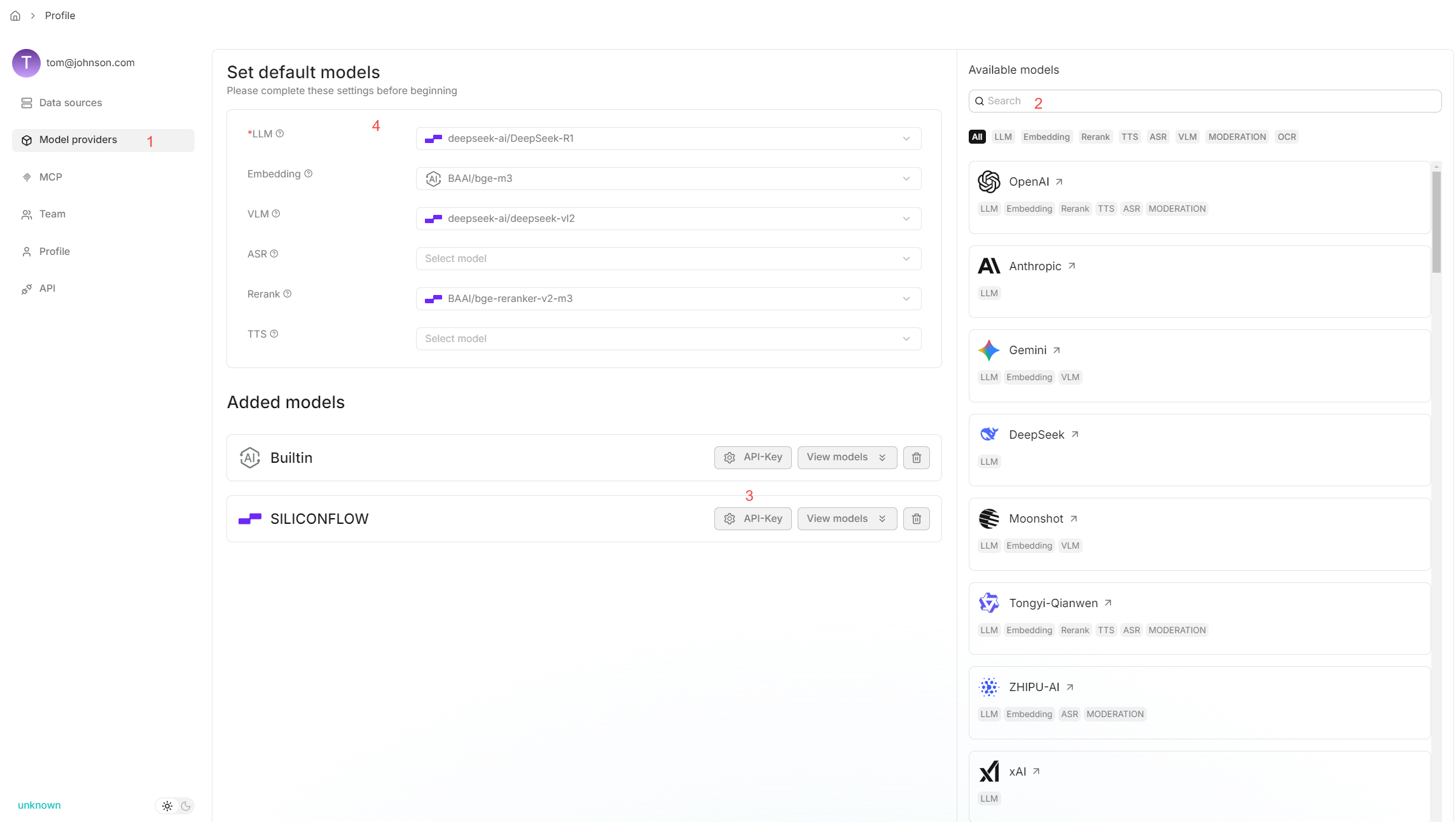
|
||||
|
||||
2. If your Agent involves dataset retrieval, ensure you [have properly configured your target knowledge base(s)](../../dataset/configure_knowledge_base.md).
|
||||
|
||||
## Configurations
|
||||
|
||||
### Model
|
||||
@ -57,13 +65,44 @@ Click the dropdown menu of **Model** to show the model configuration window.
|
||||
|
||||
Typically, you use the system prompt to describe the task for the LLM, specify how it should respond, and outline other miscellaneous requirements. We do not plan to elaborate on this topic, as it can be as extensive as prompt engineering. However, please be aware that the system prompt is often used in conjunction with keys (variables), which serve as various data inputs for the LLM.
|
||||
|
||||
:::danger IMPORTANT
|
||||
An **Agent** component relies on keys (variables) to specify its data inputs. Its immediate upstream component is *not* necessarily its data input, and the arrows in the workflow indicate *only* the processing sequence. Keys in a **Agent** component are used in conjunction with the system prompt to specify data inputs for the LLM. Use a forward slash `/` or the **(x)** button to show the keys to use.
|
||||
:::
|
||||
|
||||
#### Advanced usage
|
||||
|
||||
From v0.20.5 onwards, four framework-level prompt blocks are available in the **System prompt** field. Type `/` or click **(x)** to view them; they appear under the **Framework** entry in the dropdown menu.
|
||||
|
||||
- `task_analysis` prompt block
|
||||
- This block is responsible for analyzing tasks — either a user task or a task assigned by the lead Agent when the **Agent** component is acting as a Sub-Agent.
|
||||
- Reference design: [analyze_task_system.md](https://github.com/infiniflow/ragflow/blob/main/rag/prompts/analyze_task_system.md) and [analyze_task_user.md](https://github.com/infiniflow/ragflow/blob/main/rag/prompts/analyze_task_user.md)
|
||||
- Available *only* when this **Agent** component is acting as a planner, with either tools or sub-Agents under it.
|
||||
- Input variables:
|
||||
- `agent_prompt`: The system prompt.
|
||||
- `task`: The user prompt for either a lead Agent or a sub-Agent. The lead Agent's user prompt is defined by the user, while a sub-Agent's user prompt is defined by the lead Agent when delegating tasks.
|
||||
- `tool_desc`: A description of the tools and sub_Agents that can be called.
|
||||
- `context`: The operational context, which stores interactions between the Agent, tools, and sub-agents; initially empty.
|
||||
- `plan_generation` prompt block
|
||||
- This block creates a plan for the **Agent** component to execute next, based on the task analysis results.
|
||||
- Reference design: [next_step.md](https://github.com/infiniflow/ragflow/blob/main/rag/prompts/next_step.md)
|
||||
- Available *only* when this **Agent** component is acting as a planner, with either tools or sub-Agents under it.
|
||||
- Input variables:
|
||||
- `task_analysis`: The analysis result of the current task.
|
||||
- `desc`: A description of the tools or sub-Agents currently being called.
|
||||
- `today`: The date of today.
|
||||
- `reflection` prompt block
|
||||
- This block enables the **Agent** component to reflect, improving task accuracy and efficiency.
|
||||
- Reference design: [reflect.md](https://github.com/infiniflow/ragflow/blob/main/rag/prompts/reflect.md)
|
||||
- Available *only* when this **Agent** component is acting as a planner, with either tools or sub-Agents under it.
|
||||
- Input variables:
|
||||
- `goal`: The goal of the current task. It is the user prompt for either a lead Agent or a sub-Agent. The lead Agent's user prompt is defined by the user, while a sub-Agent's user prompt is defined by the lead Agent.
|
||||
- `tool_calls`: The history of tool calling
|
||||
- `call.name`:The name of the tool called.
|
||||
- `call.result`:The result of tool calling
|
||||
- `citation_guidelines` prompt block
|
||||
- Reference design: [citation_prompt.md](https://github.com/infiniflow/ragflow/blob/main/rag/prompts/citation_prompt.md)
|
||||
|
||||
### User prompt
|
||||
|
||||
The user-defined prompt. Defaults to `sys.query`, the user query.
|
||||
The user-defined prompt. Defaults to `sys.query`, the user query. As a general rule, when using the **Agent** component as a standalone module (not as a planner), you usually need to specify the corresponding **Retrieval** component’s output variable (`formalized_content`) here as part of the input to the LLM.
|
||||
|
||||
|
||||
### Tools
|
||||
@ -100,4 +139,24 @@ Increasing this value will significantly extend your agent's response time.
|
||||
|
||||
### Output
|
||||
|
||||
The global variable name for the output of the **Agent** component, which can be referenced by other components in the workflow.
|
||||
The global variable name for the output of the **Agent** component, which can be referenced by other components in the workflow.
|
||||
|
||||
## Frequently asked questions
|
||||
|
||||
### Why does it take so long for my Agent to respond?
|
||||
|
||||
An Agent’s response time generally depends on two key factors: the LLM’s capabilities and the prompt, the latter reflecting task complexity. When using an Agent, you should always balance task demands with the LLM’s ability. See [How to balance task complexity with an Agent's performance and speed?](#how-to-balance-task-complexity-with-an-agents-performance-and-speed) for details.
|
||||
|
||||
## Best practices
|
||||
|
||||
### How to balance task complexity with an Agent’s performance and speed?
|
||||
|
||||
- For simple tasks, such as retrieval, rewriting, formatting, or structured data extraction, use concise prompts, remove planning or reasoning instructions, enforce output length limits, and select smaller or Turbo-class models. This significantly reduces latency and cost with minimal impact on quality.
|
||||
|
||||
- For complex tasks, like multi-step reasoning, cross-document synthesis, or tool-based workflows, maintain or enhance prompts that include planning, reflection, and verification steps.
|
||||
|
||||
- In multi-Agent orchestration systems, delegate simple subtasks to sub-Agents using smaller, faster models, and reserve more powerful models for the lead Agent to handle complexity and uncertainty.
|
||||
|
||||
:::tip KEY INSIGHT
|
||||
Focus on minimizing output tokens — through summarization, bullet points, or explicit length limits — as this has far greater impact on reducing latency than optimizing input size.
|
||||
:::
|
||||
@ -13,6 +13,32 @@ A component that enables users to integrate Python or JavaScript codes into thei
|
||||
|
||||
A **Code** component is essential when you need to integrate complex code logic (Python or JavaScript) into your Agent for dynamic data processing.
|
||||
|
||||
## Prerequisites
|
||||
|
||||
### 1. Ensure gVisor is properly installed
|
||||
|
||||
We use gVisor to isolate code execution from the host system. Please follow [the official installation guide](https://gvisor.dev/docs/user_guide/install/) to install gVisor, ensuring your operating system is compatible before proceeding.
|
||||
|
||||
### 2. Ensure Sandbox is properly installed
|
||||
|
||||
RAGFlow Sandbox is a secure, pluggable code execution backend. It serves as the code executor for the **Code** component. Please follow the [instructions here](https://github.com/infiniflow/ragflow/tree/main/sandbox) to install RAGFlow Sandbox.
|
||||
|
||||
:::tip NOTE
|
||||
If your RAGFlow Sandbox is not working, please be sure to consult the [Troubleshooting](#troubleshooting) section in this document. We assure you that it addresses 99.99% of the issues!
|
||||
:::
|
||||
|
||||
### 3. (Optional) Install necessary dependencies
|
||||
|
||||
If you need to import your own Python or JavaScript packages into Sandbox, please follow the commands provided in the [How to import my own Python or JavaScript packages into Sandbox?](#how-to-import-my-own-python-or-javascript-packages-into-sandbox) section to install the additional dependencies.
|
||||
|
||||
### 4. Enable Sandbox-specific settings in RAGFlow
|
||||
|
||||
Ensure all Sandbox-specific settings are enabled in **ragflow/docker/.env**.
|
||||
|
||||
### 5. Restart the service after making changes
|
||||
|
||||
Any changes to the configuration or environment *require* a full service restart to take effect.
|
||||
|
||||
## Configurations
|
||||
|
||||
### Input
|
||||
@ -55,4 +81,112 @@ You define the output variable(s) of the **Code** component here.
|
||||
|
||||
The defined output variable(s) will be auto-populated here.
|
||||
|
||||
## Troubleshooting
|
||||
|
||||
### `HTTPConnectionPool(host='sandbox-executor-manager', port=9385): Read timed out.`
|
||||
|
||||
**Root cause**
|
||||
|
||||
- You did not properly install gVisor and `runsc` was not recognized as a valid Docker runtime.
|
||||
- You did not pull the required base images for the runners and no runner was started.
|
||||
|
||||
**Solution**
|
||||
|
||||
For the gVisor issue:
|
||||
|
||||
1. Install [gVisor](https://gvisor.dev/docs/user_guide/install/).
|
||||
2. Restart Docker.
|
||||
3. Run the following to double check:
|
||||
|
||||
```bash
|
||||
docker run --rm --runtime=runsc hello-world
|
||||
```
|
||||
|
||||
For the base image issue, pull the required base images:
|
||||
|
||||
```bash
|
||||
docker pull infiniflow/sandbox-base-nodejs:latest
|
||||
docker pull infiniflow/sandbox-base-python:latest
|
||||
```
|
||||
|
||||
### `HTTPConnectionPool(host='none', port=9385): Max retries exceeded.`
|
||||
|
||||
**Root cause**
|
||||
|
||||
`sandbox-executor-manager` is not mapped in `/etc/hosts`.
|
||||
|
||||
**Solution**
|
||||
|
||||
Add a new entry to `/etc/hosts`:
|
||||
|
||||
`127.0.0.1 es01 infinity mysql minio redis sandbox-executor-manager`
|
||||
|
||||
### `Container pool is busy`
|
||||
|
||||
**Root cause**
|
||||
|
||||
All runners are currently in use, executing tasks.
|
||||
|
||||
**Solution**
|
||||
|
||||
Please try again shortly or increase the pool size in the configuration to improve availability and reduce waiting times.
|
||||
|
||||
|
||||
## Frequently asked questions
|
||||
|
||||
### How to import my own Python or JavaScript packages into Sandbox?
|
||||
|
||||
To import your Python packages, update **sandbox_base_image/python/requirements.txt** to install the required dependencies. For example, to add the `openpyxl` package, proceed with the following command lines:
|
||||
|
||||
```bash {4,6}
|
||||
(ragflow) ➜ ragflow/sandbox main ✓ pwd # make sure you are in the right directory
|
||||
/home/infiniflow/workspace/ragflow/sandbox
|
||||
|
||||
(ragflow) ➜ ragflow/sandbox main ✓ echo "openpyxl" >> sandbox_base_image/python/requirements.txt # add the package to the requirements.txt file
|
||||
|
||||
(ragflow) ➜ ragflow/sandbox main ✗ cat sandbox_base_image/python/requirements.txt # make sure the package is added
|
||||
numpy
|
||||
pandas
|
||||
requests
|
||||
openpyxl # here it is
|
||||
|
||||
(ragflow) ➜ ragflow/sandbox main ✗ make # rebuild the docker image, this command will rebuild the iamge and start the service immediately. To build image only, using `make build` instead.
|
||||
|
||||
(ragflow) ➜ ragflow/sandbox main ✗ docker exec -it sandbox_python_0 /bin/bash # entering container to check if the package is installed
|
||||
|
||||
|
||||
# in the container
|
||||
nobody@ffd8a7dd19da:/workspace$ python # launch python shell
|
||||
Python 3.11.13 (main, Aug 12 2025, 22:46:03) [GCC 12.2.0] on linux
|
||||
Type "help", "copyright", "credits" or "license" for more information.
|
||||
>>> import openpyxl # import the package to verify installation
|
||||
>>>
|
||||
# That's okay!
|
||||
```
|
||||
|
||||
To import your JavaScript packages, navigate to `sandbox_base_image/nodejs` and use `npm` to install the required packages. For example, to add the `lodash` package, run the following commands:
|
||||
|
||||
```bash
|
||||
(ragflow) ➜ ragflow/sandbox main ✓ pwd
|
||||
/home/infiniflow/workspace/ragflow/sandbox
|
||||
|
||||
(ragflow) ➜ ragflow/sandbox main ✓ cd sandbox_base_image/nodejs
|
||||
|
||||
(ragflow) ➜ ragflow/sandbox/sandbox_base_image/nodejs main ✓ npm install lodash
|
||||
|
||||
(ragflow) ➜ ragflow/sandbox/sandbox_base_image/nodejs main ✓ cd ../.. # go back to sandbox root directory
|
||||
|
||||
(ragflow) ➜ ragflow/sandbox main ✗ make # rebuild the docker image, this command will rebuild the iamge and start the service immediately. To build image only, using `make build` instead.
|
||||
|
||||
(ragflow) ➜ ragflow/sandbox main ✗ docker exec -it sandbox_nodejs_0 /bin/bash # entering container to check if the package is installed
|
||||
|
||||
# in the container
|
||||
nobody@dd4bbcabef63:/workspace$ npm list lodash # verify via npm list
|
||||
/workspace
|
||||
`-- lodash@4.17.21 extraneous
|
||||
|
||||
nobody@dd4bbcabef63:/workspace$ ls node_modules | grep lodash # or verify via listing node_modules
|
||||
lodash
|
||||
|
||||
# That's okay!
|
||||
```
|
||||
|
||||
@ -27,7 +27,7 @@ The corresponding configuration panel appears to the right of the canvas. Use th
|
||||
|
||||
### 2. Input query variable(s)
|
||||
|
||||
The **Retrieval** component relies on query variables to specify its queries.
|
||||
The **Retrieval** component depends on query variables to specify its queries.
|
||||
|
||||
:::caution IMPORTANT
|
||||
- If you use the **Retrieval** component as a standalone workflow module, input query variables in the **Input Variables** text box.
|
||||
@ -42,7 +42,7 @@ You can specify one or multiple knowledge bases to retrieve data from. If select
|
||||
|
||||
### 4. Expand **Advanced Settings** to configure the retrieval method
|
||||
|
||||
By default, a combination of weighted keyword similarity and weighted vector cosine similarity is used during retrieval. If a rerank model is selected, a combination of weighted keyword similarity and weighted reranking score will be used for retrieval.
|
||||
By default, a combination of weighted keyword similarity and weighted vector cosine similarity is used for retrieval. If a rerank model is selected, a combination of weighted keyword similarity and weighted reranking score will be used instead.
|
||||
|
||||
As a starter, you can skip this step to stay with the default retrieval method.
|
||||
|
||||
@ -57,9 +57,9 @@ If your user query is different from the languages of the knowledge bases, you c
|
||||
|
||||
### 6. Test retrieval results
|
||||
|
||||
Click the triangle button on the top of canvas to test the retrieval results.
|
||||
Click the **Run** button on the top of canvas to test the retrieval results.
|
||||
|
||||
### 6. Choose the next component
|
||||
### 7. Choose the next component
|
||||
|
||||
When necessary, click the **+** button on the **Retrieval** component to choose the next component in the worflow from the dropdown list.
|
||||
|
||||
|
||||
@ -48,7 +48,7 @@ You start an AI conversation by creating an assistant.
|
||||
- If no target language is selected, the system will search only in the language of your query, which may cause relevant information in other languages to be missed.
|
||||
- **Variable** refers to the variables (keys) to be used in the system prompt. `{knowledge}` is a reserved variable. Click **Add** to add more variables for the system prompt.
|
||||
- If you are uncertain about the logic behind **Variable**, leave it *as-is*.
|
||||
- As of v0.20.4, if you add custom variables here, the only way you can pass in their values is to call:
|
||||
- As of v0.20.5, if you add custom variables here, the only way you can pass in their values is to call:
|
||||
- HTTP method [Converse with chat assistant](../../references/http_api_reference.md#converse-with-chat-assistant), or
|
||||
- Python method [Converse with chat assistant](../../references/python_api_reference.md#converse-with-chat-assistant).
|
||||
|
||||
|
||||
@ -124,7 +124,7 @@ See [Run retrieval test](./run_retrieval_test.md) for details.
|
||||
|
||||
## Search for knowledge base
|
||||
|
||||
As of RAGFlow v0.20.4, the search feature is still in a rudimentary form, supporting only knowledge base search by name.
|
||||
As of RAGFlow v0.20.5, the search feature is still in a rudimentary form, supporting only knowledge base search by name.
|
||||
|
||||

|
||||
|
||||
|
||||
@ -87,4 +87,4 @@ RAGFlow's file management allows you to download an uploaded file:
|
||||
|
||||

|
||||
|
||||
> As of RAGFlow v0.20.4, bulk download is not supported, nor can you download an entire folder.
|
||||
> As of RAGFlow v0.20.5, bulk download is not supported, nor can you download an entire folder.
|
||||
|
||||
@ -18,7 +18,7 @@ RAGFlow ships with a built-in [Langfuse](https://langfuse.com) integration so th
|
||||
Langfuse stores traces, spans and prompt payloads in a purpose-built observability backend and offers filtering and visualisations on top.
|
||||
|
||||
:::info NOTE
|
||||
• RAGFlow **≥ 0.20.4** (contains the Langfuse connector)
|
||||
• RAGFlow **≥ 0.20.5** (contains the Langfuse connector)
|
||||
• A Langfuse workspace (cloud or self-hosted) with a _Project Public Key_ and _Secret Key_
|
||||
:::
|
||||
|
||||
|
||||
@ -66,10 +66,10 @@ To upgrade RAGFlow, you must upgrade **both** your code **and** your Docker imag
|
||||
git clone https://github.com/infiniflow/ragflow.git
|
||||
```
|
||||
|
||||
2. Switch to the latest, officially published release, e.g., `v0.20.4`:
|
||||
2. Switch to the latest, officially published release, e.g., `v0.20.5`:
|
||||
|
||||
```bash
|
||||
git checkout -f v0.20.4
|
||||
git checkout -f v0.20.5
|
||||
```
|
||||
|
||||
3. Update **ragflow/docker/.env**:
|
||||
@ -83,14 +83,14 @@ To upgrade RAGFlow, you must upgrade **both** your code **and** your Docker imag
|
||||
<TabItem value="slim">
|
||||
|
||||
```bash
|
||||
RAGFLOW_IMAGE=infiniflow/ragflow:v0.20.4-slim
|
||||
RAGFLOW_IMAGE=infiniflow/ragflow:v0.20.5-slim
|
||||
```
|
||||
|
||||
</TabItem>
|
||||
<TabItem value="full">
|
||||
|
||||
```bash
|
||||
RAGFLOW_IMAGE=infiniflow/ragflow:v0.20.4
|
||||
RAGFLOW_IMAGE=infiniflow/ragflow:v0.20.5
|
||||
```
|
||||
|
||||
</TabItem>
|
||||
@ -114,10 +114,10 @@ No, you do not need to. Upgrading RAGFlow in itself will *not* remove your uploa
|
||||
1. From an environment with Internet access, pull the required Docker image.
|
||||
2. Save the Docker image to a **.tar** file.
|
||||
```bash
|
||||
docker save -o ragflow.v0.20.4.tar infiniflow/ragflow:v0.20.4
|
||||
docker save -o ragflow.v0.20.5.tar infiniflow/ragflow:v0.20.5
|
||||
```
|
||||
3. Copy the **.tar** file to the target server.
|
||||
4. Load the **.tar** file into Docker:
|
||||
```bash
|
||||
docker load -i ragflow.v0.20.4.tar
|
||||
docker load -i ragflow.v0.20.5.tar
|
||||
```
|
||||
|
||||
@ -44,7 +44,7 @@ This section provides instructions on setting up the RAGFlow server on Linux. If
|
||||
|
||||
`vm.max_map_count`. This value sets the maximum number of memory map areas a process may have. Its default value is 65530. While most applications require fewer than a thousand maps, reducing this value can result in abnormal behaviors, and the system will throw out-of-memory errors when a process reaches the limitation.
|
||||
|
||||
RAGFlow v0.20.4 uses Elasticsearch or [Infinity](https://github.com/infiniflow/infinity) for multiple recall. Setting the value of `vm.max_map_count` correctly is crucial to the proper functioning of the Elasticsearch component.
|
||||
RAGFlow v0.20.5 uses Elasticsearch or [Infinity](https://github.com/infiniflow/infinity) for multiple recall. Setting the value of `vm.max_map_count` correctly is crucial to the proper functioning of the Elasticsearch component.
|
||||
|
||||
<Tabs
|
||||
defaultValue="linux"
|
||||
@ -184,13 +184,13 @@ This section provides instructions on setting up the RAGFlow server on Linux. If
|
||||
```bash
|
||||
$ git clone https://github.com/infiniflow/ragflow.git
|
||||
$ cd ragflow/docker
|
||||
$ git checkout -f v0.20.4
|
||||
$ git checkout -f v0.20.5
|
||||
```
|
||||
|
||||
3. Use the pre-built Docker images and start up the server:
|
||||
|
||||
:::tip NOTE
|
||||
The command below downloads the `v0.20.4-slim` edition of the RAGFlow Docker image. Refer to the following table for descriptions of different RAGFlow editions. To download a RAGFlow edition different from `v0.20.4-slim`, update the `RAGFLOW_IMAGE` variable accordingly in **docker/.env** before using `docker compose` to start the server. For example: set `RAGFLOW_IMAGE=infiniflow/ragflow:v0.20.4` for the full edition `v0.20.4`.
|
||||
The command below downloads the `v0.20.5-slim` edition of the RAGFlow Docker image. Refer to the following table for descriptions of different RAGFlow editions. To download a RAGFlow edition different from `v0.20.5-slim`, update the `RAGFLOW_IMAGE` variable accordingly in **docker/.env** before using `docker compose` to start the server. For example: set `RAGFLOW_IMAGE=infiniflow/ragflow:v0.20.5` for the full edition `v0.20.5`.
|
||||
:::
|
||||
|
||||
```bash
|
||||
@ -207,8 +207,8 @@ This section provides instructions on setting up the RAGFlow server on Linux. If
|
||||
|
||||
| RAGFlow image tag | Image size (GB) | Has embedding models and Python packages? | Stable? |
|
||||
| ------------------- | --------------- | ----------------------------------------- | ------------------------ |
|
||||
| `v0.20.4` | ≈9 | :heavy_check_mark: | Stable release |
|
||||
| `v0.20.4-slim` | ≈2 | ❌ | Stable release |
|
||||
| `v0.20.5` | ≈9 | :heavy_check_mark: | Stable release |
|
||||
| `v0.20.5-slim` | ≈2 | ❌ | Stable release |
|
||||
| `nightly` | ≈9 | :heavy_check_mark: | *Unstable* nightly build |
|
||||
| `nightly-slim` | ≈2 | ❌ | *Unstable* nightly build |
|
||||
|
||||
@ -217,7 +217,7 @@ This section provides instructions on setting up the RAGFlow server on Linux. If
|
||||
```
|
||||
|
||||
:::danger IMPORTANT
|
||||
The embedding models included in `v0.20.4` and `nightly` are:
|
||||
The embedding models included in `v0.20.5` and `nightly` are:
|
||||
|
||||
- BAAI/bge-large-zh-v1.5
|
||||
- maidalun1020/bce-embedding-base_v1
|
||||
|
||||
@ -19,7 +19,7 @@ import TOCInline from '@theme/TOCInline';
|
||||
|
||||
### Cross-language search
|
||||
|
||||
Cross-language search (also known as cross-lingual retrieval) is a feature introduced in version 0.20.4. It enables users to submit queries in one language (for example, English) and retrieve relevant documents written in other languages such as Chinese or Spanish. This feature is enabled by the system’s default chat model, which translates queries to ensure accurate matching of semantic meaning across languages.
|
||||
Cross-language search (also known as cross-lingual retrieval) is a feature introduced in version 0.20.5. It enables users to submit queries in one language (for example, English) and retrieve relevant documents written in other languages such as Chinese or Spanish. This feature is enabled by the system’s default chat model, which translates queries to ensure accurate matching of semantic meaning across languages.
|
||||
|
||||
By enabling cross-language search, users can effortlessly access a broader range of information regardless of language barriers, significantly enhancing the system’s usability and inclusiveness.
|
||||
|
||||
|
||||
@ -1808,7 +1808,8 @@ Retrieves chunks from specified datasets.
|
||||
- `"rerank_id"`: `string`
|
||||
- `"keyword"`: `boolean`
|
||||
- `"highlight"`: `boolean`
|
||||
- `"cross_languages"`: `list[string]`
|
||||
- `"cross_languages"`: `list[string]`
|
||||
- `"metadata_condition"`: `object`
|
||||
|
||||
##### Request example
|
||||
|
||||
@ -1855,7 +1856,8 @@ curl --request POST \
|
||||
- `false`: Disable highlighting of matched terms (default).
|
||||
- `"cross_languages"`: (*Body parameter*) `list[string]`
|
||||
The languages that should be translated into, in order to achieve keywords retrievals in different languages.
|
||||
|
||||
- `"metadata_condition"`: (*Body parameter*), `object`
|
||||
The metadata condition for filtering chunks.
|
||||
#### Response
|
||||
|
||||
Success:
|
||||
@ -3811,7 +3813,7 @@ Lists agents.
|
||||
#### Request
|
||||
|
||||
- Method: GET
|
||||
- URL: `/api/v1/agents?page={page}&page_size={page_size}&orderby={orderby}&desc={desc}&name={agent_name}&id={agent_id}`
|
||||
- URL: `/api/v1/agents?page={page}&page_size={page_size}&orderby={orderby}&desc={desc}&title={agent_name}&id={agent_id}`
|
||||
- Headers:
|
||||
- `'Authorization: Bearer <YOUR_API_KEY>'`
|
||||
|
||||
@ -3819,7 +3821,7 @@ Lists agents.
|
||||
|
||||
```bash
|
||||
curl --request GET \
|
||||
--url http://{address}/api/v1/agents?page={page}&page_size={page_size}&orderby={orderby}&desc={desc}&name={agent_name}&id={agent_id} \
|
||||
--url http://{address}/api/v1/agents?page={page}&page_size={page_size}&orderby={orderby}&desc={desc}&title={agent_name}&id={agent_id} \
|
||||
--header 'Authorization: Bearer <YOUR_API_KEY>'
|
||||
```
|
||||
|
||||
@ -3837,7 +3839,7 @@ curl --request GET \
|
||||
Indicates whether the retrieved agents should be sorted in descending order. Defaults to `true`.
|
||||
- `id`: (*Filter parameter*), `string`
|
||||
The ID of the agent to retrieve.
|
||||
- `name`: (*Filter parameter*), `string`
|
||||
- `title`: (*Filter parameter*), `string`
|
||||
The name of the agent to retrieve.
|
||||
|
||||
#### Response
|
||||
|
||||
@ -921,7 +921,7 @@ chunk.update({"content":"sdfx..."})
|
||||
### Retrieve chunks
|
||||
|
||||
```python
|
||||
RAGFlow.retrieve(question:str="", dataset_ids:list[str]=None, document_ids=list[str]=None, page:int=1, page_size:int=30, similarity_threshold:float=0.2, vector_similarity_weight:float=0.3, top_k:int=1024,rerank_id:str=None,keyword:bool=False,highlight:bool=False) -> list[Chunk]
|
||||
RAGFlow.retrieve(question:str="", dataset_ids:list[str]=None, document_ids=list[str]=None, page:int=1, page_size:int=30, similarity_threshold:float=0.2, vector_similarity_weight:float=0.3, top_k:int=1024,rerank_id:str=None,keyword:bool=False,cross_languages:list[str]=None,metadata_condition: dict=None) -> list[Chunk]
|
||||
```
|
||||
|
||||
Retrieves chunks from specified datasets.
|
||||
@ -971,17 +971,14 @@ Indicates whether to enable keyword-based matching:
|
||||
- `True`: Enable keyword-based matching.
|
||||
- `False`: Disable keyword-based matching (default).
|
||||
|
||||
##### highlight: `bool`
|
||||
|
||||
Specifies whether to enable highlighting of matched terms in the results:
|
||||
|
||||
- `True`: Enable highlighting of matched terms.
|
||||
- `False`: Disable highlighting of matched terms (default).
|
||||
|
||||
##### cross_languages: `list[string]`
|
||||
|
||||
The languages that should be translated into, in order to achieve keywords retrievals in different languages.
|
||||
|
||||
##### metadata_condition: `dict`
|
||||
|
||||
filter condition for meta_fields
|
||||
|
||||
#### Returns
|
||||
|
||||
- Success: A list of `Chunk` objects representing the document chunks.
|
||||
|
||||
@ -9,8 +9,8 @@ Key features, improvements and bug fixes in the latest releases.
|
||||
|
||||
:::info
|
||||
Each RAGFlow release is available in two editions:
|
||||
- **Slim edition**: excludes built-in embedding models and is identified by a **-slim** suffix added to the version name. Example: `infiniflow/ragflow:v0.20.4-slim`
|
||||
- **Full edition**: includes built-in embedding models and has no suffix added to the version name. Example: `infiniflow/ragflow:v0.20.4`
|
||||
- **Slim edition**: excludes built-in embedding models and is identified by a **-slim** suffix added to the version name. Example: `infiniflow/ragflow:v0.20.5-slim`
|
||||
- **Full edition**: includes built-in embedding models and has no suffix added to the version name. Example: `infiniflow/ragflow:v0.20.5`
|
||||
:::
|
||||
|
||||
:::danger IMPORTANT
|
||||
@ -22,6 +22,31 @@ The embedding models included in a full edition are:
|
||||
These two embedding models are optimized specifically for English and Chinese, so performance may be compromised if you use them to embed documents in other languages.
|
||||
:::
|
||||
|
||||
## v0.20.5
|
||||
|
||||
Released on September 10, 2025.
|
||||
|
||||
### Improvements
|
||||
|
||||
- Agent Performance Optimized: Improved planning and reflection speed for simple tasks; optimized concurrent tool calls for parallelizable scenarios, significantly reducing overall response time.
|
||||
- Agent Prompt Framework exposed: Developers can now customize and override framework-level prompts in the system prompt section, enhancing flexibility and control.
|
||||
- Execute SQL Component Enhanced: Replaced the original variable reference component with a text input field, allowing free-form SQL writing with variable support.
|
||||
- Chat: Re-enabled Reasoning and Cross-language search.
|
||||
- Retrieval API Enhanced: Added metadata filtering support to the [Retrieve chunks](https://ragflow.io/docs/dev/http_api_reference#retrieve-chunks) method.
|
||||
|
||||
### Added models
|
||||
|
||||
- Meituan LongCat
|
||||
- Kimi: kimi-k2-turbo-preview and kimi-k2-0905-preview
|
||||
- Qwen: qwen3-max-preview
|
||||
- SiliconFlow: DeepSeek V3.1
|
||||
|
||||
### Fixed issues
|
||||
|
||||
- Dataset: Deleted files remained searchable.
|
||||
- Chat: Unable to chat with an Ollama model.
|
||||
- Agent: Resolved issues including cite toggle failure, task mode requiring dialogue triggers, repeated answers in multi-turn dialogues, and duplicate summarization of parallel execution results.
|
||||
|
||||
## v0.20.4
|
||||
|
||||
Released on August 27, 2025.
|
||||
|
||||
@ -36,10 +36,8 @@ try:
|
||||
updated_dataset = dataset_instance.update(updated_message)
|
||||
|
||||
# get the dataset (list datasets)
|
||||
dataset_list = ragflow_instance.list_datasets(id=dataset_instance.id)
|
||||
dataset_instance_2 = dataset_list[0]
|
||||
print(dataset_instance)
|
||||
print(dataset_instance_2)
|
||||
print(updated_dataset)
|
||||
|
||||
# delete the dataset (delete datasets)
|
||||
to_be_deleted_datasets = [dataset_instance.id]
|
||||
|
||||
@ -21,7 +21,7 @@ class NodeEmbeddings:
|
||||
embeddings: np.ndarray
|
||||
|
||||
|
||||
def embed_nod2vec(
|
||||
def embed_node2vec(
|
||||
graph: nx.Graph | nx.DiGraph,
|
||||
dimensions: int = 1536,
|
||||
num_walks: int = 10,
|
||||
@ -44,13 +44,13 @@ def embed_nod2vec(
|
||||
return NodeEmbeddings(embeddings=lcc_tensors[0], nodes=lcc_tensors[1])
|
||||
|
||||
|
||||
def run(graph: nx.Graph, args: dict[str, Any]) -> NodeEmbeddings:
|
||||
def run(graph: nx.Graph, args: dict[str, Any]) -> dict:
|
||||
"""Run method definition."""
|
||||
if args.get("use_lcc", True):
|
||||
graph = stable_largest_connected_component(graph)
|
||||
|
||||
# create graph embedding using node2vec
|
||||
embeddings = embed_nod2vec(
|
||||
embeddings = embed_node2vec(
|
||||
graph=graph,
|
||||
dimensions=args.get("dimensions", 1536),
|
||||
num_walks=args.get("num_walks", 10),
|
||||
|
||||
@ -23,7 +23,7 @@ import trio
|
||||
|
||||
from api.utils import get_uuid
|
||||
from graphrag.query_analyze_prompt import PROMPTS
|
||||
from graphrag.utils import get_entity_type2sampels, get_llm_cache, set_llm_cache, get_relation
|
||||
from graphrag.utils import get_entity_type2samples, get_llm_cache, set_llm_cache, get_relation
|
||||
from rag.utils import num_tokens_from_string, get_float
|
||||
from rag.utils.doc_store_conn import OrderByExpr
|
||||
|
||||
@ -42,7 +42,7 @@ class KGSearch(Dealer):
|
||||
return response
|
||||
|
||||
def query_rewrite(self, llm, question, idxnms, kb_ids):
|
||||
ty2ents = trio.run(lambda: get_entity_type2sampels(idxnms, kb_ids))
|
||||
ty2ents = trio.run(lambda: get_entity_type2samples(idxnms, kb_ids))
|
||||
hint_prompt = PROMPTS["minirag_query2kwd"].format(query=question,
|
||||
TYPE_POOL=json.dumps(ty2ents, ensure_ascii=False, indent=2))
|
||||
result = self._chat(llm, hint_prompt, [{"role": "user", "content": "Output:"}], {})
|
||||
|
||||
@ -561,7 +561,7 @@ def merge_tuples(list1, list2):
|
||||
return result
|
||||
|
||||
|
||||
async def get_entity_type2sampels(idxnms, kb_ids: list):
|
||||
async def get_entity_type2samples(idxnms, kb_ids: list):
|
||||
es_res = await trio.to_thread.run_sync(lambda: settings.retrievaler.search({"knowledge_graph_kwd": "ty2ents", "kb_id": kb_ids, "size": 10000, "fields": ["content_with_weight"]}, idxnms, kb_ids))
|
||||
|
||||
res = defaultdict(list)
|
||||
|
||||
@ -56,7 +56,7 @@ env:
|
||||
ragflow:
|
||||
image:
|
||||
repository: infiniflow/ragflow
|
||||
tag: v0.20.4-slim
|
||||
tag: v0.20.5-slim
|
||||
pullPolicy: IfNotPresent
|
||||
pullSecrets: []
|
||||
# Optional service configuration overrides
|
||||
|
||||
@ -1,6 +1,6 @@
|
||||
[project]
|
||||
name = "ragflow"
|
||||
version = "0.20.4"
|
||||
version = "0.20.5"
|
||||
description = "[RAGFlow](https://ragflow.io/) is an open-source RAG (Retrieval-Augmented Generation) engine based on deep document understanding. It offers a streamlined RAG workflow for businesses of any scale, combining LLM (Large Language Models) to provide truthful question-answering capabilities, backed by well-founded citations from various complex formatted data."
|
||||
authors = [{ name = "Zhichang Yu", email = "yuzhichang@gmail.com" }]
|
||||
license-files = ["LICENSE"]
|
||||
|
||||
@ -14,36 +14,45 @@
|
||||
# limitations under the License.
|
||||
#
|
||||
|
||||
import os
|
||||
import importlib
|
||||
import inspect
|
||||
import pkgutil
|
||||
from pathlib import Path
|
||||
from types import ModuleType
|
||||
from typing import Dict, Type
|
||||
|
||||
_package_path = os.path.dirname(__file__)
|
||||
__all_classes: Dict[str, Type] = {}
|
||||
|
||||
def _import_submodules() -> None:
|
||||
for filename in os.listdir(_package_path): # noqa: F821
|
||||
if filename.startswith("__") or not filename.endswith(".py") or filename.startswith("base"):
|
||||
continue
|
||||
module_name = filename[:-3]
|
||||
_pkg_dir = Path(__file__).resolve().parent
|
||||
_pkg_name = __name__
|
||||
|
||||
|
||||
def _should_skip_module(mod_name: str) -> bool:
|
||||
leaf = mod_name.rsplit(".", 1)[-1]
|
||||
return leaf in {"__init__"} or leaf.startswith("__") or leaf.startswith("_") or leaf.startswith("base")
|
||||
|
||||
|
||||
def _import_submodules() -> None:
|
||||
for modinfo in pkgutil.walk_packages([str(_pkg_dir)], prefix=_pkg_name + "."): # noqa: F821
|
||||
mod_name = modinfo.name
|
||||
if _should_skip_module(mod_name): # noqa: F821
|
||||
continue
|
||||
try:
|
||||
module = importlib.import_module(f".{module_name}", package=__name__)
|
||||
module = importlib.import_module(mod_name)
|
||||
_extract_classes_from_module(module) # noqa: F821
|
||||
except ImportError as e:
|
||||
print(f"Warning: Failed to import module {module_name}: {str(e)}")
|
||||
print(f"Warning: Failed to import module {mod_name}: {e}")
|
||||
|
||||
|
||||
def _extract_classes_from_module(module: ModuleType) -> None:
|
||||
for name, obj in inspect.getmembers(module):
|
||||
if (inspect.isclass(obj) and
|
||||
obj.__module__ == module.__name__ and not name.startswith("_")):
|
||||
if inspect.isclass(obj) and obj.__module__ == module.__name__ and not name.startswith("_"):
|
||||
__all_classes[name] = obj
|
||||
globals()[name] = obj
|
||||
|
||||
|
||||
_import_submodules()
|
||||
|
||||
__all__ = list(__all_classes.keys()) + ["__all_classes"]
|
||||
|
||||
del _package_path, _import_submodules, _extract_classes_from_module
|
||||
del _pkg_dir, _pkg_name, _import_submodules, _extract_classes_from_module
|
||||
|
||||
@ -1,5 +1,5 @@
|
||||
#
|
||||
# Copyright 2024 The InfiniFlow Authors. All Rights Reserved.
|
||||
# Copyright 2025 The InfiniFlow Authors. All Rights Reserved.
|
||||
#
|
||||
# Licensed under the Apache License, Version 2.0 (the "License");
|
||||
# you may not use this file except in compliance with the License.
|
||||
@ -13,13 +13,15 @@
|
||||
# See the License for the specific language governing permissions and
|
||||
# limitations under the License.
|
||||
#
|
||||
import time
|
||||
import os
|
||||
import logging
|
||||
import os
|
||||
import time
|
||||
from functools import partial
|
||||
from typing import Any
|
||||
|
||||
import trio
|
||||
from agent.component.base import ComponentParamBase, ComponentBase
|
||||
|
||||
from agent.component.base import ComponentBase, ComponentParamBase
|
||||
from api.utils.api_utils import timeout
|
||||
|
||||
|
||||
@ -31,14 +33,16 @@ class ProcessParamBase(ComponentParamBase):
|
||||
|
||||
|
||||
class ProcessBase(ComponentBase):
|
||||
|
||||
def __init__(self, pipeline, id, param: ProcessParamBase):
|
||||
super().__init__(pipeline, id, param)
|
||||
self.callback = partial(self._canvas.callback, self.component_name)
|
||||
if hasattr(self._canvas, "callback"):
|
||||
self.callback = partial(self._canvas.callback, self.component_name)
|
||||
else:
|
||||
self.callback = partial(lambda *args, **kwargs: None, self.component_name)
|
||||
|
||||
async def invoke(self, **kwargs) -> dict[str, Any]:
|
||||
self.set_output("_created_time", time.perf_counter())
|
||||
for k,v in kwargs.items():
|
||||
for k, v in kwargs.items():
|
||||
self.set_output(k, v)
|
||||
try:
|
||||
with trio.fail_after(self._param.timeout):
|
||||
@ -54,6 +58,6 @@ class ProcessBase(ComponentBase):
|
||||
self.set_output("_elapsed_time", time.perf_counter() - self.output("_created_time"))
|
||||
return self.output()
|
||||
|
||||
@timeout(os.environ.get("COMPONENT_EXEC_TIMEOUT", 10*60))
|
||||
@timeout(os.environ.get("COMPONENT_EXEC_TIMEOUT", 10 * 60))
|
||||
async def _invoke(self, **kwargs):
|
||||
raise NotImplementedError()
|
||||
|
||||
15
rag/flow/chunker/__init__.py
Normal file
15
rag/flow/chunker/__init__.py
Normal file
@ -0,0 +1,15 @@
|
||||
#
|
||||
# Copyright 2025 The InfiniFlow Authors. All Rights Reserved.
|
||||
#
|
||||
# Licensed under the Apache License, Version 2.0 (the "License");
|
||||
# you may not use this file except in compliance with the License.
|
||||
# You may obtain a copy of the License at
|
||||
#
|
||||
# http://www.apache.org/licenses/LICENSE-2.0
|
||||
#
|
||||
# Unless required by applicable law or agreed to in writing, software
|
||||
# distributed under the License is distributed on an "AS IS" BASIS,
|
||||
# WITHOUT WARRANTIES OR CONDITIONS OF ANY KIND, either express or implied.
|
||||
# See the License for the specific language governing permissions and
|
||||
# limitations under the License.
|
||||
|
||||
@ -1,5 +1,5 @@
|
||||
#
|
||||
# Copyright 2024 The InfiniFlow Authors. All Rights Reserved.
|
||||
# Copyright 2025 The InfiniFlow Authors. All Rights Reserved.
|
||||
#
|
||||
# Licensed under the Apache License, Version 2.0 (the "License");
|
||||
# you may not use this file except in compliance with the License.
|
||||
@ -13,12 +13,15 @@
|
||||
# See the License for the specific language governing permissions and
|
||||
# limitations under the License.
|
||||
import random
|
||||
|
||||
import trio
|
||||
|
||||
from api.db import LLMType
|
||||
from api.db.services.llm_service import LLMBundle
|
||||
from deepdoc.parser.pdf_parser import RAGFlowPdfParser
|
||||
from graphrag.utils import get_llm_cache, chat_limiter, set_llm_cache
|
||||
from graphrag.utils import chat_limiter, get_llm_cache, set_llm_cache
|
||||
from rag.flow.base import ProcessBase, ProcessParamBase
|
||||
from rag.flow.chunker.schema import ChunkerFromUpstream
|
||||
from rag.nlp import naive_merge, naive_merge_with_images
|
||||
from rag.prompts.prompts import keyword_extraction, question_proposal
|
||||
|
||||
@ -26,7 +29,23 @@ from rag.prompts.prompts import keyword_extraction, question_proposal
|
||||
class ChunkerParam(ProcessParamBase):
|
||||
def __init__(self):
|
||||
super().__init__()
|
||||
self.method_options = ["general", "q&a", "resume", "manual", "table", "paper", "book", "laws", "presentation", "one"]
|
||||
self.method_options = [
|
||||
# General
|
||||
"general",
|
||||
"onetable",
|
||||
# Customer Service
|
||||
"q&a",
|
||||
"manual",
|
||||
# Recruitment
|
||||
"resume",
|
||||
# Education & Research
|
||||
"book",
|
||||
"paper",
|
||||
"laws",
|
||||
"presentation",
|
||||
# Other
|
||||
# "Tag" # TODO: Other method
|
||||
]
|
||||
self.method = "general"
|
||||
self.chunk_token_size = 512
|
||||
self.delimiter = "\n"
|
||||
@ -35,10 +54,7 @@ class ChunkerParam(ProcessParamBase):
|
||||
self.auto_keywords = 0
|
||||
self.auto_questions = 0
|
||||
self.tag_sets = []
|
||||
self.llm_setting = {
|
||||
"llm_name": "",
|
||||
"lang": "Chinese"
|
||||
}
|
||||
self.llm_setting = {"llm_name": "", "lang": "Chinese"}
|
||||
|
||||
def check(self):
|
||||
self.check_valid_value(self.method.lower(), "Chunk method abnormal.", self.method_options)
|
||||
@ -48,53 +64,79 @@ class ChunkerParam(ProcessParamBase):
|
||||
self.check_nonnegative_number(self.auto_questions, "Auto-question value: (0, 10]")
|
||||
self.check_decimal_float(self.overlapped_percent, "Overlapped percentage: [0, 1)")
|
||||
|
||||
def get_input_form(self) -> dict[str, dict]:
|
||||
return {}
|
||||
|
||||
|
||||
class Chunker(ProcessBase):
|
||||
component_name = "Chunker"
|
||||
|
||||
def _general(self, **kwargs):
|
||||
self.callback(random.randint(1,5)/100., "Start to chunk via `General`.")
|
||||
if kwargs.get("output_format") in ["markdown", "text"]:
|
||||
cks = naive_merge(kwargs.get(kwargs["output_format"]), self._param.chunk_token_size, self._param.delimiter, self._param.overlapped_percent)
|
||||
def _general(self, from_upstream: ChunkerFromUpstream):
|
||||
self.callback(random.randint(1, 5) / 100.0, "Start to chunk via `General`.")
|
||||
if from_upstream.output_format in ["markdown", "text"]:
|
||||
if from_upstream.output_format == "markdown":
|
||||
payload = from_upstream.markdown_result
|
||||
else: # == "text"
|
||||
payload = from_upstream.text_result
|
||||
|
||||
if not payload:
|
||||
payload = ""
|
||||
|
||||
cks = naive_merge(
|
||||
payload,
|
||||
self._param.chunk_token_size,
|
||||
self._param.delimiter,
|
||||
self._param.overlapped_percent,
|
||||
)
|
||||
return [{"text": c} for c in cks]
|
||||
|
||||
sections, section_images = [], []
|
||||
for o in kwargs["json"]:
|
||||
sections.append((o["text"], o.get("position_tag","")))
|
||||
for o in from_upstream.json_result or []:
|
||||
sections.append((o.get("text", ""), o.get("position_tag", "")))
|
||||
section_images.append(o.get("image"))
|
||||
|
||||
chunks, images = naive_merge_with_images(sections, section_images,self._param.chunk_token_size, self._param.delimiter, self._param.overlapped_percent)
|
||||
return [{
|
||||
"text": RAGFlowPdfParser.remove_tag(c),
|
||||
"image": img,
|
||||
"positions": RAGFlowPdfParser.extract_positions(c)
|
||||
} for c,img in zip(chunks,images)]
|
||||
chunks, images = naive_merge_with_images(
|
||||
sections,
|
||||
section_images,
|
||||
self._param.chunk_token_size,
|
||||
self._param.delimiter,
|
||||
self._param.overlapped_percent,
|
||||
)
|
||||
|
||||
def _q_and_a(self, **kwargs):
|
||||
return [
|
||||
{
|
||||
"text": RAGFlowPdfParser.remove_tag(c),
|
||||
"image": img,
|
||||
"positions": RAGFlowPdfParser.extract_positions(c),
|
||||
}
|
||||
for c, img in zip(chunks, images)
|
||||
]
|
||||
|
||||
def _q_and_a(self, from_upstream: ChunkerFromUpstream):
|
||||
pass
|
||||
|
||||
def _resume(self, **kwargs):
|
||||
def _resume(self, from_upstream: ChunkerFromUpstream):
|
||||
pass
|
||||
|
||||
def _manual(self, **kwargs):
|
||||
def _manual(self, from_upstream: ChunkerFromUpstream):
|
||||
pass
|
||||
|
||||
def _table(self, **kwargs):
|
||||
def _table(self, from_upstream: ChunkerFromUpstream):
|
||||
pass
|
||||
|
||||
def _paper(self, **kwargs):
|
||||
def _paper(self, from_upstream: ChunkerFromUpstream):
|
||||
pass
|
||||
|
||||
def _book(self, **kwargs):
|
||||
def _book(self, from_upstream: ChunkerFromUpstream):
|
||||
pass
|
||||
|
||||
def _laws(self, **kwargs):
|
||||
def _laws(self, from_upstream: ChunkerFromUpstream):
|
||||
pass
|
||||
|
||||
def _presentation(self, **kwargs):
|
||||
def _presentation(self, from_upstream: ChunkerFromUpstream):
|
||||
pass
|
||||
|
||||
def _one(self, **kwargs):
|
||||
def _one(self, from_upstream: ChunkerFromUpstream):
|
||||
pass
|
||||
|
||||
async def _invoke(self, **kwargs):
|
||||
@ -110,7 +152,14 @@ class Chunker(ProcessBase):
|
||||
"presentation": self._presentation,
|
||||
"one": self._one,
|
||||
}
|
||||
chunks = function_map[self._param.method](**kwargs)
|
||||
|
||||
try:
|
||||
from_upstream = ChunkerFromUpstream.model_validate(kwargs)
|
||||
except Exception as e:
|
||||
self.set_output("_ERROR", f"Input error: {str(e)}")
|
||||
return
|
||||
|
||||
chunks = function_map[self._param.method](from_upstream)
|
||||
llm_setting = self._param.llm_setting
|
||||
|
||||
async def auto_keywords():
|
||||
37
rag/flow/chunker/schema.py
Normal file
37
rag/flow/chunker/schema.py
Normal file
@ -0,0 +1,37 @@
|
||||
#
|
||||
# Copyright 2025 The InfiniFlow Authors. All Rights Reserved.
|
||||
#
|
||||
# Licensed under the Apache License, Version 2.0 (the "License");
|
||||
# you may not use this file except in compliance with the License.
|
||||
# You may obtain a copy of the License at
|
||||
#
|
||||
# http://www.apache.org/licenses/LICENSE-2.0
|
||||
#
|
||||
# Unless required by applicable law or agreed to in writing, software
|
||||
# distributed under the License is distributed on an "AS IS" BASIS,
|
||||
# WITHOUT WARRANTIES OR CONDITIONS OF ANY KIND, either express or implied.
|
||||
# See the License for the specific language governing permissions and
|
||||
# limitations under the License.
|
||||
from typing import Any, Literal
|
||||
|
||||
from pydantic import BaseModel, ConfigDict, Field
|
||||
|
||||
|
||||
class ChunkerFromUpstream(BaseModel):
|
||||
created_time: float | None = Field(default=None, alias="_created_time")
|
||||
elapsed_time: float | None = Field(default=None, alias="_elapsed_time")
|
||||
|
||||
name: str
|
||||
blob: bytes
|
||||
|
||||
output_format: Literal["json", "markdown", "text", "html"] | None = Field(default=None)
|
||||
|
||||
json_result: list[dict[str, Any]] | None = Field(default=None, alias="json")
|
||||
markdown_result: str | None = Field(default=None, alias="markdown")
|
||||
text_result: str | None = Field(default=None, alias="text")
|
||||
html_result: str | None = Field(default=None, alias="html")
|
||||
|
||||
model_config = ConfigDict(populate_by_name=True, extra="forbid")
|
||||
|
||||
# def to_dict(self, *, exclude_none: bool = True) -> dict:
|
||||
# return self.model_dump(by_alias=True, exclude_none=exclude_none)
|
||||
@ -1,5 +1,5 @@
|
||||
#
|
||||
# Copyright 2024 The InfiniFlow Authors. All Rights Reserved.
|
||||
# Copyright 2025 The InfiniFlow Authors. All Rights Reserved.
|
||||
#
|
||||
# Licensed under the Apache License, Version 2.0 (the "License");
|
||||
# you may not use this file except in compliance with the License.
|
||||
@ -27,6 +27,9 @@ class FileParam(ProcessParamBase):
|
||||
def check(self):
|
||||
pass
|
||||
|
||||
def get_input_form(self) -> dict[str, dict]:
|
||||
return {}
|
||||
|
||||
|
||||
class File(ProcessBase):
|
||||
component_name = "File"
|
||||
@ -1,107 +0,0 @@
|
||||
#
|
||||
# Copyright 2024 The InfiniFlow Authors. All Rights Reserved.
|
||||
#
|
||||
# Licensed under the Apache License, Version 2.0 (the "License");
|
||||
# you may not use this file except in compliance with the License.
|
||||
# You may obtain a copy of the License at
|
||||
#
|
||||
# http://www.apache.org/licenses/LICENSE-2.0
|
||||
#
|
||||
# Unless required by applicable law or agreed to in writing, software
|
||||
# distributed under the License is distributed on an "AS IS" BASIS,
|
||||
# WITHOUT WARRANTIES OR CONDITIONS OF ANY KIND, either express or implied.
|
||||
# See the License for the specific language governing permissions and
|
||||
# limitations under the License.
|
||||
import random
|
||||
import trio
|
||||
from api.db import LLMType
|
||||
from api.db.services.llm_service import LLMBundle
|
||||
from deepdoc.parser.pdf_parser import RAGFlowPdfParser, PlainParser, VisionParser
|
||||
from rag.flow.base import ProcessBase, ProcessParamBase
|
||||
from rag.llm.cv_model import Base as VLM
|
||||
from deepdoc.parser import ExcelParser
|
||||
|
||||
|
||||
class ParserParam(ProcessParamBase):
|
||||
def __init__(self):
|
||||
super().__init__()
|
||||
self.setups = {
|
||||
"pdf": {
|
||||
"parse_method": "deepdoc", # deepdoc/plain_text/vlm
|
||||
"vlm_name": "",
|
||||
"lang": "Chinese",
|
||||
"suffix": ["pdf"],
|
||||
"output_format": "json"
|
||||
},
|
||||
"excel": {
|
||||
"output_format": "html"
|
||||
},
|
||||
"ppt": {},
|
||||
"image": {
|
||||
"parse_method": "ocr"
|
||||
},
|
||||
"email": {},
|
||||
"text": {},
|
||||
"audio": {},
|
||||
"video": {},
|
||||
}
|
||||
|
||||
def check(self):
|
||||
if self.setups["pdf"].get("parse_method") not in ["deepdoc", "plain_text"]:
|
||||
assert self.setups["pdf"].get("vlm_name"), "No VLM specified."
|
||||
assert self.setups["pdf"].get("lang"), "No language specified."
|
||||
|
||||
|
||||
class Parser(ProcessBase):
|
||||
component_name = "Parser"
|
||||
|
||||
def _pdf(self, blob):
|
||||
self.callback(random.randint(1,5)/100., "Start to work on a PDF.")
|
||||
conf = self._param.setups["pdf"]
|
||||
self.set_output("output_format", conf["output_format"])
|
||||
if conf.get("parse_method") == "deepdoc":
|
||||
bboxes = RAGFlowPdfParser().parse_into_bboxes(blob, callback=self.callback)
|
||||
elif conf.get("parse_method") == "plain_text":
|
||||
lines,_ = PlainParser()(blob)
|
||||
bboxes = [{"text": t} for t,_ in lines]
|
||||
else:
|
||||
assert conf.get("vlm_name")
|
||||
vision_model = LLMBundle(self._canvas.tenant_id, LLMType.IMAGE2TEXT, llm_name=conf.get("vlm_name"), lang=self.setups["pdf"].get("lang"))
|
||||
lines, _ = VisionParser(vision_model=vision_model)(bin, callback=self.callback)
|
||||
bboxes = []
|
||||
for t, poss in lines:
|
||||
pn, x0, x1, top, bott = poss.split(" ")
|
||||
bboxes.append({"page_number": int(pn), "x0": int(x0), "x1": int(x1), "top": int(top), "bottom": int(bott), "text": t})
|
||||
|
||||
self.set_output("json", bboxes)
|
||||
mkdn = ""
|
||||
for b in bboxes:
|
||||
if b.get("layout_type", "") == "title":
|
||||
mkdn += "\n## "
|
||||
if b.get("layout_type", "") == "figure":
|
||||
mkdn += "\n".format(VLM.image2base64(b["image"]))
|
||||
continue
|
||||
mkdn += b.get("text", "") + "\n"
|
||||
self.set_output("markdown", mkdn)
|
||||
|
||||
def _excel(self, blob):
|
||||
self.callback(random.randint(1,5)/100., "Start to work on a Excel.")
|
||||
conf = self._param.setups["excel"]
|
||||
excel_parser = ExcelParser()
|
||||
if conf.get("output_format") == "html":
|
||||
html = excel_parser.html(blob,1000000000)
|
||||
self.set_output("html", html)
|
||||
elif conf.get("output_format") == "json":
|
||||
self.set_output("json", [{"text": txt} for txt in excel_parser(blob) if txt])
|
||||
elif conf.get("output_format") == "markdown":
|
||||
self.set_output("markdown", excel_parser.markdown(blob))
|
||||
|
||||
async def _invoke(self, **kwargs):
|
||||
function_map = {
|
||||
"pdf": self._pdf,
|
||||
}
|
||||
for p_type, conf in self._param.setups.items():
|
||||
if kwargs.get("name", "").split(".")[-1].lower() not in conf.get("suffix", []):
|
||||
continue
|
||||
await trio.to_thread.run_sync(function_map[p_type], kwargs["blob"])
|
||||
break
|
||||
14
rag/flow/parser/__init__.py
Normal file
14
rag/flow/parser/__init__.py
Normal file
@ -0,0 +1,14 @@
|
||||
#
|
||||
# Copyright 2025 The InfiniFlow Authors. All Rights Reserved.
|
||||
#
|
||||
# Licensed under the Apache License, Version 2.0 (the "License");
|
||||
# you may not use this file except in compliance with the License.
|
||||
# You may obtain a copy of the License at
|
||||
#
|
||||
# http://www.apache.org/licenses/LICENSE-2.0
|
||||
#
|
||||
# Unless required by applicable law or agreed to in writing, software
|
||||
# distributed under the License is distributed on an "AS IS" BASIS,
|
||||
# WITHOUT WARRANTIES OR CONDITIONS OF ANY KIND, either express or implied.
|
||||
# See the License for the specific language governing permissions and
|
||||
# limitations under the License.
|
||||
154
rag/flow/parser/parser.py
Normal file
154
rag/flow/parser/parser.py
Normal file
@ -0,0 +1,154 @@
|
||||
#
|
||||
# Copyright 2025 The InfiniFlow Authors. All Rights Reserved.
|
||||
#
|
||||
# Licensed under the Apache License, Version 2.0 (the "License");
|
||||
# you may not use this file except in compliance with the License.
|
||||
# You may obtain a copy of the License at
|
||||
#
|
||||
# http://www.apache.org/licenses/LICENSE-2.0
|
||||
#
|
||||
# Unless required by applicable law or agreed to in writing, software
|
||||
# distributed under the License is distributed on an "AS IS" BASIS,
|
||||
# WITHOUT WARRANTIES OR CONDITIONS OF ANY KIND, either express or implied.
|
||||
# See the License for the specific language governing permissions and
|
||||
# limitations under the License.
|
||||
import random
|
||||
|
||||
import trio
|
||||
|
||||
from api.db import LLMType
|
||||
from api.db.services.llm_service import LLMBundle
|
||||
from deepdoc.parser import ExcelParser
|
||||
from deepdoc.parser.pdf_parser import PlainParser, RAGFlowPdfParser, VisionParser
|
||||
from rag.flow.base import ProcessBase, ProcessParamBase
|
||||
from rag.flow.parser.schema import ParserFromUpstream
|
||||
from rag.llm.cv_model import Base as VLM
|
||||
|
||||
|
||||
class ParserParam(ProcessParamBase):
|
||||
def __init__(self):
|
||||
super().__init__()
|
||||
self.allowed_output_format = {
|
||||
"pdf": ["json", "markdown"],
|
||||
"excel": ["json", "markdown", "html"],
|
||||
"ppt": [],
|
||||
"image": [],
|
||||
"email": [],
|
||||
"text": [],
|
||||
"audio": [],
|
||||
"video": [],
|
||||
}
|
||||
|
||||
self.setups = {
|
||||
"pdf": {
|
||||
"parse_method": "deepdoc", # deepdoc/plain_text/vlm
|
||||
"vlm_name": "",
|
||||
"lang": "Chinese",
|
||||
"suffix": ["pdf"],
|
||||
"output_format": "json",
|
||||
},
|
||||
"excel": {
|
||||
"output_format": "html",
|
||||
"suffix": ["xls", "xlsx", "csv"],
|
||||
},
|
||||
"ppt": {},
|
||||
"image": {
|
||||
"parse_method": "ocr",
|
||||
},
|
||||
"email": {},
|
||||
"text": {},
|
||||
"audio": {},
|
||||
"video": {},
|
||||
}
|
||||
|
||||
def check(self):
|
||||
pdf_config = self.setups.get("pdf", {})
|
||||
if pdf_config:
|
||||
pdf_parse_method = pdf_config.get("parse_method", "")
|
||||
self.check_valid_value(pdf_parse_method.lower(), "Parse method abnormal.", ["deepdoc", "plain_text", "vlm"])
|
||||
|
||||
if pdf_parse_method not in ["deepdoc", "plain_text"]:
|
||||
self.check_empty(pdf_config.get("vlm_name"), "VLM")
|
||||
|
||||
pdf_language = pdf_config.get("lang", "")
|
||||
self.check_empty(pdf_language, "Language")
|
||||
|
||||
pdf_output_format = pdf_config.get("output_format", "")
|
||||
self.check_valid_value(pdf_output_format, "PDF output format abnormal.", self.allowed_output_format["pdf"])
|
||||
|
||||
excel_config = self.setups.get("excel", "")
|
||||
if excel_config:
|
||||
excel_output_format = excel_config.get("output_format", "")
|
||||
self.check_valid_value(excel_output_format, "Excel output format abnormal.", self.allowed_output_format["excel"])
|
||||
|
||||
image_config = self.setups.get("image", "")
|
||||
if image_config:
|
||||
image_parse_method = image_config.get("parse_method", "")
|
||||
self.check_valid_value(image_parse_method.lower(), "Parse method abnormal.", ["ocr"])
|
||||
|
||||
def get_input_form(self) -> dict[str, dict]:
|
||||
return {}
|
||||
|
||||
|
||||
class Parser(ProcessBase):
|
||||
component_name = "Parser"
|
||||
|
||||
def _pdf(self, blob):
|
||||
self.callback(random.randint(1, 5) / 100.0, "Start to work on a PDF.")
|
||||
conf = self._param.setups["pdf"]
|
||||
self.set_output("output_format", conf["output_format"])
|
||||
if conf.get("parse_method") == "deepdoc":
|
||||
bboxes = RAGFlowPdfParser().parse_into_bboxes(blob, callback=self.callback)
|
||||
elif conf.get("parse_method") == "plain_text":
|
||||
lines, _ = PlainParser()(blob)
|
||||
bboxes = [{"text": t} for t, _ in lines]
|
||||
else:
|
||||
assert conf.get("vlm_name")
|
||||
vision_model = LLMBundle(self._canvas._tenant_id, LLMType.IMAGE2TEXT, llm_name=conf.get("vlm_name"), lang=self._param.setups["pdf"].get("lang"))
|
||||
lines, _ = VisionParser(vision_model=vision_model)(blob, callback=self.callback)
|
||||
bboxes = []
|
||||
for t, poss in lines:
|
||||
pn, x0, x1, top, bott = poss.split(" ")
|
||||
bboxes.append({"page_number": int(pn), "x0": float(x0), "x1": float(x1), "top": float(top), "bottom": float(bott), "text": t})
|
||||
if conf.get("output_format") == "json":
|
||||
self.set_output("json", bboxes)
|
||||
if conf.get("output_format") == "markdown":
|
||||
mkdn = ""
|
||||
for b in bboxes:
|
||||
if b.get("layout_type", "") == "title":
|
||||
mkdn += "\n## "
|
||||
if b.get("layout_type", "") == "figure":
|
||||
mkdn += "\n".format(VLM.image2base64(b["image"]))
|
||||
continue
|
||||
mkdn += b.get("text", "") + "\n"
|
||||
self.set_output("markdown", mkdn)
|
||||
|
||||
def _excel(self, blob):
|
||||
self.callback(random.randint(1, 5) / 100.0, "Start to work on a Excel.")
|
||||
conf = self._param.setups["excel"]
|
||||
self.set_output("output_format", conf["output_format"])
|
||||
excel_parser = ExcelParser()
|
||||
if conf.get("output_format") == "html":
|
||||
html = excel_parser.html(blob, 1000000000)
|
||||
self.set_output("html", html)
|
||||
elif conf.get("output_format") == "json":
|
||||
self.set_output("json", [{"text": txt} for txt in excel_parser(blob) if txt])
|
||||
elif conf.get("output_format") == "markdown":
|
||||
self.set_output("markdown", excel_parser.markdown(blob))
|
||||
|
||||
async def _invoke(self, **kwargs):
|
||||
function_map = {
|
||||
"pdf": self._pdf,
|
||||
"excel": self._excel,
|
||||
}
|
||||
try:
|
||||
from_upstream = ParserFromUpstream.model_validate(kwargs)
|
||||
except Exception as e:
|
||||
self.set_output("_ERROR", f"Input error: {str(e)}")
|
||||
return
|
||||
|
||||
for p_type, conf in self._param.setups.items():
|
||||
if from_upstream.name.split(".")[-1].lower() not in conf.get("suffix", []):
|
||||
continue
|
||||
await trio.to_thread.run_sync(function_map[p_type], from_upstream.blob)
|
||||
break
|
||||
25
rag/flow/parser/schema.py
Normal file
25
rag/flow/parser/schema.py
Normal file
@ -0,0 +1,25 @@
|
||||
#
|
||||
# Copyright 2025 The InfiniFlow Authors. All Rights Reserved.
|
||||
#
|
||||
# Licensed under the Apache License, Version 2.0 (the "License");
|
||||
# you may not use this file except in compliance with the License.
|
||||
# You may obtain a copy of the License at
|
||||
#
|
||||
# http://www.apache.org/licenses/LICENSE-2.0
|
||||
#
|
||||
# Unless required by applicable law or agreed to in writing, software
|
||||
# distributed under the License is distributed on an "AS IS" BASIS,
|
||||
# WITHOUT WARRANTIES OR CONDITIONS OF ANY KIND, either express or implied.
|
||||
# See the License for the specific language governing permissions and
|
||||
# limitations under the License.
|
||||
from pydantic import BaseModel, ConfigDict, Field
|
||||
|
||||
|
||||
class ParserFromUpstream(BaseModel):
|
||||
created_time: float | None = Field(default=None, alias="_created_time")
|
||||
elapsed_time: float | None = Field(default=None, alias="_elapsed_time")
|
||||
|
||||
name: str
|
||||
blob: bytes
|
||||
|
||||
model_config = ConfigDict(populate_by_name=True, extra="forbid")
|
||||
@ -1,5 +1,5 @@
|
||||
#
|
||||
# Copyright 2024 The InfiniFlow Authors. All Rights Reserved.
|
||||
# Copyright 2025 The InfiniFlow Authors. All Rights Reserved.
|
||||
#
|
||||
# Licensed under the Apache License, Version 2.0 (the "License");
|
||||
# you may not use this file except in compliance with the License.
|
||||
@ -18,14 +18,15 @@ import json
|
||||
import logging
|
||||
import random
|
||||
import time
|
||||
|
||||
import trio
|
||||
|
||||
from agent.canvas import Graph
|
||||
from api.db.services.document_service import DocumentService
|
||||
from rag.utils.redis_conn import REDIS_CONN
|
||||
|
||||
|
||||
class Pipeline(Graph):
|
||||
|
||||
def __init__(self, dsl: str, tenant_id=None, doc_id=None, task_id=None, flow_id=None):
|
||||
super().__init__(dsl, tenant_id, task_id)
|
||||
self._doc_id = doc_id
|
||||
@ -35,7 +36,7 @@ class Pipeline(Graph):
|
||||
self._kb_id = DocumentService.get_knowledgebase_id(doc_id)
|
||||
assert self._kb_id, f"Can't find KB of this document: {doc_id}"
|
||||
|
||||
def callback(self, component_name: str, progress: float|int|None=None, message: str = "") -> None:
|
||||
def callback(self, component_name: str, progress: float | int | None = None, message: str = "") -> None:
|
||||
log_key = f"{self._flow_id}-{self.task_id}-logs"
|
||||
try:
|
||||
bin = REDIS_CONN.get(log_key)
|
||||
@ -44,16 +45,10 @@ class Pipeline(Graph):
|
||||
if obj[-1]["component_name"] == component_name:
|
||||
obj[-1]["trace"].append({"progress": progress, "message": message, "datetime": datetime.datetime.now().strftime("%H:%M:%S")})
|
||||
else:
|
||||
obj.append({
|
||||
"component_name": component_name,
|
||||
"trace": [{"progress": progress, "message": message, "datetime": datetime.datetime.now().strftime("%H:%M:%S")}]
|
||||
})
|
||||
obj.append({"component_name": component_name, "trace": [{"progress": progress, "message": message, "datetime": datetime.datetime.now().strftime("%H:%M:%S")}]})
|
||||
else:
|
||||
obj = [{
|
||||
"component_name": component_name,
|
||||
"trace": [{"progress": progress, "message": message, "datetime": datetime.datetime.now().strftime("%H:%M:%S")}]
|
||||
}]
|
||||
REDIS_CONN.set_obj(log_key, obj, 60*10)
|
||||
obj = [{"component_name": component_name, "trace": [{"progress": progress, "message": message, "datetime": datetime.datetime.now().strftime("%H:%M:%S")}]}]
|
||||
REDIS_CONN.set_obj(log_key, obj, 60 * 10)
|
||||
except Exception as e:
|
||||
logging.exception(e)
|
||||
|
||||
@ -71,21 +66,19 @@ class Pipeline(Graph):
|
||||
super().reset()
|
||||
log_key = f"{self._flow_id}-{self.task_id}-logs"
|
||||
try:
|
||||
REDIS_CONN.set_obj(log_key, [], 60*10)
|
||||
REDIS_CONN.set_obj(log_key, [], 60 * 10)
|
||||
except Exception as e:
|
||||
logging.exception(e)
|
||||
|
||||
async def run(self, **kwargs):
|
||||
st = time.perf_counter()
|
||||
if not self.path:
|
||||
self.path.append("begin")
|
||||
self.path.append("File")
|
||||
|
||||
if self._doc_id:
|
||||
DocumentService.update_by_id(self._doc_id, {
|
||||
"progress": random.randint(0,5)/100.,
|
||||
"progress_msg": "Start the pipeline...",
|
||||
"process_begin_at": datetime.datetime.now().strftime("%Y-%m-%d %H:%M:%S")
|
||||
})
|
||||
DocumentService.update_by_id(
|
||||
self._doc_id, {"progress": random.randint(0, 5) / 100.0, "progress_msg": "Start the pipeline...", "process_begin_at": datetime.datetime.now().strftime("%Y-%m-%d %H:%M:%S")}
|
||||
)
|
||||
|
||||
self.error = ""
|
||||
idx = len(self.path) - 1
|
||||
@ -99,23 +92,21 @@ class Pipeline(Graph):
|
||||
self.path.extend(cpn_obj.get_downstream())
|
||||
|
||||
while idx < len(self.path) and not self.error:
|
||||
last_cpn = self.get_component_obj(self.path[idx-1])
|
||||
last_cpn = self.get_component_obj(self.path[idx - 1])
|
||||
cpn_obj = self.get_component_obj(self.path[idx])
|
||||
|
||||
async def invoke():
|
||||
nonlocal last_cpn, cpn_obj
|
||||
await cpn_obj.invoke(**last_cpn.output())
|
||||
|
||||
async with trio.open_nursery() as nursery:
|
||||
nursery.start_soon(invoke)
|
||||
if cpn_obj.error():
|
||||
self.error = "[ERROR]" + cpn_obj.error()
|
||||
self.callback(cpn_obj.component_name, -1, self.error)
|
||||
break
|
||||
idx += 1
|
||||
self.path.extend(cpn_obj.get_downstream())
|
||||
|
||||
if self._doc_id:
|
||||
DocumentService.update_by_id(self._doc_id, {
|
||||
"progress": 1 if not self.error else -1,
|
||||
"progress_msg": "Pipeline finished...\n" + self.error,
|
||||
"process_duration": time.perf_counter() - st
|
||||
})
|
||||
|
||||
DocumentService.update_by_id(self._doc_id, {"progress": 1 if not self.error else -1, "progress_msg": "Pipeline finished...\n" + self.error, "process_duration": time.perf_counter() - st})
|
||||
|
||||
@ -1,5 +1,5 @@
|
||||
#
|
||||
# Copyright 2024 The InfiniFlow Authors. All Rights Reserved.
|
||||
# Copyright 2025 The InfiniFlow Authors. All Rights Reserved.
|
||||
#
|
||||
# Licensed under the Apache License, Version 2.0 (the "License");
|
||||
# you may not use this file except in compliance with the License.
|
||||
@ -18,12 +18,14 @@ import json
|
||||
import os
|
||||
import time
|
||||
from concurrent.futures import ThreadPoolExecutor
|
||||
|
||||
import trio
|
||||
|
||||
from api import settings
|
||||
from rag.flow.pipeline import Pipeline
|
||||
|
||||
|
||||
def print_logs(pipeline):
|
||||
def print_logs(pipeline: Pipeline):
|
||||
last_logs = "[]"
|
||||
while True:
|
||||
time.sleep(5)
|
||||
@ -34,16 +36,16 @@ def print_logs(pipeline):
|
||||
last_logs = logs_str
|
||||
|
||||
|
||||
if __name__ == '__main__':
|
||||
if __name__ == "__main__":
|
||||
parser = argparse.ArgumentParser()
|
||||
dsl_default_path = os.path.join(
|
||||
os.path.dirname(os.path.realpath(__file__)),
|
||||
"dsl_examples",
|
||||
"general_pdf_all.json",
|
||||
)
|
||||
parser.add_argument('-s', '--dsl', default=dsl_default_path, help="input dsl", action='store', required=True)
|
||||
parser.add_argument('-d', '--doc_id', default=False, help="Document ID", action='store', required=True)
|
||||
parser.add_argument('-t', '--tenant_id', default=False, help="Tenant ID", action='store', required=True)
|
||||
parser.add_argument("-s", "--dsl", default=dsl_default_path, help="input dsl", action="store", required=False)
|
||||
parser.add_argument("-d", "--doc_id", default=False, help="Document ID", action="store", required=True)
|
||||
parser.add_argument("-t", "--tenant_id", default=False, help="Tenant ID", action="store", required=True)
|
||||
args = parser.parse_args()
|
||||
|
||||
settings.init_settings()
|
||||
@ -53,5 +55,7 @@ if __name__ == '__main__':
|
||||
exe = ThreadPoolExecutor(max_workers=5)
|
||||
thr = exe.submit(print_logs, pipeline)
|
||||
|
||||
# queue_dataflow(dsl=open(args.dsl, "r").read(), tenant_id=args.tenant_id, doc_id=args.doc_id, task_id="xxxx", flow_id="xxx", priority=0)
|
||||
|
||||
trio.run(pipeline.run)
|
||||
thr.result()
|
||||
thr.result()
|
||||
|
||||
@ -1,15 +1,15 @@
|
||||
{
|
||||
"components": {
|
||||
"begin": {
|
||||
"File": {
|
||||
"obj":{
|
||||
"component_name": "File",
|
||||
"params": {
|
||||
}
|
||||
},
|
||||
"downstream": ["parser:0"],
|
||||
"downstream": ["Parser:0"],
|
||||
"upstream": []
|
||||
},
|
||||
"parser:0": {
|
||||
"Parser:0": {
|
||||
"obj": {
|
||||
"component_name": "Parser",
|
||||
"params": {
|
||||
@ -22,14 +22,22 @@
|
||||
"pdf"
|
||||
],
|
||||
"output_format": "json"
|
||||
},
|
||||
"excel": {
|
||||
"output_format": "html",
|
||||
"suffix": [
|
||||
"xls",
|
||||
"xlsx",
|
||||
"csv"
|
||||
]
|
||||
}
|
||||
}
|
||||
}
|
||||
},
|
||||
"downstream": ["chunker:0"],
|
||||
"upstream": ["begin"]
|
||||
"downstream": ["Chunker:0"],
|
||||
"upstream": ["Begin"]
|
||||
},
|
||||
"chunker:0": {
|
||||
"Chunker:0": {
|
||||
"obj": {
|
||||
"component_name": "Chunker",
|
||||
"params": {
|
||||
@ -37,18 +45,19 @@
|
||||
"auto_keywords": 5
|
||||
}
|
||||
},
|
||||
"downstream": ["tokenizer:0"],
|
||||
"upstream": ["chunker:0"]
|
||||
"downstream": ["Tokenizer:0"],
|
||||
"upstream": ["Parser:0"]
|
||||
},
|
||||
"tokenizer:0": {
|
||||
"Tokenizer:0": {
|
||||
"obj": {
|
||||
"component_name": "Tokenizer",
|
||||
"params": {
|
||||
}
|
||||
},
|
||||
"downstream": [],
|
||||
"upstream": ["chunker:0"]
|
||||
"upstream": ["Chunker:0"]
|
||||
}
|
||||
},
|
||||
"path": []
|
||||
}
|
||||
}
|
||||
|
||||
|
||||
14
rag/flow/tokenizer/__init__.py
Normal file
14
rag/flow/tokenizer/__init__.py
Normal file
@ -0,0 +1,14 @@
|
||||
#
|
||||
# Copyright 2025 The InfiniFlow Authors. All Rights Reserved.
|
||||
#
|
||||
# Licensed under the Apache License, Version 2.0 (the "License");
|
||||
# you may not use this file except in compliance with the License.
|
||||
# You may obtain a copy of the License at
|
||||
#
|
||||
# http://www.apache.org/licenses/LICENSE-2.0
|
||||
#
|
||||
# Unless required by applicable law or agreed to in writing, software
|
||||
# distributed under the License is distributed on an "AS IS" BASIS,
|
||||
# WITHOUT WARRANTIES OR CONDITIONS OF ANY KIND, either express or implied.
|
||||
# See the License for the specific language governing permissions and
|
||||
# limitations under the License.
|
||||
51
rag/flow/tokenizer/schema.py
Normal file
51
rag/flow/tokenizer/schema.py
Normal file
@ -0,0 +1,51 @@
|
||||
#
|
||||
# Copyright 2025 The InfiniFlow Authors. All Rights Reserved.
|
||||
#
|
||||
# Licensed under the Apache License, Version 2.0 (the "License");
|
||||
# you may not use this file except in compliance with the License.
|
||||
# You may obtain a copy of the License at
|
||||
#
|
||||
# http://www.apache.org/licenses/LICENSE-2.0
|
||||
#
|
||||
# Unless required by applicable law or agreed to in writing, software
|
||||
# distributed under the License is distributed on an "AS IS" BASIS,
|
||||
# WITHOUT WARRANTIES OR CONDITIONS OF ANY KIND, either express or implied.
|
||||
# See the License for the specific language governing permissions and
|
||||
# limitations under the License.
|
||||
from typing import Any, Literal
|
||||
|
||||
from pydantic import BaseModel, ConfigDict, Field, model_validator
|
||||
|
||||
|
||||
class TokenizerFromUpstream(BaseModel):
|
||||
created_time: float | None = Field(default=None, alias="_created_time")
|
||||
elapsed_time: float | None = Field(default=None, alias="_elapsed_time")
|
||||
|
||||
name: str = ""
|
||||
blob: bytes
|
||||
|
||||
output_format: Literal["json", "markdown", "text", "html"] | None = Field(default=None)
|
||||
|
||||
chunks: list[dict[str, Any]] | None = Field(default=None)
|
||||
|
||||
json_result: list[dict[str, Any]] | None = Field(default=None, alias="json")
|
||||
markdown_result: str | None = Field(default=None, alias="markdown")
|
||||
text_result: str | None = Field(default=None, alias="text")
|
||||
html_result: str | None = Field(default=None, alias="html")
|
||||
|
||||
model_config = ConfigDict(populate_by_name=True, extra="forbid")
|
||||
|
||||
@model_validator(mode="after")
|
||||
def _check_payloads(self) -> "TokenizerFromUpstream":
|
||||
if self.chunks:
|
||||
return self
|
||||
|
||||
if self.output_format in {"markdown", "text"}:
|
||||
if self.output_format == "markdown" and not self.markdown_result:
|
||||
raise ValueError("output_format=markdown requires a markdown payload (field: 'markdown' or 'markdown_result').")
|
||||
if self.output_format == "text" and not self.text_result:
|
||||
raise ValueError("output_format=text requires a text payload (field: 'text' or 'text_result').")
|
||||
else:
|
||||
if not self.json_result:
|
||||
raise ValueError("When no chunks are provided and output_format is not markdown/text, a JSON list payload is required (field: 'json' or 'json_result').")
|
||||
return self
|
||||
@ -1,5 +1,5 @@
|
||||
#
|
||||
# Copyright 2024 The InfiniFlow Authors. All Rights Reserved.
|
||||
# Copyright 2025 The InfiniFlow Authors. All Rights Reserved.
|
||||
#
|
||||
# Licensed under the Apache License, Version 2.0 (the "License");
|
||||
# you may not use this file except in compliance with the License.
|
||||
@ -12,6 +12,7 @@
|
||||
# WITHOUT WARRANTIES OR CONDITIONS OF ANY KIND, either express or implied.
|
||||
# See the License for the specific language governing permissions and
|
||||
# limitations under the License.
|
||||
import logging
|
||||
import random
|
||||
import re
|
||||
|
||||
@ -24,6 +25,7 @@ from api.db.services.llm_service import LLMBundle
|
||||
from api.db.services.user_service import TenantService
|
||||
from api.utils.api_utils import timeout
|
||||
from rag.flow.base import ProcessBase, ProcessParamBase
|
||||
from rag.flow.tokenizer.schema import TokenizerFromUpstream
|
||||
from rag.nlp import rag_tokenizer
|
||||
from rag.settings import EMBEDDING_BATCH_SIZE
|
||||
from rag.svr.task_executor import embed_limiter
|
||||
@ -40,6 +42,9 @@ class TokenizerParam(ProcessParamBase):
|
||||
for v in self.search_method:
|
||||
self.check_valid_value(v.lower(), "Chunk method abnormal.", ["full_text", "embedding"])
|
||||
|
||||
def get_input_form(self) -> dict[str, dict]:
|
||||
return {}
|
||||
|
||||
|
||||
class Tokenizer(ProcessBase):
|
||||
component_name = "Tokenizer"
|
||||
@ -67,19 +72,19 @@ class Tokenizer(ProcessBase):
|
||||
@timeout(60)
|
||||
def batch_encode(txts):
|
||||
nonlocal embedding_model
|
||||
return embedding_model.encode([truncate(c, embedding_model.max_length-10) for c in txts])
|
||||
return embedding_model.encode([truncate(c, embedding_model.max_length - 10) for c in txts])
|
||||
|
||||
cnts_ = np.array([])
|
||||
for i in range(0, len(texts), EMBEDDING_BATCH_SIZE):
|
||||
async with embed_limiter:
|
||||
vts, c = await trio.to_thread.run_sync(lambda: batch_encode(texts[i: i + EMBEDDING_BATCH_SIZE]))
|
||||
vts, c = await trio.to_thread.run_sync(lambda: batch_encode(texts[i : i + EMBEDDING_BATCH_SIZE]))
|
||||
if len(cnts_) == 0:
|
||||
cnts_ = vts
|
||||
else:
|
||||
cnts_ = np.concatenate((cnts_, vts), axis=0)
|
||||
token_count += c
|
||||
if i % 33 == 32:
|
||||
self.callback(i*1./len(texts)/parts/EMBEDDING_BATCH_SIZE + 0.5*(parts-1))
|
||||
self.callback(i * 1.0 / len(texts) / parts / EMBEDDING_BATCH_SIZE + 0.5 * (parts - 1))
|
||||
|
||||
cnts = cnts_
|
||||
title_w = float(self._param.filename_embd_weight)
|
||||
@ -92,11 +97,17 @@ class Tokenizer(ProcessBase):
|
||||
return chunks, token_count
|
||||
|
||||
async def _invoke(self, **kwargs):
|
||||
try:
|
||||
from_upstream = TokenizerFromUpstream.model_validate(kwargs)
|
||||
except Exception as e:
|
||||
self.set_output("_ERROR", f"Input error: {str(e)}")
|
||||
return
|
||||
|
||||
parts = sum(["full_text" in self._param.search_method, "embedding" in self._param.search_method])
|
||||
if "full_text" in self._param.search_method:
|
||||
self.callback(random.randint(1,5)/100., "Start to tokenize.")
|
||||
if kwargs.get("chunks"):
|
||||
chunks = kwargs["chunks"]
|
||||
self.callback(random.randint(1, 5) / 100.0, "Start to tokenize.")
|
||||
if from_upstream.chunks:
|
||||
chunks = from_upstream.chunks
|
||||
for i, ck in enumerate(chunks):
|
||||
if ck.get("questions"):
|
||||
ck["question_tks"] = rag_tokenizer.tokenize("\n".join(ck["questions"]))
|
||||
@ -105,30 +116,40 @@ class Tokenizer(ProcessBase):
|
||||
ck["content_ltks"] = rag_tokenizer.tokenize(ck["text"])
|
||||
ck["content_sm_ltks"] = rag_tokenizer.fine_grained_tokenize(ck["content_ltks"])
|
||||
if i % 100 == 99:
|
||||
self.callback(i*1./len(chunks)/parts)
|
||||
elif kwargs.get("output_format") in ["markdown", "text"]:
|
||||
ck = {
|
||||
"text": kwargs.get(kwargs["output_format"], "")
|
||||
}
|
||||
if "full_text" in self._param.search_method:
|
||||
self.callback(i * 1.0 / len(chunks) / parts)
|
||||
elif from_upstream.output_format in ["markdown", "text"]:
|
||||
if from_upstream.output_format == "markdown":
|
||||
payload = from_upstream.markdown_result
|
||||
else: # == "text"
|
||||
payload = from_upstream.text_result
|
||||
|
||||
if not payload:
|
||||
return ""
|
||||
|
||||
ck = {"text": payload}
|
||||
if "full_text" in self._param.search_method:
|
||||
ck["content_ltks"] = rag_tokenizer.tokenize(kwargs.get(kwargs["output_format"], ""))
|
||||
ck["content_sm_ltks"] = rag_tokenizer.fine_grained_tokenize(ck["content_ltks"])
|
||||
chunks = [ck]
|
||||
else:
|
||||
chunks = kwargs["json"]
|
||||
chunks = from_upstream.json_result
|
||||
for i, ck in enumerate(chunks):
|
||||
ck["content_ltks"] = rag_tokenizer.tokenize(ck["text"])
|
||||
ck["content_sm_ltks"] = rag_tokenizer.fine_grained_tokenize(ck["content_ltks"])
|
||||
if i % 100 == 99:
|
||||
self.callback(i*1./len(chunks)/parts)
|
||||
self.callback(i * 1.0 / len(chunks) / parts)
|
||||
|
||||
self.callback(1./parts, "Finish tokenizing.")
|
||||
self.callback(1.0 / parts, "Finish tokenizing.")
|
||||
|
||||
if "embedding" in self._param.search_method:
|
||||
self.callback(random.randint(1,5)/100. + 0.5*(parts-1), "Start embedding inference.")
|
||||
chunks, token_count = await self._embedding(kwargs.get("name", ""), chunks)
|
||||
self.callback(random.randint(1, 5) / 100.0 + 0.5 * (parts - 1), "Start embedding inference.")
|
||||
|
||||
if from_upstream.name.strip() == "":
|
||||
logging.warning("Tokenizer: empty name provided from upstream, embedding may be not accurate.")
|
||||
|
||||
chunks, token_count = await self._embedding(from_upstream.name, chunks)
|
||||
self.set_output("embedding_token_consumption", token_count)
|
||||
|
||||
self.callback(1., "Finish embedding.")
|
||||
self.callback(1.0, "Finish embedding.")
|
||||
|
||||
self.set_output("chunks", chunks)
|
||||
@ -155,7 +155,10 @@ class Base(ABC):
|
||||
def _chat_streamly(self, history, gen_conf, **kwargs):
|
||||
logging.info("[HISTORY STREAMLY]" + json.dumps(history, ensure_ascii=False, indent=4))
|
||||
reasoning_start = False
|
||||
response = self.client.chat.completions.create(model=self.model_name, messages=history, stream=True, **gen_conf, stop=kwargs.get("stop"))
|
||||
if kwargs.get("stop") or "stop" in gen_conf:
|
||||
response = self.client.chat.completions.create(model=self.model_name, messages=history, stream=True, **gen_conf, stop=kwargs.get("stop"))
|
||||
else:
|
||||
response = self.client.chat.completions.create(model=self.model_name, messages=history, stream=True, **gen_conf)
|
||||
for resp in response:
|
||||
if not resp.choices:
|
||||
continue
|
||||
@ -374,7 +377,7 @@ class Base(ABC):
|
||||
if not tol:
|
||||
total_tokens += num_tokens_from_string(resp.choices[0].delta.content)
|
||||
else:
|
||||
total_tokens += tol
|
||||
total_tokens = tol
|
||||
|
||||
finish_reason = resp.choices[0].finish_reason if hasattr(resp.choices[0], "finish_reason") else ""
|
||||
if finish_reason == "length":
|
||||
@ -410,7 +413,7 @@ class Base(ABC):
|
||||
if not tol:
|
||||
total_tokens += num_tokens_from_string(resp.choices[0].delta.content)
|
||||
else:
|
||||
total_tokens += tol
|
||||
total_tokens = tol
|
||||
answer += resp.choices[0].delta.content
|
||||
yield resp.choices[0].delta.content
|
||||
|
||||
@ -1353,6 +1356,15 @@ class Ai302Chat(Base):
|
||||
super().__init__(key, model_name, base_url, **kwargs)
|
||||
|
||||
|
||||
class MeituanChat(Base):
|
||||
_FACTORY_NAME = "Meituan"
|
||||
|
||||
def __init__(self, key, model_name, base_url="https://api.longcat.chat/openai", **kwargs):
|
||||
if not base_url:
|
||||
base_url = "https://api.longcat.chat/openai"
|
||||
super().__init__(key, model_name, base_url, **kwargs)
|
||||
|
||||
|
||||
class LiteLLMBase(ABC):
|
||||
_FACTORY_NAME = ["Tongyi-Qianwen", "Bedrock", "Moonshot", "xAI", "DeepInfra", "Groq", "Cohere", "Gemini", "DeepSeek", "NVIDIA", "TogetherAI", "Anthropic", "Ollama"]
|
||||
|
||||
@ -1534,6 +1546,7 @@ class LiteLLMBase(ABC):
|
||||
"model": self.model_name,
|
||||
"messages": history,
|
||||
"api_key": self.api_key,
|
||||
"num_retries": self.max_retries,
|
||||
**kwargs,
|
||||
}
|
||||
if stream:
|
||||
|
||||
@ -687,8 +687,20 @@ def naive_merge_docx(sections, chunk_token_num=128, delimiter="\n。;!?"):
|
||||
tk_nums[-1] += tnum
|
||||
|
||||
dels = get_delimiters(delimiter)
|
||||
line = ""
|
||||
for sec, image in sections:
|
||||
split_sec = re.split(r"(%s)" % dels, sec)
|
||||
if not image:
|
||||
line += sec + "\n"
|
||||
continue
|
||||
split_sec = re.split(r"(%s)" % dels, line + sec)
|
||||
for sub_sec in split_sec:
|
||||
if re.match(f"^{dels}$", sub_sec):
|
||||
continue
|
||||
add_chunk(sub_sec, image,"")
|
||||
line = ""
|
||||
|
||||
if line:
|
||||
split_sec = re.split(r"(%s)" % dels, line)
|
||||
for sub_sec in split_sec:
|
||||
if re.match(f"^{dels}$", sub_sec):
|
||||
continue
|
||||
|
||||
@ -160,15 +160,15 @@ class Dealer:
|
||||
return tks
|
||||
|
||||
def weights(self, tks, preprocess=True):
|
||||
def skill(t):
|
||||
if t not in self.sk:
|
||||
return 1
|
||||
return 6
|
||||
num_pattern = re.compile(r"[0-9,.]{2,}$")
|
||||
short_letter_pattern = re.compile(r"[a-z]{1,2}$")
|
||||
num_space_pattern = re.compile(r"[0-9. -]{2,}$")
|
||||
letter_pattern = re.compile(r"[a-z. -]+$")
|
||||
|
||||
def ner(t):
|
||||
if re.match(r"[0-9,.]{2,}$", t):
|
||||
if num_pattern.match(t):
|
||||
return 2
|
||||
if re.match(r"[a-z]{1,2}$", t):
|
||||
if short_letter_pattern.match(t):
|
||||
return 0.01
|
||||
if not self.ne or t not in self.ne:
|
||||
return 1
|
||||
@ -189,10 +189,10 @@ class Dealer:
|
||||
return 1
|
||||
|
||||
def freq(t):
|
||||
if re.match(r"[0-9. -]{2,}$", t):
|
||||
if num_space_pattern.match(t):
|
||||
return 3
|
||||
s = rag_tokenizer.freq(t)
|
||||
if not s and re.match(r"[a-z. -]+$", t):
|
||||
if not s and letter_pattern.match(t):
|
||||
return 300
|
||||
if not s:
|
||||
s = 0
|
||||
@ -207,11 +207,11 @@ class Dealer:
|
||||
return max(s, 10)
|
||||
|
||||
def df(t):
|
||||
if re.match(r"[0-9. -]{2,}$", t):
|
||||
if num_space_pattern.match(t):
|
||||
return 5
|
||||
if t in self.df:
|
||||
return self.df[t] + 3
|
||||
elif re.match(r"[a-z. -]+$", t):
|
||||
elif letter_pattern.match(t):
|
||||
return 300
|
||||
elif len(t) >= 4:
|
||||
s = [tt for tt in rag_tokenizer.fine_grained_tokenize(t).split() if len(tt) > 1]
|
||||
|
||||
@ -1,8 +1,48 @@
|
||||
Your responsibility is to execute assigned tasks to a high standard. Please:
|
||||
1. Carefully analyze the task requirements.
|
||||
2. Develop a reasonable execution plan.
|
||||
3. Execute step-by-step and document the reasoning process.
|
||||
4. Provide clear and accurate results.
|
||||
You are an intelligent task analyzer that adapts analysis depth to task complexity.
|
||||
|
||||
If difficulties are encountered, clearly state the problem and explore alternative approaches.
|
||||
**Analysis Framework**
|
||||
|
||||
**Step 1: Task Transmission Assessment**
|
||||
**Note**: This section is not subject to word count limitations when transmission is needed, as it serves critical handoff functions.
|
||||
|
||||
**Evaluate if task transmission information is needed:**
|
||||
- **Is this an initial step?** If yes, skip this section
|
||||
- **Are there upstream agents/steps?** If no, provide minimal transmission
|
||||
- **Is there critical state/context to preserve?** If yes, include full transmission
|
||||
|
||||
### If Task Transmission is Needed:
|
||||
- **Current State Summary**: [1-2 sentences on where we are]
|
||||
- **Key Data/Results**: [Critical findings that must carry forward]
|
||||
- **Context Dependencies**: [Essential context for next agent/step]
|
||||
- **Unresolved Items**: [Issues requiring continuation]
|
||||
- **Status for User**: [Clear status update in user terms]
|
||||
- **Technical State**: [System state for technical handoffs]
|
||||
|
||||
**Step 2: Complexity Classification**
|
||||
Classify as LOW / MEDIUM / HIGH:
|
||||
- **LOW**: Single-step tasks, direct queries, small talk
|
||||
- **MEDIUM**: Multi-step tasks within one domain
|
||||
- **HIGH**: Multi-domain coordination or complex reasoning
|
||||
|
||||
**Step 3: Adaptive Analysis**
|
||||
Scale depth to match complexity. Always stop once success criteria are met.
|
||||
|
||||
**For LOW (max 50 words for analysis only):**
|
||||
- Detect small talk; if true, output exactly: `Small talk — no further analysis needed`
|
||||
- One-sentence objective
|
||||
- Direct execution approach (1–2 steps)
|
||||
|
||||
**For MEDIUM (80–150 words for analysis only):**
|
||||
- Objective; Intent & Scope
|
||||
- 3–5 step minimal Plan (may mark parallel steps)
|
||||
- **Uncertainty & Probes** (at least one probe with a clear stop condition)
|
||||
- Success Criteria + basic Failure detection & fallback
|
||||
- **Source Plan** (how evidence will be obtained/verified)
|
||||
|
||||
**For HIGH (150–250 words for analysis only):**
|
||||
- Comprehensive objective analysis; Intent & Scope
|
||||
- 5–8 step Plan with dependencies/parallelism
|
||||
- **Uncertainty & Probes** (key unknowns → probe → stop condition)
|
||||
- Measurable Success Criteria; Failure detectors & fallbacks
|
||||
- **Source Plan** (evidence acquisition & validation)
|
||||
- **Reflection Hooks** (escalation/de-escalation triggers)
|
||||
|
||||
@ -1,23 +1,9 @@
|
||||
Please analyze the following task:
|
||||
**Input Variables**
|
||||
- **{{ task }}** — the task/request to analyze
|
||||
- **{{ context }}** — background, history, situational context
|
||||
- **{{ agent_prompt }}** — special instructions/role hints
|
||||
- **{{ tools_desc }}** — available sub-agents and capabilities
|
||||
|
||||
Task: {{ task }}
|
||||
|
||||
Context: {{ context }}
|
||||
|
||||
**Agent Prompt**
|
||||
{{ agent_prompt }}
|
||||
|
||||
**Analysis Requirements:**
|
||||
1. Is it just a small talk? (If yes, no further plan or analysis is needed)
|
||||
2. What is the core objective of the task?
|
||||
3. What is the complexity level of the task?
|
||||
4. What types of specialized skills are required?
|
||||
5. Does the task need to be decomposed into subtasks? (If yes, propose the subtask structure)
|
||||
6. How to know the task or the subtasks are impossible to lead to the success after a few rounds of interaction?
|
||||
7. What are the expected success criteria?
|
||||
|
||||
**Available Sub-Agents and Their Specializations:**
|
||||
|
||||
{{ tools_desc }}
|
||||
|
||||
Provide a detailed analysis of the task based on the above requirements.
|
||||
**Final Output Rule**
|
||||
Return the Task Transmission section (if needed) followed by the concrete analysis and planning steps according to LOW / MEDIUM / HIGH complexity.
|
||||
Do not restate the framework, definitions, or rules. Output only the final structured result.
|
||||
|
||||
@ -5,8 +5,7 @@ Your job is:
|
||||
3. Use `complete_task` if no further step you need to take from tools. (All necessary steps done or little hope to be done)
|
||||
|
||||
# ========== TASK ANALYSIS =============
|
||||
{{ task_analisys }}
|
||||
|
||||
{{ task_analysis }}
|
||||
|
||||
# ========== TOOLS (JSON-Schema) ==========
|
||||
You may invoke only the tools listed below.
|
||||
@ -16,8 +15,24 @@ Return a JSON array of objects in which item is with exactly two top-level keys:
|
||||
|
||||
{{ desc }}
|
||||
|
||||
|
||||
# ========== MULTI-STEP EXECUTION ==========
|
||||
When tasks require multiple independent steps, you can execute them in parallel by returning multiple tool calls in a single JSON array.
|
||||
|
||||
• **Data Collection**: Gathering information from multiple sources simultaneously
|
||||
• **Validation**: Cross-checking facts using different tools
|
||||
• **Comprehensive Analysis**: Analyzing different aspects of the same problem
|
||||
• **Efficiency**: Reducing total execution time when steps don't depend on each other
|
||||
|
||||
**Example Scenarios:**
|
||||
- Searching multiple databases for the same query
|
||||
- Checking weather in multiple cities
|
||||
- Validating information through different APIs
|
||||
- Performing calculations on different datasets
|
||||
- Gathering user preferences from multiple sources
|
||||
|
||||
# ========== RESPONSE FORMAT ==========
|
||||
✦ **When you need a tool**
|
||||
**When you need a tool**
|
||||
Return ONLY the Json (no additional keys, no commentary, end with `<|stop|>`), such as following:
|
||||
[{
|
||||
"name": "<tool_name1>",
|
||||
@ -27,7 +42,20 @@ Return ONLY the Json (no additional keys, no commentary, end with `<|stop|>`), s
|
||||
"arguments": { /* tool arguments matching its schema */ }
|
||||
}...]<|stop|>
|
||||
|
||||
✦ **When you are certain the task is solved OR no further information can be obtained**
|
||||
**When you need multiple tools:**
|
||||
Return ONLY:
|
||||
[{
|
||||
"name": "<tool_name1>",
|
||||
"arguments": { /* tool arguments matching its schema */ }
|
||||
},{
|
||||
"name": "<tool_name2>",
|
||||
"arguments": { /* tool arguments matching its schema */ }
|
||||
},{
|
||||
"name": "<tool_name3>",
|
||||
"arguments": { /* tool arguments matching its schema */ }
|
||||
}...]<|stop|>
|
||||
|
||||
**When you are certain the task is solved OR no further information can be obtained**
|
||||
Return ONLY:
|
||||
[{
|
||||
"name": "complete_task",
|
||||
@ -61,3 +89,4 @@ Internal guideline:
|
||||
2. **Act**: Emit the JSON object to call the tool.
|
||||
|
||||
Today is {{ today }}. Remember that success in answering questions accurately is paramount - take all necessary steps to ensure your answer is correct.
|
||||
|
||||
|
||||
@ -157,8 +157,8 @@ ASK_SUMMARY = load_prompt("ask_summary")
|
||||
PROMPT_JINJA_ENV = jinja2.Environment(autoescape=False, trim_blocks=True, lstrip_blocks=True)
|
||||
|
||||
|
||||
def citation_prompt() -> str:
|
||||
template = PROMPT_JINJA_ENV.from_string(CITATION_PROMPT_TEMPLATE)
|
||||
def citation_prompt(user_defined_prompts: dict={}) -> str:
|
||||
template = PROMPT_JINJA_ENV.from_string(user_defined_prompts.get("citation_guidelines", CITATION_PROMPT_TEMPLATE))
|
||||
return template.render()
|
||||
|
||||
|
||||
@ -339,13 +339,16 @@ def form_history(history, limit=-6):
|
||||
return context
|
||||
|
||||
|
||||
def analyze_task(chat_mdl, prompt, task_name, tools_description: list[dict]):
|
||||
def analyze_task(chat_mdl, prompt, task_name, tools_description: list[dict], user_defined_prompts: dict={}):
|
||||
tools_desc = tool_schema(tools_description)
|
||||
context = ""
|
||||
|
||||
template = PROMPT_JINJA_ENV.from_string(ANALYZE_TASK_USER)
|
||||
if user_defined_prompts.get("task_analysis"):
|
||||
template = PROMPT_JINJA_ENV.from_string(user_defined_prompts["task_analysis"])
|
||||
else:
|
||||
template = PROMPT_JINJA_ENV.from_string(ANALYZE_TASK_SYSTEM + "\n\n" + ANALYZE_TASK_USER)
|
||||
context = template.render(task=task_name, context=context, agent_prompt=prompt, tools_desc=tools_desc)
|
||||
kwd = chat_mdl.chat(ANALYZE_TASK_SYSTEM,[{"role": "user", "content": context}], {})
|
||||
kwd = chat_mdl.chat(context, [{"role": "user", "content": "Please analyze it."}])
|
||||
if isinstance(kwd, tuple):
|
||||
kwd = kwd[0]
|
||||
kwd = re.sub(r"^.*</think>", "", kwd, flags=re.DOTALL)
|
||||
@ -354,28 +357,28 @@ def analyze_task(chat_mdl, prompt, task_name, tools_description: list[dict]):
|
||||
return kwd
|
||||
|
||||
|
||||
def next_step(chat_mdl, history:list, tools_description: list[dict], task_desc):
|
||||
def next_step(chat_mdl, history:list, tools_description: list[dict], task_desc, user_defined_prompts: dict={}):
|
||||
if not tools_description:
|
||||
return ""
|
||||
desc = tool_schema(tools_description)
|
||||
template = PROMPT_JINJA_ENV.from_string(NEXT_STEP)
|
||||
template = PROMPT_JINJA_ENV.from_string(user_defined_prompts.get("plan_generation", NEXT_STEP))
|
||||
user_prompt = "\nWhat's the next tool to call? If ready OR IMPOSSIBLE TO BE READY, then call `complete_task`."
|
||||
hist = deepcopy(history)
|
||||
if hist[-1]["role"] == "user":
|
||||
hist[-1]["content"] += user_prompt
|
||||
else:
|
||||
hist.append({"role": "user", "content": user_prompt})
|
||||
json_str = chat_mdl.chat(template.render(task_analisys=task_desc, desc=desc, today=datetime.datetime.now().strftime("%Y-%m-%d")),
|
||||
json_str = chat_mdl.chat(template.render(task_analysis=task_desc, desc=desc, today=datetime.datetime.now().strftime("%Y-%m-%d")),
|
||||
hist[1:], stop=["<|stop|>"])
|
||||
tk_cnt = num_tokens_from_string(json_str)
|
||||
json_str = re.sub(r"^.*</think>", "", json_str, flags=re.DOTALL)
|
||||
return json_str, tk_cnt
|
||||
|
||||
|
||||
def reflect(chat_mdl, history: list[dict], tool_call_res: list[Tuple]):
|
||||
def reflect(chat_mdl, history: list[dict], tool_call_res: list[Tuple], user_defined_prompts: dict={}):
|
||||
tool_calls = [{"name": p[0], "result": p[1]} for p in tool_call_res]
|
||||
goal = history[1]["content"]
|
||||
template = PROMPT_JINJA_ENV.from_string(REFLECT)
|
||||
template = PROMPT_JINJA_ENV.from_string(user_defined_prompts.get("reflection", REFLECT))
|
||||
user_prompt = template.render(goal=goal, tool_calls=tool_calls)
|
||||
hist = deepcopy(history)
|
||||
if hist[-1]["role"] == "user":
|
||||
@ -398,7 +401,7 @@ def form_message(system_prompt, user_prompt):
|
||||
return [{"role": "system", "content": system_prompt},{"role": "user", "content": user_prompt}]
|
||||
|
||||
|
||||
def tool_call_summary(chat_mdl, name: str, params: dict, result: str) -> str:
|
||||
def tool_call_summary(chat_mdl, name: str, params: dict, result: str, user_defined_prompts: dict={}) -> str:
|
||||
template = PROMPT_JINJA_ENV.from_string(SUMMARY4MEMORY)
|
||||
system_prompt = template.render(name=name,
|
||||
params=json.dumps(params, ensure_ascii=False, indent=2),
|
||||
@ -409,7 +412,7 @@ def tool_call_summary(chat_mdl, name: str, params: dict, result: str) -> str:
|
||||
return re.sub(r"^.*</think>", "", ans, flags=re.DOTALL)
|
||||
|
||||
|
||||
def rank_memories(chat_mdl, goal:str, sub_goal:str, tool_call_summaries: list[str]):
|
||||
def rank_memories(chat_mdl, goal:str, sub_goal:str, tool_call_summaries: list[str], user_defined_prompts: dict={}):
|
||||
template = PROMPT_JINJA_ENV.from_string(RANK_MEMORY)
|
||||
system_prompt = template.render(goal=goal, sub_goal=sub_goal, results=[{"i": i, "content": s} for i,s in enumerate(tool_call_summaries)])
|
||||
user_prompt = " → rank: "
|
||||
|
||||
@ -6,29 +6,70 @@ Tool call: `{{ call.name }}`
|
||||
Results: {{ call.result }}
|
||||
{% endfor %}
|
||||
|
||||
## Task Complexity Analysis & Reflection Scope
|
||||
|
||||
**Reflection Instructions:**
|
||||
**First, analyze the task complexity using these dimensions:**
|
||||
|
||||
Analyze the current state of the overall task ({{ goal }}), then provide structured responses to the following:
|
||||
### Complexity Assessment Matrix
|
||||
- **Scope Breadth**: Single-step (1) | Multi-step (2) | Multi-domain (3)
|
||||
- **Data Dependency**: Self-contained (1) | External inputs (2) | Multiple sources (3)
|
||||
- **Decision Points**: Linear (1) | Few branches (2) | Complex logic (3)
|
||||
- **Risk Level**: Low (1) | Medium (2) | High (3)
|
||||
|
||||
## 1. Goal Achievement Status
|
||||
**Complexity Score**: Sum all dimensions (4-12 points)
|
||||
|
||||
---
|
||||
|
||||
## Task Transmission Assessment
|
||||
**Note**: This section is not subject to word count limitations when transmission is needed, as it serves critical handoff functions.
|
||||
**Evaluate if task transmission information is needed:**
|
||||
- **Is this an initial step?** If yes, skip this section
|
||||
- **Are there downstream agents/steps?** If no, provide minimal transmission
|
||||
- **Is there critical state/context to preserve?** If yes, include full transmission
|
||||
|
||||
### If Task Transmission is Needed:
|
||||
- **Current State Summary**: [1-2 sentences on where we are]
|
||||
- **Key Data/Results**: [Critical findings that must carry forward]
|
||||
- **Context Dependencies**: [Essential context for next agent/step]
|
||||
- **Unresolved Items**: [Issues requiring continuation]
|
||||
- **Status for User**: [Clear status update in user terms]
|
||||
- **Technical State**: [System state for technical handoffs]
|
||||
|
||||
---
|
||||
|
||||
## Situational Reflection (Adjust Length Based on Complexity Score)
|
||||
|
||||
### Reflection Guidelines:
|
||||
- **Simple Tasks (4-5 points)**: ~50-100 words, focus on completion status and immediate next step
|
||||
- **Moderate Tasks (6-8 points)**: ~100-200 words, include core details and main risks
|
||||
- **Complex Tasks (9-12 points)**: ~200-300 words, provide full analysis and alternatives
|
||||
|
||||
### 1. Goal Achievement Status
|
||||
- Does the current outcome align with the original purpose of this task phase?
|
||||
- If not, what critical gaps exist?
|
||||
|
||||
## 2. Step Completion Check
|
||||
### 2. Step Completion Check
|
||||
- Which planned steps were completed? (List verified items)
|
||||
- Which steps are pending/incomplete? (Specify exactly what’s missing)
|
||||
- Which steps are pending/incomplete? (Specify exactly what's missing)
|
||||
|
||||
## 3. Information Adequacy
|
||||
### 3. Information Adequacy
|
||||
- Is the collected data sufficient to proceed?
|
||||
- What key information is still needed? (e.g., metrics, user input, external data)
|
||||
|
||||
## 4. Critical Observations
|
||||
### 4. Critical Observations
|
||||
- Unexpected outcomes: [Flag anomalies/errors]
|
||||
- Risks/blockers: [Identify immediate obstacles]
|
||||
- Accuracy concerns: [Highlight unreliable results]
|
||||
|
||||
## 5. Next-Step Recommendations
|
||||
### 5. Next-Step Recommendations
|
||||
- Proposed immediate action: [Concrete next step]
|
||||
- Alternative strategies if blocked: [Workaround solution]
|
||||
- Tools/inputs required for next phase: [Specify resources]
|
||||
- Tools/inputs required for next phase: [Specify resources]
|
||||
|
||||
---
|
||||
|
||||
**Output Instructions:**
|
||||
1. First determine your complexity score
|
||||
2. Assess if task transmission section is needed using the evaluation questions
|
||||
3. Provide situational reflection with length appropriate to complexity
|
||||
4. Use clear headers for easy parsing by downstream systems
|
||||
|
||||
@ -21,10 +21,12 @@ import sys
|
||||
import threading
|
||||
import time
|
||||
|
||||
from api.utils import get_uuid
|
||||
from api.utils.api_utils import timeout
|
||||
from api.utils.log_utils import init_root_logger, get_project_base_directory
|
||||
from graphrag.general.index import run_graphrag
|
||||
from graphrag.utils import get_llm_cache, set_llm_cache, get_tags_from_cache, set_tags_to_cache
|
||||
from rag.flow.pipeline import Pipeline
|
||||
from rag.prompts import keyword_extraction, question_proposal, content_tagging
|
||||
|
||||
import logging
|
||||
@ -223,7 +225,14 @@ async def collect():
|
||||
logging.warning(f"collect task {msg['id']} {state}")
|
||||
redis_msg.ack()
|
||||
return None, None
|
||||
task["task_type"] = msg.get("task_type", "")
|
||||
|
||||
task_type = msg.get("task_type", "")
|
||||
task["task_type"] = task_type
|
||||
if task_type == "dataflow":
|
||||
task["tenant_id"]=msg.get("tenant_id", "")
|
||||
task["dsl"] = msg.get("dsl", "")
|
||||
task["dataflow_id"] = msg.get("dataflow_id", get_uuid())
|
||||
task["kb_id"] = msg.get("kb_id", "")
|
||||
return redis_msg, task
|
||||
|
||||
|
||||
@ -473,6 +482,15 @@ async def embedding(docs, mdl, parser_config=None, callback=None):
|
||||
return tk_count, vector_size
|
||||
|
||||
|
||||
async def run_dataflow(dsl:str, tenant_id:str, doc_id:str, task_id:str, flow_id:str, callback=None):
|
||||
_ = callback
|
||||
|
||||
pipeline = Pipeline(dsl=dsl, tenant_id=tenant_id, doc_id=doc_id, task_id=task_id, flow_id=flow_id)
|
||||
pipeline.reset()
|
||||
|
||||
await pipeline.run()
|
||||
|
||||
|
||||
@timeout(3600)
|
||||
async def run_raptor(row, chat_mdl, embd_mdl, vector_size, callback=None):
|
||||
chunks = []
|
||||
@ -558,15 +576,20 @@ async def do_handle_task(task):
|
||||
|
||||
init_kb(task, vector_size)
|
||||
|
||||
# Either using RAPTOR or Standard chunking methods
|
||||
if task.get("task_type", "") == "raptor":
|
||||
task_type = task.get("task_type", "")
|
||||
if task_type == "dataflow":
|
||||
task_dataflow_dsl = task["dsl"]
|
||||
task_dataflow_id = task["dataflow_id"]
|
||||
await run_dataflow(dsl=task_dataflow_dsl, tenant_id=task_tenant_id, doc_id=task_doc_id, task_id=task_id, flow_id=task_dataflow_id, callback=None)
|
||||
return
|
||||
elif task_type == "raptor":
|
||||
# bind LLM for raptor
|
||||
chat_model = LLMBundle(task_tenant_id, LLMType.CHAT, llm_name=task_llm_id, lang=task_language)
|
||||
# run RAPTOR
|
||||
async with kg_limiter:
|
||||
chunks, token_count = await run_raptor(task, chat_model, embedding_model, vector_size, progress_callback)
|
||||
# Either using graphrag or Standard chunking methods
|
||||
elif task.get("task_type", "") == "graphrag":
|
||||
elif task_type == "graphrag":
|
||||
if not task_parser_config.get("graphrag", {}).get("use_graphrag", False):
|
||||
progress_callback(prog=-1.0, msg="Internal configuration error.")
|
||||
return
|
||||
|
||||
@ -67,7 +67,7 @@ def equivalent_condition_to_str(condition: dict, table_instance=None) -> str | N
|
||||
|
||||
cond = list()
|
||||
for k, v in condition.items():
|
||||
if not isinstance(k, str) or k in ["kb_id"] or not v:
|
||||
if not isinstance(k, str) or not v:
|
||||
continue
|
||||
if field_keyword(k):
|
||||
if isinstance(v, list):
|
||||
|
||||
@ -80,10 +80,13 @@ class RAGFlowS3:
|
||||
s3_params['region_name'] = self.region_name
|
||||
if self.endpoint_url:
|
||||
s3_params['endpoint_url'] = self.endpoint_url
|
||||
|
||||
# Configure signature_version and addressing_style through Config object
|
||||
if self.signature_version:
|
||||
s3_params['signature_version'] = self.signature_version
|
||||
config_kwargs['signature_version'] = self.signature_version
|
||||
if self.addressing_style:
|
||||
s3_params['addressing_style'] = self.addressing_style
|
||||
config_kwargs['s3'] = {'addressing_style': self.addressing_style}
|
||||
|
||||
if config_kwargs:
|
||||
s3_params['config'] = Config(**config_kwargs)
|
||||
|
||||
|
||||
@ -1,6 +1,6 @@
|
||||
[project]
|
||||
name = "ragflow-sdk"
|
||||
version = "0.20.4"
|
||||
version = "0.20.5"
|
||||
description = "Python client sdk of [RAGFlow](https://github.com/infiniflow/ragflow). RAGFlow is an open-source RAG (Retrieval-Augmented Generation) engine based on deep document understanding."
|
||||
authors = [{ name = "Zhichang Yu", email = "yuzhichang@gmail.com" }]
|
||||
license = { text = "Apache License, Version 2.0" }
|
||||
|
||||
@ -197,7 +197,8 @@ class RAGFlow:
|
||||
top_k=1024,
|
||||
rerank_id: str | None = None,
|
||||
keyword: bool = False,
|
||||
cross_languages: list[str]|None = None
|
||||
cross_languages: list[str]|None = None,
|
||||
metadata_condition: dict | None = None,
|
||||
):
|
||||
if document_ids is None:
|
||||
document_ids = []
|
||||
@ -212,7 +213,8 @@ class RAGFlow:
|
||||
"question": question,
|
||||
"dataset_ids": dataset_ids,
|
||||
"document_ids": document_ids,
|
||||
"cross_languages": cross_languages
|
||||
"cross_languages": cross_languages,
|
||||
"metadata_condition": metadata_condition
|
||||
}
|
||||
# Send a POST request to the backend service (using requests library as an example, actual implementation may vary)
|
||||
res = self.post("/retrieval", json=data_json)
|
||||
|
||||
2
sdk/python/uv.lock
generated
2
sdk/python/uv.lock
generated
@ -342,7 +342,7 @@ wheels = [
|
||||
|
||||
[[package]]
|
||||
name = "ragflow-sdk"
|
||||
version = "0.20.4"
|
||||
version = "0.20.5"
|
||||
source = { virtual = "." }
|
||||
dependencies = [
|
||||
{ name = "beartype" },
|
||||
|
||||
@ -41,12 +41,7 @@ else
|
||||
fi
|
||||
|
||||
# get python version
|
||||
python_version=''
|
||||
if command -v python &> /dev/null; then
|
||||
python_version=$(python --version | cut -d ' ' -f2)
|
||||
else
|
||||
python_version="Python not installed"
|
||||
fi
|
||||
python_version=$(python3 --version 2>&1 || python --version 2>&1 || echo "Python not installed")
|
||||
|
||||
# Print all information
|
||||
echo "Current Repository: $git_repo_name"
|
||||
|
||||
2
uv.lock
generated
2
uv.lock
generated
@ -5268,7 +5268,7 @@ wheels = [
|
||||
|
||||
[[package]]
|
||||
name = "ragflow"
|
||||
version = "0.20.4"
|
||||
version = "0.20.5"
|
||||
source = { virtual = "." }
|
||||
dependencies = [
|
||||
{ name = "akshare" },
|
||||
|
||||
@ -13,7 +13,7 @@ module.exports = {
|
||||
'check-file/filename-naming-convention': [
|
||||
'error',
|
||||
{
|
||||
'**/*.{jsx,tsx}': 'KEBAB_CASE',
|
||||
'**/*.{jsx,tsx}': '[a-z0-9.-]*',
|
||||
'**/*.{js,ts}': '[a-z0-9.-]*',
|
||||
},
|
||||
],
|
||||
|
||||
3
web/.gitignore
vendored
3
web/.gitignore
vendored
@ -7,3 +7,6 @@
|
||||
/src/.umi-test
|
||||
/dist
|
||||
.swc
|
||||
|
||||
*storybook.log
|
||||
storybook-static
|
||||
|
||||
47
web/.storybook/main.ts
Normal file
47
web/.storybook/main.ts
Normal file
@ -0,0 +1,47 @@
|
||||
import type { StorybookConfig } from '@storybook/react-webpack5';
|
||||
import path from 'path';
|
||||
|
||||
const config: StorybookConfig = {
|
||||
stories: ['../src/**/*.mdx', '../src/**/*.stories.@(js|jsx|mjs|ts|tsx)'],
|
||||
addons: [
|
||||
'@storybook/addon-webpack5-compiler-swc',
|
||||
'@storybook/addon-docs',
|
||||
'@storybook/addon-onboarding',
|
||||
{
|
||||
name: '@storybook/addon-styling-webpack',
|
||||
options: {
|
||||
rules: [
|
||||
{
|
||||
test: /\.css$/,
|
||||
use: [
|
||||
'style-loader',
|
||||
'css-loader',
|
||||
{
|
||||
loader: 'postcss-loader',
|
||||
options: {
|
||||
postcssOptions: {
|
||||
plugins: [require('tailwindcss'), require('autoprefixer')],
|
||||
},
|
||||
},
|
||||
},
|
||||
],
|
||||
},
|
||||
],
|
||||
},
|
||||
},
|
||||
],
|
||||
framework: {
|
||||
name: '@storybook/react-webpack5',
|
||||
options: {},
|
||||
},
|
||||
webpackFinal: async (config) => {
|
||||
if (config.resolve) {
|
||||
config.resolve.alias = {
|
||||
...config.resolve.alias,
|
||||
'@': path.resolve(__dirname, '../src'),
|
||||
};
|
||||
}
|
||||
return config;
|
||||
},
|
||||
};
|
||||
export default config;
|
||||
22
web/.storybook/preview.ts
Normal file
22
web/.storybook/preview.ts
Normal file
@ -0,0 +1,22 @@
|
||||
import '@/locales/config';
|
||||
import type { Preview } from '@storybook/react-webpack5';
|
||||
import { createElement } from 'react';
|
||||
import { TooltipProvider } from '../src/components/ui/tooltip';
|
||||
|
||||
import '../tailwind.css';
|
||||
|
||||
const preview: Preview = {
|
||||
parameters: {
|
||||
controls: {
|
||||
matchers: {
|
||||
color: /(background|color)$/i,
|
||||
date: /Date$/i,
|
||||
},
|
||||
},
|
||||
},
|
||||
decorators: [
|
||||
(Story) => createElement(TooltipProvider, null, createElement(Story)),
|
||||
],
|
||||
};
|
||||
|
||||
export default preview;
|
||||
3217
web/package-lock.json
generated
3217
web/package-lock.json
generated
File diff suppressed because it is too large
Load Diff
@ -3,12 +3,14 @@
|
||||
"author": "bill",
|
||||
"scripts": {
|
||||
"build": "umi build",
|
||||
"build-storybook": "storybook build",
|
||||
"dev": "cross-env UMI_DEV_SERVER_COMPRESS=none umi dev",
|
||||
"postinstall": "umi setup",
|
||||
"lint": "umi lint --eslint-only",
|
||||
"prepare": "cd .. && husky web/.husky",
|
||||
"setup": "umi setup",
|
||||
"start": "npm run dev",
|
||||
"storybook": "storybook dev -p 6006",
|
||||
"test": "jest --no-cache --coverage"
|
||||
},
|
||||
"lint-staged": {
|
||||
@ -116,11 +118,17 @@
|
||||
"devDependencies": {
|
||||
"@react-dev-inspector/umi4-plugin": "^2.0.1",
|
||||
"@redux-devtools/extension": "^3.3.0",
|
||||
"@storybook/addon-docs": "^9.1.4",
|
||||
"@storybook/addon-onboarding": "^9.1.4",
|
||||
"@storybook/addon-styling-webpack": "^2.0.0",
|
||||
"@storybook/addon-webpack5-compiler-swc": "^4.0.1",
|
||||
"@storybook/react-webpack5": "^9.1.4",
|
||||
"@testing-library/jest-dom": "^6.4.5",
|
||||
"@testing-library/react": "^15.0.7",
|
||||
"@types/dompurify": "^3.0.5",
|
||||
"@types/jest": "^29.5.12",
|
||||
"@types/lodash": "^4.14.202",
|
||||
"@types/node": "^24.3.0",
|
||||
"@types/react": "^18.0.33",
|
||||
"@types/react-copy-to-clipboard": "^5.0.7",
|
||||
"@types/react-dom": "^18.0.11",
|
||||
@ -131,19 +139,24 @@
|
||||
"@umijs/lint": "^4.1.1",
|
||||
"@umijs/plugins": "^4.1.0",
|
||||
"@welldone-software/why-did-you-render": "^8.0.3",
|
||||
"autoprefixer": "^10.4.21",
|
||||
"cross-env": "^7.0.3",
|
||||
"eslint-plugin-check-file": "^2.8.0",
|
||||
"eslint-plugin-storybook": "^9.1.4",
|
||||
"eslint-webpack-plugin": "^4.1.0",
|
||||
"html-loader": "^5.1.0",
|
||||
"husky": "^9.0.11",
|
||||
"jest": "^29.7.0",
|
||||
"jest-environment-jsdom": "^29.7.0",
|
||||
"lint-staged": "^15.2.7",
|
||||
"postcss": "^8.5.6",
|
||||
"postcss-loader": "^8.2.0",
|
||||
"prettier": "^3.2.4",
|
||||
"prettier-plugin-organize-imports": "^3.2.4",
|
||||
"prettier-plugin-packagejson": "^2.4.9",
|
||||
"react-dev-inspector": "^2.0.1",
|
||||
"remark-loader": "^6.0.0",
|
||||
"storybook": "^9.1.4",
|
||||
"tailwindcss": "^3",
|
||||
"terser-webpack-plugin": "^5.3.11",
|
||||
"ts-node": "^10.9.2",
|
||||
|
||||
7
web/postcss.config.js
Normal file
7
web/postcss.config.js
Normal file
@ -0,0 +1,7 @@
|
||||
// postcss.config.js
|
||||
module.exports = {
|
||||
plugins: {
|
||||
tailwindcss: {},
|
||||
autoprefixer: {},
|
||||
},
|
||||
};
|
||||
7
web/src/assets/svg/llm/longcat.svg
Normal file
7
web/src/assets/svg/llm/longcat.svg
Normal file

@ -0,0 +1,7 @@
|
||||
<?xml version="1.0" encoding="UTF-8"?>
|
||||
<svg version="1.1" xmlns="http://www.w3.org/2000/svg" width="200" height="200">
|
||||
<path d="M0 0 C66 0 132 0 200 0 C200 66 200 132 200 200 C134 200 68 200 0 200 C0 134 0 68 0 0 Z " fill="#FEFEFE" transform="translate(0,0)"/>
|
||||
<path d="M0 0 C2.39453125 1.14453125 2.39453125 1.14453125 4.8125 2.8125 C5.75738281 3.44800781 6.70226562 4.08351563 7.67578125 4.73828125 C8.19865723 5.09615723 8.7215332 5.4540332 9.26025391 5.82275391 C13.36191523 8.59825361 17.54956498 11.24621033 21.71533203 13.92407227 C24.9487779 16.00737354 28.16762901 18.09844886 31.32421875 20.296875 C32.74154297 21.26367188 32.74154297 21.26367188 34.1875 22.25 C34.98542969 22.81203125 35.78335938 23.3740625 36.60546875 23.953125 C40.02234807 25.44696457 41.42547679 25.15782554 45 24 C48.42901527 22.04876439 51.64079366 19.81837726 54.875 17.5625 C56.74772639 16.28893482 58.62143497 15.01681278 60.49609375 13.74609375 C61.42276855 13.11429199 62.34944336 12.48249023 63.30419922 11.83154297 C67.15319175 9.21651472 71.024932 6.64382662 74.9375 4.125 C75.56833496 3.7029126 76.19916992 3.2808252 76.84912109 2.84594727 C80.69057438 0.39471936 83.44464046 -0.73870695 88 0 C90.63825077 2.11084554 91.56855734 4.03836878 92.5 7.24609375 C92.74572754 8.07737793 92.99145508 8.90866211 93.24462891 9.76513672 C93.49390137 10.6470166 93.74317383 11.52889648 94 12.4375 C94.39517822 13.79512451 94.39517822 13.79512451 94.79833984 15.18017578 C96.40537717 20.7505079 97.90130769 26.33936261 99.24584961 31.97924805 C100.02006027 35.08035146 100.88550777 38.14165289 101.77734375 41.2109375 C104.26417513 49.86388766 106.60157415 58.55531387 108.9375 67.25 C109.5691163 69.59948589 110.20107941 71.94887564 110.83413696 74.29797363 C111.25284122 75.85317822 111.67015085 77.40875899 112.08602905 78.96472168 C113.16723782 82.99279371 114.28613741 87.0052878 115.46533203 91.00585938 C115.70192032 91.81972107 115.93850861 92.63358276 116.18226624 93.47210693 C116.6346324 95.02228962 117.09591729 96.56990767 117.56761169 98.11431885 C118.82718955 102.45952922 118.9222718 104.388641 118 109 C105.79 109 93.58 109 81 109 C83.31 104.38 85.62 99.76 88 95 C89.40365551 90.78903348 89.26447125 86.78724127 89.3125 82.375 C89.34150391 81.51003906 89.37050781 80.64507812 89.40039062 79.75390625 C89.48768877 70.79577373 86.17425574 64.13690446 81 57 C80.67 56.67 80.34 56.34 80 56 C79.66923795 54.42436986 79.38669942 52.83856139 79.125 51.25 C78.00132777 44.77185934 76.52477508 38.39389016 75 32 C69.3212598 32.97811077 65.83453902 35.5234875 61.41796875 39.078125 C60.47566406 39.81546875 59.53335938 40.5528125 58.5625 41.3125 C57.23412109 42.38951172 57.23412109 42.38951172 55.87890625 43.48828125 C52.08591214 45.47998915 50.1672323 44.78190208 46 44 C44.52591059 44.0330709 43.05235766 44.10841633 41.58203125 44.21875 C33.06908878 44.76725748 27.04476719 45.01018891 20.0625 39.6875 C18.34756469 38.15516212 16.65623266 36.59560518 15 35 C13.10956661 33.11039348 13.10956661 33.11039348 11 32 C8.40433962 32.39037028 8.40433962 32.39037028 6 33 C5.81207886 34.08885498 5.81207886 34.08885498 5.62036133 35.19970703 C5.03729887 38.51192489 4.42521919 41.8181454 3.8125 45.125 C3.61591797 46.26710937 3.41933594 47.40921875 3.21679688 48.5859375 C1.95587995 55.25909786 0.76122004 59.1634442 -4 64 C-8.6447071 72.51751445 -9.42049497 82.17344862 -7.45703125 91.609375 C-6.07241923 96.0462533 -4.04327606 100.17429394 -1.8671875 104.2734375 C-1 106 -1 106 0 109 C-5.10863896 109.0246501 -10.21724359 109.04283607 -15.32592773 109.05493164 C-17.06519168 109.05997204 -18.80445136 109.0668043 -20.54370117 109.07543945 C-23.03825937 109.08751792 -25.53276173 109.09323108 -28.02734375 109.09765625 C-28.80963852 109.10281754 -29.59193329 109.10797882 -30.39793396 109.11329651 C-32.26567114 109.11349226 -34.13329204 109.06199694 -36 109 C-36.33 108.67 -36.66 108.34 -37 108 C-36.6691145 101.49258523 -35.15776262 95.68688958 -33.30078125 89.4609375 C-31.60460125 83.73515116 -30.09924894 77.95763523 -28.5625 72.1875 C-26.4733134 64.37300626 -24.32774597 56.58848741 -21.98681641 48.84594727 C-19.4138662 40.2171001 -17.1927551 31.48599768 -14.94165039 22.76855469 C-10.8136506 7.00766372 -10.8136506 7.00766372 -8 1 C-5.18797299 -0.4060135 -3.12018031 -0.23410947 0 0 Z " fill="#2BE155" transform="translate(59,42)"/>
|
||||
<path d="M0 0 C2.97 0 5.94 0 9 0 C9 7.59 9 15.18 9 23 C5.7 23 2.4 23 -1 23 C-1.1094017 15.24463474 -0.91988309 7.70402087 0 0 Z " fill="#141414" transform="translate(83,109)"/>
|
||||
<path d="M0 0 C2.97 0 5.94 0 9 0 C9.33 7.59 9.66 15.18 10 23 C6.7 23 3.4 23 0 23 C0 15.41 0 7.82 0 0 Z " fill="#101010" transform="translate(108,109)"/>
|
||||
</svg>
|
||||
|
After Width: | Height: | Size: 4.6 KiB |
@ -1,48 +0,0 @@
|
||||
import isObject from 'lodash/isObject';
|
||||
import { DvaModel } from 'umi';
|
||||
import { BaseState } from './interfaces/common';
|
||||
|
||||
type State = Record<string, any>;
|
||||
type DvaModelKey<T> = keyof DvaModel<T>;
|
||||
|
||||
export const modelExtend = <T>(
|
||||
baseModel: Partial<DvaModel<any>>,
|
||||
extendModel: DvaModel<any>,
|
||||
): DvaModel<T> => {
|
||||
return Object.keys(extendModel).reduce<DvaModel<T>>((pre, cur) => {
|
||||
const baseValue = baseModel[cur as DvaModelKey<State>];
|
||||
const value = extendModel[cur as DvaModelKey<State>];
|
||||
|
||||
if (isObject(value) && isObject(baseValue) && typeof value !== 'string') {
|
||||
const key = cur as Exclude<DvaModelKey<State>, 'namespace'>;
|
||||
|
||||
pre[key] = {
|
||||
...baseValue,
|
||||
...value,
|
||||
} as any;
|
||||
} else {
|
||||
pre[cur as DvaModelKey<State>] = value as any;
|
||||
}
|
||||
|
||||
return pre;
|
||||
}, {} as DvaModel<T>);
|
||||
};
|
||||
|
||||
export const paginationModel: Partial<DvaModel<BaseState>> = {
|
||||
state: {
|
||||
searchString: '',
|
||||
pagination: {
|
||||
total: 0,
|
||||
current: 1,
|
||||
pageSize: 10,
|
||||
},
|
||||
},
|
||||
reducers: {
|
||||
setSearchString(state, { payload }) {
|
||||
return { ...state, searchString: payload };
|
||||
},
|
||||
setPagination(state, { payload }) {
|
||||
return { ...state, pagination: { ...state.pagination, ...payload } };
|
||||
},
|
||||
},
|
||||
};
|
||||
@ -53,14 +53,13 @@ const MarkdownToc: React.FC<MarkdownTocProps> = ({ content }) => {
|
||||
|
||||
return (
|
||||
<div
|
||||
className="markdown-toc"
|
||||
className="markdown-toc bg-bg-base text-text-primary shadow shadow-text-secondary"
|
||||
style={{
|
||||
position: 'fixed',
|
||||
right: 20,
|
||||
top: 100,
|
||||
bottom: 150,
|
||||
width: 200,
|
||||
background: '#fff',
|
||||
padding: '10px',
|
||||
maxHeight: 'calc(100vh - 170px)',
|
||||
overflowY: 'auto',
|
||||
|
||||
@ -6,6 +6,8 @@ import {
|
||||
} from '@/components/ui/form';
|
||||
import { MultiSelect } from '@/components/ui/multi-select';
|
||||
import { cn } from '@/lib/utils';
|
||||
import { t } from 'i18next';
|
||||
import { toLower } from 'lodash';
|
||||
import { useFormContext } from 'react-hook-form';
|
||||
import { useTranslation } from 'react-i18next';
|
||||
|
||||
@ -20,7 +22,10 @@ const Languages = [
|
||||
'Vietnamese',
|
||||
];
|
||||
|
||||
const options = Languages.map((x) => ({ label: x, value: x }));
|
||||
const options = Languages.map((x) => ({
|
||||
label: t('language.' + toLower(x)),
|
||||
value: x,
|
||||
}));
|
||||
|
||||
type CrossLanguageItemProps = {
|
||||
name?: string;
|
||||
|
||||
@ -52,6 +52,7 @@ export function DelimiterFormField() {
|
||||
<FormItem className=" items-center space-y-0 ">
|
||||
<div className="flex items-center gap-1">
|
||||
<FormLabel
|
||||
required
|
||||
tooltip={t('knowledgeDetails.delimiterTip')}
|
||||
className="text-sm text-muted-foreground whitespace-break-spaces w-1/4"
|
||||
>
|
||||
|
||||
Some files were not shown because too many files have changed in this diff Show More
Reference in New Issue
Block a user